Building A Computer Around A 6502 Processor

When it came time to try out some old-school computing [Quinn Dunki] grabbed a 6502 processor and got to work. For those that are unfamiliar, this is the first chip that was both powerful, affordable, and available to the hobby computing market back in the 1970’s. They were used in Apple computers, Commodore 64, and a slew of other hardware.

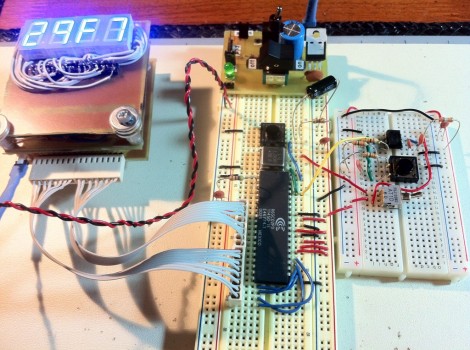
The first order of business in making something with the chip is to establish a clock signal. She sourced a crystal oscillator which runs at 1 MHz, but also wanted the option to single step through code. Her solution was to build two clock signals in one. A toggle switch allows her to choose the crystal, or a 555 timer circuit which uses a push button to fire each clock pulse.

Check out the video after the break to see some single stepping action. There’s no memory on board just yet. But the input pins have been hard-wired to voltage or ground to simulate data input. We wondered what she was up to with that HEX Out project which stiffs the logic on the data bus. Looks like it’s extremely useful in this project!

Continue reading “Building A Computer Around A 6502 Processor”

DIY Binary Alarm Clock Small Enough To Fit In Your Pocket

portable-binary-clock

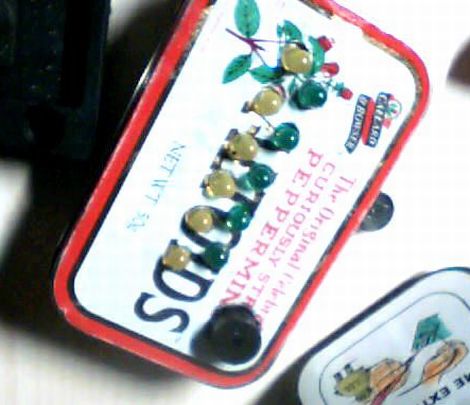
[linux-dude] always wanted to have a binary clock, but he didn’t want to pay someone else to make it for him. Additionally, he was looking for a compact alarm clock he could take on the road, rather than relying on the one in his hotel room.

Inspired by other binary clock projects he has seen over the years, he set off to build his own, which he wanted to fit inside an Altoids tin. His binary clock uses an Arduino Duemilanove (which fits perfectly in the tin) to keep time and control the indicator LEDs. The LEDs are arranged in two rows as you would expect, representing hours and minutes. A small piezo speaker serves as the alarm buzzer, which should be sufficient to wake up most people, though something bigger might be required for heavy sleepers.

We didn’t see any sort of battery pack or power plug mentioned, so we’re not quite sure how [linux-dude] keeps his clock juiced up. Additionally, the lack of an real time clock is something we’re puzzled by. While the Arduino does have a clock function that can be used, an RTC might serve him better – then again if he’s gone for just a day or two at a time, a small amount of drift may not be an issue.

Building A Better Clock To Drive You Insane

[youtube=http://www.youtube.com/watch?v=YpqFU4SGe1Y&w=470]

[Simon] came up with an improved version of Lord Vetinari’s clock that begs to be installed in waiting rooms around the world.

Last week, we were introduced to a real-life Vetinari Clock that keeps regular time but ticks at irregular intervals. It’s a great way to turn someone’s mind into porridge, but the original build broke after a few weeks because of some limitations in the clock drive. [Simon] built a very minimal circuit does away with these problems.

Just as in the first build, a microcontroller pulses the second hand motor once every second. As for the random component of this build, the microcontroller has a puts 32 bytes into a 128 byte array. The array is checked 4 times a second, and if the byte is 1, the second hand is incremented. If the byte is 0, time stops for a little bit. [Simon] included the schematic, board layout and code if you’d like to build one yourself.

There are a few drawbacks to this design; the pattern of ticking and not ticking is hard-coded into the microcontroller. Even though the 32 second long pattern shouldn’t be noticeable by watching the clock, it’s not an entirely random solution. Judging from the comments on the original build, using radioactive decay to increment a second might be a bit uncalled for.

We would like to see a second hand that stops when you look at it though. Facial recognition, anyone?

Vetinari Clock Will Drive You Insane

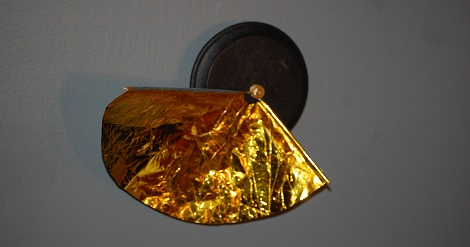
Sometimes we need more psy ops in our life. Being an eminent fan of the Discworld series, Reddit user [rdmiller3] decided he needed to build Lord Vetinari’s clock. This fictional clock was placed in the waiting room for Lord Vetinari in several of the Discworld books. Although the clock keeps accurate time overall, it sometimes tics irregularly and out of sync. The reason? To whittle away the minds of whoever waits for Lord Vetinari.

The build uses a standard battery-powered analog clockwork. The ticking mechanism is just a magnet mounted inside a coil driven iron core. The coil leads were disconnected from the clock circuit and connected to digital inputs of an Arduino. With a few random() calls, the clock keeps accurate but random time.

Unfortunately, the clock stopped working after a few weeks because the 5 V from the Arduino was, “pounding it way too hard.” [rdmiller3] says a few resistors and LEDs for the voltage drop would make for a more reliable circuit, though. Check out the hard to watch video of the clock in action after the break.

Continue reading “Vetinari Clock Will Drive You Insane”

A Sunrise Clock For Those Cold, Dark Winter Mornings

sunrise_alarm_clock

For most of the working world, the onset of autumn and winter in the Northern hemisphere means one thing – waking up well before the sun rises to get a start on the daily grind. [Brent] from Freeside Atlanta knows that routine well and decided to build himself a sunrise alarm clock in an attempt to wake himself more naturally on those dark mornings.

He bought an assortment of LEDs in varying colors including blue, red, yellow, and white, along with a few UV diodes for good measure. His goal with this array of LEDs was to simulate the natural colors of the sunrise, rather than simply slowly brightening the room. The clock uses a DS1307 RTC to keep the time, and an Arduino is tasked with lighting the LEDs about 25 minutes before it’s time for [Brent] to wake up.

He says that it seems to be working pretty well, gently waking his body before the clock radio kicks in. It certainly beats a loud buzzer!

Amazing RGB POV Clock

rgb_pov_propeller_clock

We’re no strangers to POV time pieces around here, but something about them never gets old. Whether they use a ring of LEDs to draw clock hands, or an intricately cut HDD platter to replicate LCD segments, we love seeing them. [David] sent in this hard drive POV clock built by a fellow named [Kly], and it’s just beautiful.

[Kly’s] “Propeller” POV clock is named as such due to the design of the circuit board. The board is mounted on the HDD spindle, rotating much like an airplane’s propeller. The construction details are sparse, but from what we can find, it is based around a PIC32MX microcontroller, which is used to control the 66 SMD RGB LEDs mounted on the circuit board.

As you can see in the video below, the tightly packed LEDs result in some pretty amazing visuals.

Aside from watching the video below, be sure to swing by his Youtube channel for a handful of videos showing RGB POV clock in action.

Continue reading “Amazing RGB POV Clock”

Recycled Clock Spins Round And Round To Tell Time

pop_bottle_recycled_clock

[duckcrazy] recently shared the details on a clock he built, using recycled components to tell time.

He began his project by dismantling a handful of carefully selected pop bottles and an old clock. The bottom and midsection of the bottles were saved, and he verified that they could be easily inserted within one another. The base of the clock is made up of a CD, on which the clock’s motor components were mounted.

He constructed two open paper cylinders bearing hour and minute designations, then glued the respective clock hands inside. The cylinders and clock hands were re-mounted onto the clock’s motor, and the entire thing was enclosed within the pop bottles.

It’s a novel way to build a clock, and moving beyond the plastic bottles and paper for a moment, there’s a lot of potential for some even cooler designs based on his work. We imagine that laser-etched cylinders powered by a micro and a continuous rotation servo would be pretty sweet, though that’s just the tip of the iceberg.