Building A SkyCam-like Camera Mount

With the Olympics on there are a lot of really great camera shots shown during the events. One of the best is the overhead view, which is provided by a camera suspended between cables. It’s not new for the Olympics, SkyCam has been around for over twenty years. What is new is [Dan Royer’s] attempts to build his own aerial camera setup.

He’s not starting from zero with this project. [Dan] has done some really great work with the Drawbot. It’s a two-motor, two-axis plotter which uses CNC to draw on a white board. For this project he combined two Drawbots in order to add a third axis. The image above shows the camera mount suspended between the four strings. He’s been working hard on getting the software ready for this kind of addressing. Along the way he broke the strings a few times because he was too far from the kill switch to stop it in time. But what he’s got is a nice start and we hope to see a more illustrative follow-up soon.

One of the things that SkyCam has going for it is a stabilization system. We wonder if a spinning gyroscope would work as well as it did for that balancing bike.
CNC Table Saw Jig

table saw jig

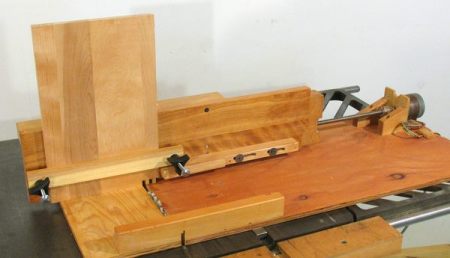
[Woodgears.ca] seems to be a wealth of clever hacks, and this CNC box joint jig is no exception.  Although one has to manually move the jig to make the actual cut, it still gives the user a lot of extra functionality. One only has to click the mouse button to advance the workpiece.  One drawback to using a table saw, even with this jig is that some internal parts still may have to be cut. Check out the video after the break to see this device in action, or skip to around 3:08 to see what hand operations still have to be done.

Besides just being a cool build, we loved the box-jointed project enclosure for the electronics. As this was made in 2003, it’s nice to see that the idea of “self-replication” (at least in part) didn’t start with the [Rep-Rap]. The 10 year old (as of 2003) Thinkpad notebook computer running QBasic in DOS is a nice “hacker” touch as is using 100 Watt light bulbs as power resistors. Pretty clever electronics, especially for someone that’s known more for his excellent woodworking skills than his obvious electrical engineering knowledge! Continue reading “CNC Table Saw Jig”

Fast And Easy Solder Paste Stencils

If you’re making your own boards with SMD parts, you might want to get a solder paste stencil. Usually made of laser-cut mylar or extremely thin steel, these stencils allow you to squeegee solder paste onto your board’s pads and make assembly a whole lot easier. [Rochey] needed a stencil for a board he was working on, and lacking a laser cutter he turned to what he had available – a few bits of plastic and a CNC machine.

[Rochey] began making his stencils out of laminating pouches and an xacto knife. This worked well, but it was time-consuming, and a bit fiddly when cutting 1 mm square holes. To speed up the process, [Rochey] put one of these laminating pouches on his CNC machine, exported the ‘Top Cream’ layer in Eagle to the CNC software of his choice, and had his machine attack the plastic with a 1 mm drill bit.

To [Rochey]’s surprise, everything went as planned; in five minutes, he had a stencil with perfectly accurate holes that masked off everything but the SMD pads.

Thanks [Fabien] for sending this one in.

Hackaday Links: June 17, 2012

Portal gag-video

These guys make your own video editing chops look just plain sad. They put together a video demonstrating the portal gun in real life.

Unleashing the beast

We have this problem all the time. The noise regulations were preventing [Massimiliano Rivetti] from letting the true voice of his Ferrari be heard. He hacked into the control system and can now adjust it via iPhone to roar with power. [Thanks Claudio via openPicus]

Music so bad you want to throw something

Here’s a novel way to include the worker bees in music selection around the office. A piezo element was attached to the back of a framed poster and when you throw something at it, the next track is played. We really loved the demo video for this one. [Thanks Calum via DontBelieveTheHype]

Acrylic frame for a CNC machine

[Jake] wrote in to show off his progress on a CNC build. He’s got a frame made of acrylic and some other materials. It’s not up and running yet, but what he’s got so far looks very nice.

Helo built for one

All we can think with this one-man helicopter is failure of those propellers. At least with an ultralight plane you can glide to a gentler crash-landing. [Thanks Filespace]

Mantis9 PCB Mill

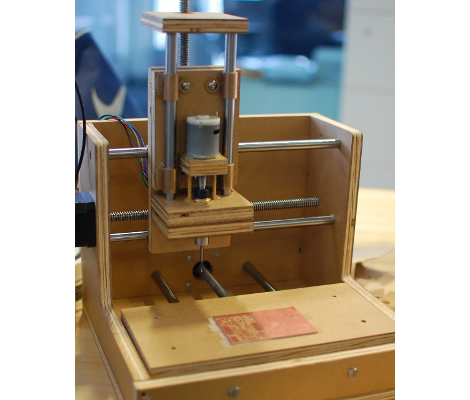
This is the Mantis9 PCB mill. It’s the first time we’ve featured the project, but it’s already well known by some as it keeps popping up in the comments for other CNC mill projects. Yes, it’s made out of wood — which some frown upon — but we’re happy with the build instructions and the especially the price tag (parts as low as $85).

We did feature an earlier revision of the hardware back in 2010. Subsequent versions changed the frame to use an open-front design, but it’s the build techniques that saw the biggest evolution. The problem was getting the holes for the parallel rods to align accurately. In the end it’s a simple operation that solves the problem; clamp both boards together and drill the holes at the same time. A drill press is used for all of the fabrication, ensuring that the holes are perpendicular to the surface of the boards. From there the rods are given some bronze bushings and pressed into place. Only then are the platforms secured to the bushings using epoxy. This is to ensure that the bushings don’t bind from poor alignment. We think it should end up having less play in it than other builds that use drawer slides.

Check out a PCB milling run in the clip after the break.

Continue reading “Mantis9 PCB Mill”

Open Rail, Or, Why Didn’t We Think Of This?

Hackaday readers familiar with the with the CNC and automated machinery scene will be familiar with MakerSlide, the open-source linear bearing system. This linear movement system composed of special aluminum extrusions and mounting plates riding on v-wheels has been used in a lot of awesome builds including the Quantum ORD Bot 3D printer and the Shapeoko CNC router. If there’s one downside to the MakerSlide, it’s the hard-to-source aluminum extrusion with the requisite v-wheel guides. [Mark] and [Trish] of Phlatboyz have an ingenious solution to this problem: just have bolt-on v-wheel guides. It’s an idea so simple we’re kicking ourselves for not thinking of it first.

Open Rail is completely compatible with the MakerSlide linear bearing system. Instead of requiring a special aluminum extrusion, the Open rail system uses regular, plain-jane aluminum extrusions available at any reputable hardware store. Just pop a few t-nut into the Open Rail and attach it to your extrusion. Couldn’t be easier.

Considering how easy it is to find surplus aluminum extrusion, we’ll expect a few gigantic MakerSlide and Open Rail derived CNC projects in the very near future.

Android CNC Controller

[Matt] is the proud owner of a JGRO-based CNC router and he’s been working on a way to control it without a computer. What he came up with is a way to drive the CNC machine using this Android tablet.

A big part of the hack is the CNC controller that he’s using. The TinyG is a board that can take commands via USB and convert them to instructions for up to six axes. In the video after the break [Matt] shows off a direct USB connection as the control method. This is the most interesting part to us, but the system can also be run through the network with the assistance of a computer feeding commands to the TinyG. This second method means the Android controller would be wireless.

A trio of repositories host the code [Matt] is using. From the demo it looks like the Android app has no shortage of features.

Continue reading “Android CNC Controller”