The D In DNS Stands For DOOM

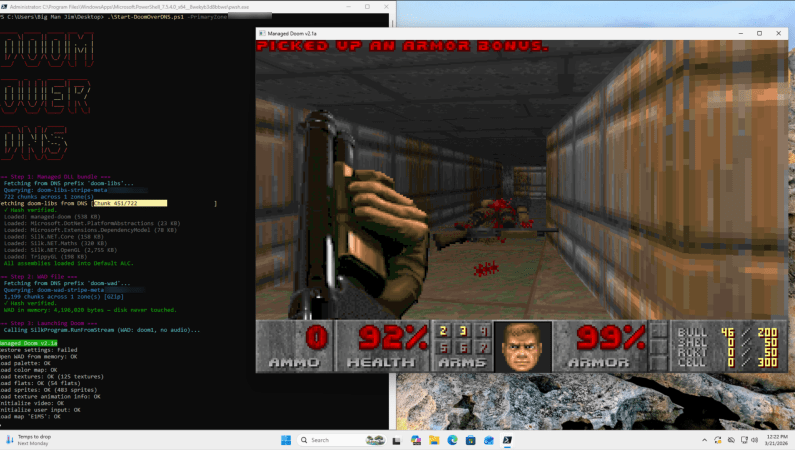
As literally everything ought to be able to play DOOM in some fashion, [Adam Rice] recently set out to make the venerable DNS finally play the game after far too many decades of being DOOM-less. You may be wondering how video games and a boring domain records database relate to each other. This is where DNS TXT records come into play, which are essentially fields for arbitrary data with no requirements or limitations on this payload, other than a 2,000 character limit.

Add to this the concept of DNS zones which can contain thousands of records and the inkling of a plan begins to form. Essentially the entire game (in C#) is fetched from TXT records, loaded into memory and run from there. This is in some ways a benign form of how DNS TXT records can be abused by people with less harmless intentions, though [Adam] admits to using the Claude chatbot to help with the code, so YMMV.

The engine and WAD file with the game’s resources are compressed to fit into 1.7 MB along with a 1.2 MB DLL bundle, requiring 1,966 TXT records in Base64 encoding on a Cloudflare Pro DNS zone. With a free Cloudflare account you’d need to split it across multiple zones. With the TXT records synced across the globe, every caching DNS server in the world now has a copy of DOOM on it, for better or worse.

You can find the project source on GitHub if you want to give this a shake yourself.

Thanks to [MrRTFM] for the tip.

 

Hackaday Links Column Banner

Hackaday Links: March 29, 2026

Whether it’s a new couch or a rare piece of hardware picked up on eBay, we all know what it feels like to eagerly await a delivery truck. But the CERN researchers involved in a delivery earlier this week weren’t transporting anyone’s Amazon Prime packages, they were hauling antimatter.

Moving antimatter, specifically antiprotons, via trucks might seem a bit ridiculous. But ultimately CERN wants to transfer samples between various European laboratories, and that means they need a practical and reliable way of getting the temperamental stuff from point A to B. To demonstrate this capability, the researchers loaded a truck with 92 antiprotons and drove it around for 30 minutes. Of course, you can’t just put antiprotons in a cardboard box, the experiment utilized a cryogenically cooled magnetic containment unit that they hope will eventually be able to keep antimatter from rudely annihilating itself on trips lasting as long as 8 hours.

Speaking of deliveries, anyone building a new computer should be careful when ordering components. Shady companies are looking to capitalize on the currently sky high prices of solid-state drives by counterfeiting popular models, and according to the Japanese site AKIBA PC Hotline, there are some examples in the wild that would fool  all but the most advanced users. They examine a bootleg drive that’s a nearly identical replica of the Samsung 990 PRO —  the unit and its packaging are basically a mirror image of the real deal, the stated capacity appears valid, and it even exhibits similar performance when put through a basic benchmark test.

Continue reading “Hackaday Links: March 29, 2026”

Old Desk Phone Gets DOOM Port

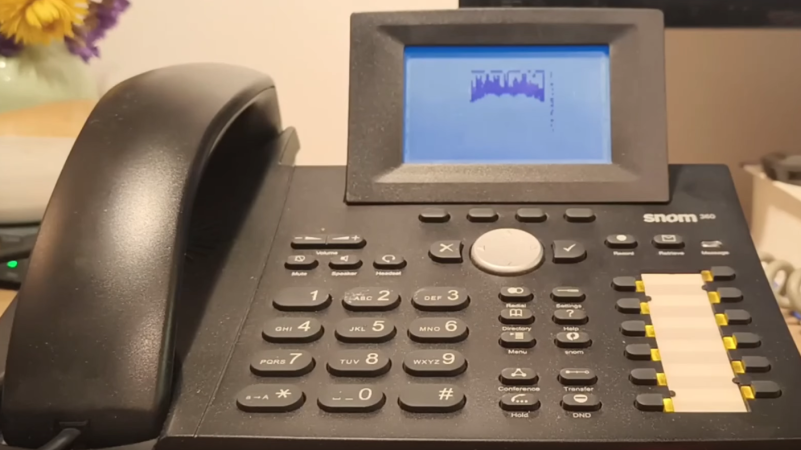
Old desk phones are fairly useless these days unless you’re building a corporate PBX in your house. However, they can be fun to hack on, as [0x19] demonstrates by porting DOOM to a Snom 360 office phone. 

The Snom 360 is a device from the early VoIP era, with [ox19] laying their hands on some examples from 2005. The initial plan was just to do some telephony with Asterisk, but [ox19] soon realized more was possible. Digging into a firmware image revealed the device ran a Linux kernel on a MIPS chip, so the way forward became obvious.

They set about hacking the phone to run DOOM on its ancient single-color LCD. Doing so was no mean feat. It required compilation of custom firmware, pulling over a better version of BusyBox, and reworking doomgeneric to run on this oddball platform. It also required figuring out how the keyboard was read and the screen was driven to write custom drivers—not at all trivial things on a bespoke phone platform. With all that done, though, [0x19] had a dodgy version of DOOM running slowly on a desk phone on a barely-legible LCD display.

Porting DOOM is generally a task done more for the technical thrill than to actually play the game on terribly limited hardware. We love seeing it done, whether the game is ported to a LEGO brick or a pair of earbuds. If you’re doing your own silly port, don’t hesitate to notify the tipsline—just make sure it’s one we haven’t seen before.

Running DOOM On Earbuds

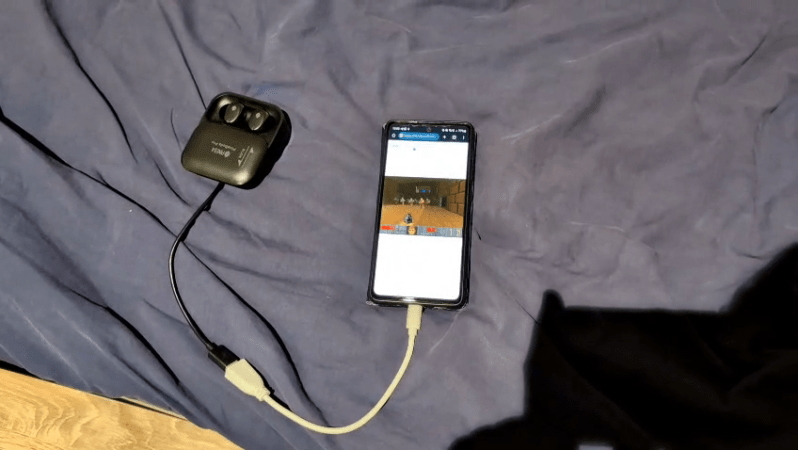
In 1993, DOOM was a great game to play if you had a 486 with a VGA monitor and nothing to do all weekend. In 2026, you can play it on a set of earbuds instead, if for some reason that’s something you’ve always dreamed of doing.

The project comes to us from [Arin Sarkisian], who figured out that the Pinebuds Pro had enough processing power to run one of the seminal FPS games from the 1990s. Inside these earbuds is a Cortex-M4F, which is set to run at 100 MHz. [Arin] figured out it could easily be cranked up to 300 MHz with low power mode switched off, which would come in handy for one main reason. See, the earbuds might be able to run the DOOM engine, but they don’t have a display.

Thus, [Arin] figured the easiest way to get the video data out would be via the Cortex-M4F’s serial UART running at 2.4 mbps. Running the game at a resolution of 320 x 200 at 3 frames per second would consume this entire bandwidth. However, all those extra clock cycles allow running an MJPEG compression algorithm that allow spitting out up to 18 frames per second. Much better!

All that was left to do was to figure out a control scheme. To that end, a web server is set up off-board that passes key presses to the buds and accepts and displays the MJPEG stream to the player. If you’re so inclined you can even play the game yourself on the project website, though you might just have to get in a queue. In the meantime, you can watch the Twitch stream of whoever else is playing at the time.

Files are on GitHub—both the earbud firmware and the web interface used to play the game. It was perhaps only a matter of time until we saw DOOM on earbuds; no surprise given that we’ve already seen it played on everything from receipt printers to cookware. No matter how cliche, we’re going to keep publishing interesting DOOM ports—so keep them coming to the tipsline.

Thanks to [alialiali] for the tip!

Hacking The Krups Cook4Me Smart Cooking Pot For Doom

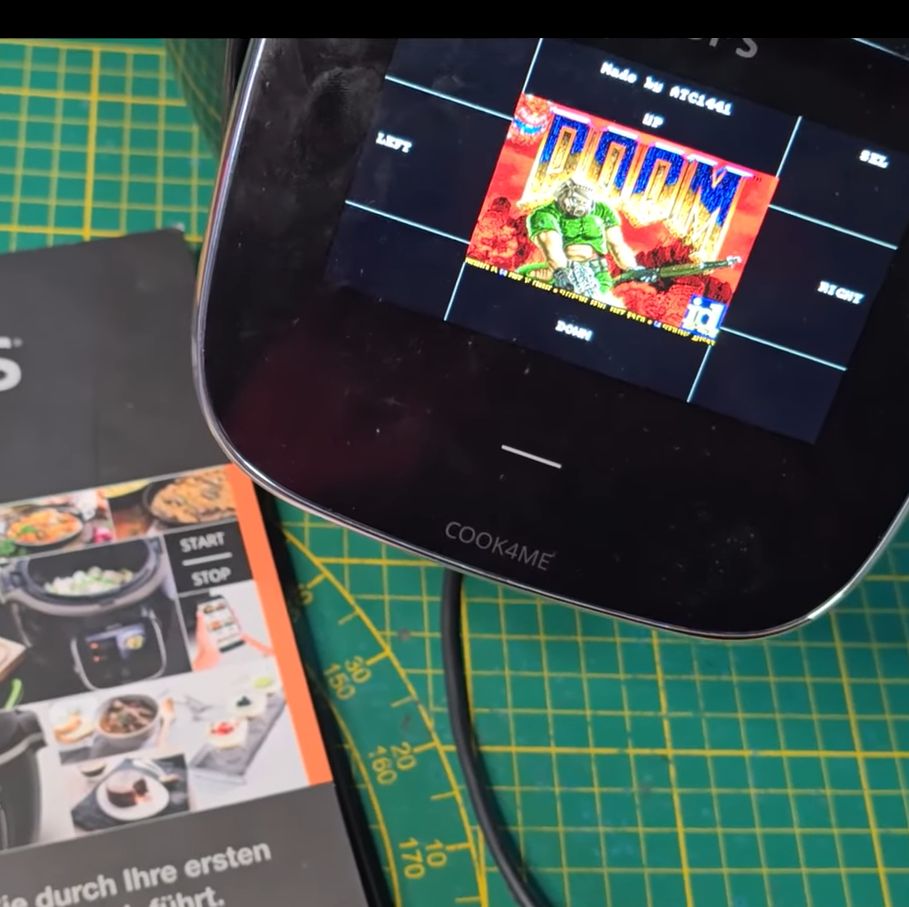
With more and more kitchen utilities gaining touch screens and capable microcontrollers it’d be inconceivable that they do not get put to other uses as well. To this end [Aaron Christophel] is back with another briefly Doom-less device in the form of the Krups Cook4Me pressure cooking pot with its rather sizeable touch screen and proclaimed smarts in addition to WiFi and an associated smartphone app.

Inside is an ESP32 module for the WiFi side, with the brains of the whole operation being a Renesas R7S721031VC SoC with a single 400 MHz Cortex-A9. This is backed by 128 MB of Flash and 128 MB of RAM. The lower touch interface is handled by a separate Microchip PIC MCU to apparently enable for low standby power usage until woken up by touch.

The developers were nice enough to make it easy to dump the firmware on the SoC via SWD, allowing for convenient reverse-engineering and porting of Doom. With the touch screen used as the human input device it was actually quite playable, and considering the fairly beefy SoC, Doom runs like a dream. Sadly, due to the rarity of this device, [Aaron] is not releasing project files for it.

As for why a simple cooking pot needs all of this hardware, the answer is probably along the lines of ‘because we can’.

Continue reading “Hacking The Krups Cook4Me Smart Cooking Pot For Doom

a torn-up printer with a very long image of different frames

Playing DOOM On A Receipt Printer

Gaming is a wonderful thing. Unfortunately for many of us, work takes up our valuable time, which should be allocated to our gaming. What if there was a better way? Well, printers can print an image quickly, and receipt printers can print a lot of images. This sounds like an effective display for DOOM in a pinch. [Bringus Studios] managed to find such a printer and got the classic shooter running.

Getting the printer’s attached computer, which was only designed for printing the cost of your chicken sandwich, to run Half-Life was far from easy. [Bringus] struggled through the process of swapping operating systems from Windows 7 to Linux just to return to Windows 7 after a painful process of maintaining compatibility between 32 and 64 bit software. Driver issues followed through the entire process just to get anything running at all.

But we can’t play DOOM while at work on a normal screen. The printer MUST display our glorious 480p gameplay. To achieve such a workflow, [Bringus] implemented a script to print out a frame of the display, allowing for “visible gameplay”. Along with some heat issues from the nature of thermal receipts, eventually the printer displayed the glory of DOOM.

Playing games on a thermal printer might be one of the weirdest things you’ve seen today, but what if we could reverse the script a bit and create a printer from something else? Here at Hackaday, we have exactly the thing for you: a printer made from a vintage typewriter!

Continue reading “Playing DOOM On A Receipt Printer”

rat playing doom

Rats Get Even Better At Playing DOOM

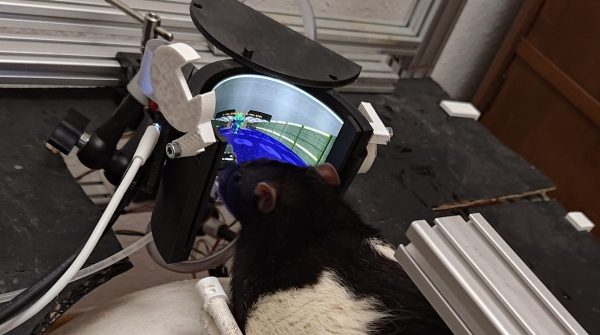
We all know that you can play DOOM on nearly anything, but what about the lesser known work being done to let other species get in on the action? For ages now, our rodent friends haven’t been able to play the 1993 masterpiece, but [Viktor Tóth] and colleagues have been working hard to fix this unfortunate oversight.

If you’ve got the feeling this isn’t the first time you’ve read about rats attempting to slay demons, it’s probably because [Victor] has been working on this mission for years now — with a previous attempt succeeding in allowing rats to navigate the DOOM landscape. Getting the rodents to actually play through the game properly has proved slightly more difficult, however.

Diagram of screen in front of rat playing doom

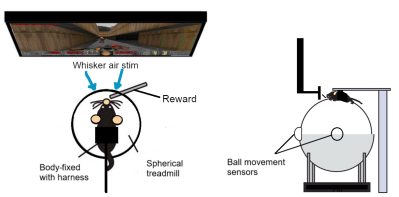
Improving on the previous attempt, V2 has the capability to allow rats to traverse through levels, be immersed in the virtual world with a panoramic screen, and take out enemies. Rewards are given to successful behaviors in the form of sugar water through a solenoid powered dispenser.

While this current system looks promising, the rats haven’t gotten too far though the game due to time constraints. But they’ve managed to travel through the levels and shoot, which is still pretty impressive for rodents.

DOOM has been an indicator of just how far we can take technology for decades. While this particular project has taken the meme into a slightly different direction, there are always surprises. You can even play DOOM in KiCad when you’re tired of using it to design PCBs.