
Restoring A Soviet ES-4001 Mainframe Control Panel

Recently the [Chornobyl Family] got their hands on an ES-4001 control panel for a 1970s-era Soviet mainframe, with the intention to restore it to full working order. Not just because they’re really into cool old Soviet technology, but also because of the connection that this control panel holds to the Chernobyl nuclear accident that was so instrumental to the area in modern times.
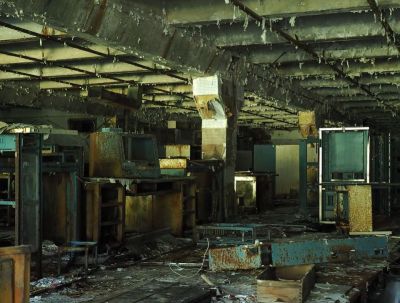
The Duga-1 computer room with what's left of the ES-1060 mainframe. (Credit: Chornobyl Family, YouTube)
The Duga-1 computer room with what’s left of the ES-1060 mainframe. (Credit: Chornobyl Family, YouTube)

During the 1970s the USSR felt that it could not be left behind in the race to create better digital computers. This led them to not only create a few original designs, but also effectively clone the IBM System/360 and System/370. This resulted in the ES EVM-series of mainframes, with an ES-1060 finding itself installed at the Duga-1 early warning radar system near what is now the Chornobyl nuclear power plant in Ukraine.

Although the radar arrays are the most well-known feature of the Duga-1, below it is the computer center where the ES-1060 was installed. It was never put into service following the ChNPP Unit-4 accident — all that remains of a once pinnacle of Soviet engineering are the picked-over carcass of the mainframe and its control panel.

The control panel in question was obtained was from the early 1980s, serving a more gentle service life in a datacenter and looks to be in a mostly good condition. That said, there was still enough to be done to make it work and undo the damage of its violent removal from the mainframe. Along the way we also learn how the system was used and how the control panel works.

Although similar in some ways to the System/370, it’s still very different, and with only about 300 of these mainframes produced, it’s worth saving whatever elements still remain today, along with the surviving documentation.

Continue reading “Restoring A Soviet ES-4001 Mainframe Control Panel” →
The Russian Woodpecker: Official Bird Of The Cold War Nests In Giant Antenna

On July 4th, 1976, as Americans celebrated the country’s bicentennial with beer and bottle rockets, a strong signal began disrupting shortwave, maritime, aeronautical, and telecommunications signals all over the world. The signal was a rapid 10 Hz tapping that sounded like a woodpecker or a helicopter thup-thupping on the roof. It had a wide bandwidth of 40 kHz and sometimes exceeded 10 MW.

This was during the Cold War, and plenty of people rushed to the conclusion that it was some sort of Soviet mind control scheme or weather control experiment. But amateur radio operators traced the mysterious signal to an over-the-horizon radar antenna near Chernobyl, Ukraine (then part of the USSR) and they named it the Russian Woodpecker. Here’s a clip of the sound.

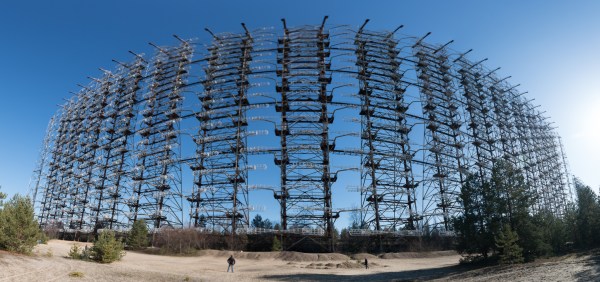
The frequency-hopping Woodpecker signal was so strong that it made communication impossible on certain channels and could even be heard across telephone lines when conditions were right. Several countries filed official complaints with the USSR through the UN, but there was no stopping the Russian Woodpecker. Russia wouldn’t even own up to the signal’s existence, which has since been traced to an immense antenna structure that is nearly half a mile long and at 490 feet, stands slightly taller than the Great Pyramid at Giza.

This imposing steel structure stands within the irradiated forest near Pripyat, an idyllic town founded in 1970 to house the Chernobyl nuclear plant workers. Pictured above is the transmitter, also known as Duga-1, Chernobyl-2, or Duga-3 depending on who you ask. Located 30 miles northeast of Chernobyl, on old Soviet maps the area is simply labeled Boy Scout Camp. Today, it’s all within the Chernobyl Exclusion Zone.

It was such a secret that the government denied it’s existence, yet was being heard all over the world. What was this mammoth installation used for?

Continue reading “The Russian Woodpecker: Official Bird Of The Cold War Nests In Giant Antenna” →









