Printed Separator Separates Printed Pages

We all know people trapped in aging bodies who can’t do all the things they used to do. It’s easy to accept that you may never move small furniture around by yourself again, but losing the ability to do something as simple as separating the pages of your newspaper to keep reading it is an end to enjoyment.

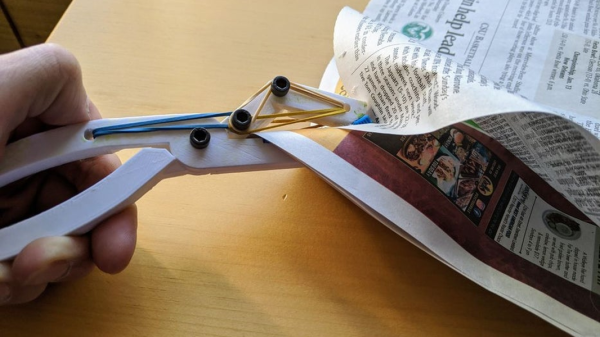
When [Randomcitizen4] visited his grandma over the holidays, she mentioned having trouble with this, among other things. He fired up his printer and got to work designing a device to help her get back to the funny pages. This simple gripper mechanism uses rubber bands for tension and flexible filament to get a firm grip on the paper. The jaws default to the open position so they’re ready to grab some newsprint, and a light squeeze of the handles slides the top page back from the stack, creating a gap for Grandma’s fingers. You can see a demo on page 32 after the break.

Although the device does work on some books and magazines, he’d like to improve the design of the grips to make the device more universally useful. [Randomcitizen4] says he tried a few things already, but we wonder if a more complex surface pattern might do the trick — maybe less like fins and more like a tire tread pattern. All the STLs are available if you want to give it a go.

If Grandma’s newspaper ever goes out of print, she should still be able to read it on a tablet or an e-reader. Then maybe [Randomcitizen4] can build some kind of remote-controlled page turner for her.

Continue reading “Printed Separator Separates Printed Pages”
A Better Bowden Drive For Floppy Filaments

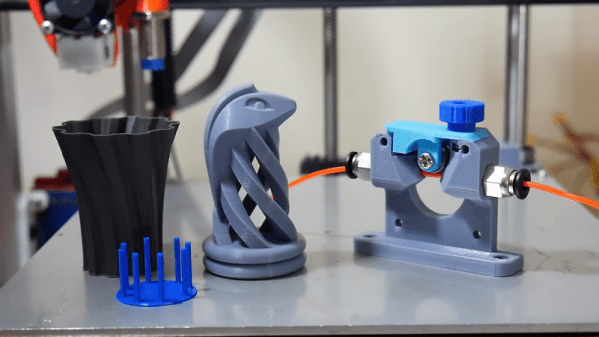
You might not think to use the word “rigid” to describe most 3D-printer filaments, but most plastic filaments are actually pretty stiff over a short length, stiff enough to be pushed into an extruder. Try the same thing with a softer plastic like TPE, though, and you might find yourself looking at this modified Bowden drive for elastomeric filaments.

The idea behind the Bowden drive favored by some 3D-printer designers is simple: clamp the filament between a motor-driven wheel and an idler to push it up a pipe into the hot end of the extruder. But with TPE and similar elastomeric filaments, [Tech2C] found that the Bowden drive on his Hypercube printer was causing jams and under-extrusion artifacts in finished prints. A careful analysis of the stock drive showed a few weaknesses, such as how much of the filament is not supported on the output side of the wheel. [Tech2C] reworked the drive to close that gap and also to move the output tube opening closer to the drive. The stock drive wheel was also replaced with a smaller diameter wheel with more aggressive knurling. Bolted to the stepper, the new drive gave remarkably improved results – a TPE vase was almost flawless with the new drive, while the old drive had blobs and artifacts galore. And a retraction test print showed no stringing at all with PLA, meaning the new drive isn’t just good for the soft stuff.

All in all, a great upgrade for this versatile and hackable little printer. We’ve seen the Hypercube before, of course – this bed height probe using SMD resistors as strain gauges connects to the other end of the Bowden drive.

Continue reading “A Better Bowden Drive For Floppy Filaments”

3D Printed Sneakers Are Now A Thing

Shoes may seem simple at face value, but are actually rather complex. To create a comfortable shoe that can handle a full day of wear without causing blisters, as well as deal with the stresses of running and jumping and so on, is quite difficult. Is it possible to create a shoe that can handle all that, using a 3D printer?

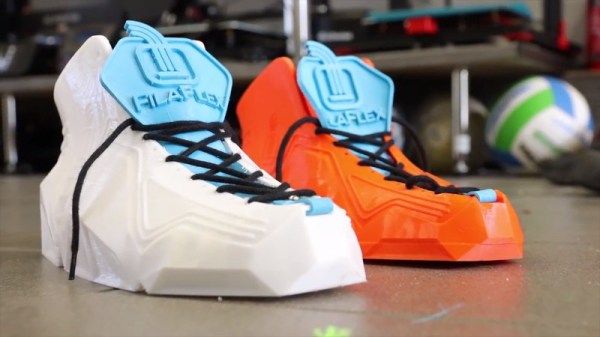
[RCLifeOn] discovered these sneakers by [Recreus] on Thingiverse, and decided to have a go printing them at home. While [Recreus] recommend printing the shoes in their Filaflex material, for this build, one shoe was printed in thermoplastic polyurethane, the other in Ninjaflex. As two filaments that are both commonly known to be pliable and flexible, the difference in the final parts is actually quite significant. The Ninjaflex shoe is significantly more flexible and cushions the foot better, while the rigidity of the TPU shoe is better for ankle support.

Our host then takes the shoes on a long run through the woods, battling dirt, mud, and other undesirables. Both shoes hold up against the abuse, although [RCLifeOn] notes that the Ninjaflex shoe is much more comfortable and forgiving for longer duration wear.

We’ve seen other 3D printed shoe hacks before, too – like these nifty shoelace locks.

3D Printed Door Latch Has One Moving Part – Itself!

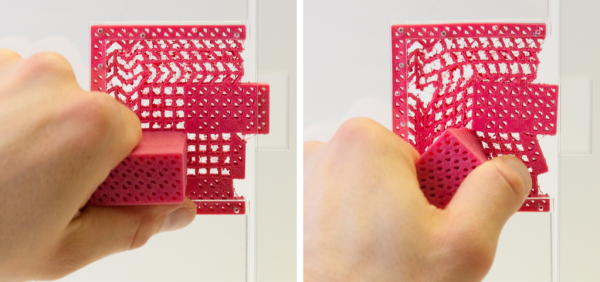
A group at the Hasso-Plattner Institute in Germany explored a curious idea: using 3D printed material not just as a material – but as a machine in itself. What does this mean? The clearest example is the one-piece door handle and latch, 3D printed on an Ultimaker 2 with pink Ninjaflex. It is fully functional but has no moving parts (besides itself) and has no assemblies. In other words, the material itself is also the mechanism.

The video (embedded below) showcases some similar concept pieces: door hinges, a pair of pliers, a pair of walker legs, and a pantograph round out the bunch. Clearly the objects aren’t designed with durability or practicality in mind – the “pliers” in particular seem a little absurd – but they do demonstrate different takes on the idea of using a one-piece item’s material properties as a functional machine in itself.

Continue reading “3D Printed Door Latch Has One Moving Part – Itself!”