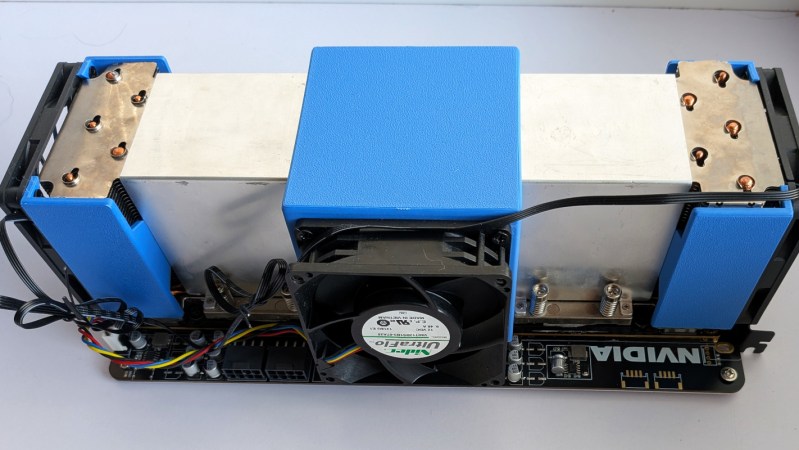
Wrangling Datacenter GPUs Into A Desktop

As we’ve seen many times before, there’s usually some way wrangle a bit more life out of what would otherwise be considered old and obsolete technology. Perhaps one thing that has been passed over by the masses a bit to early is older datacenter GPUs, which is understandable in one sense because of the rate NVIDIA is pumping out new ones, but these cards have plenty of useful life left in them for the average person, as [Andrew] demonstrates.

The cards [Andrew] is using are Tesla V100s of 2017 vintage. Despite being older hardware they have high-speed memory which allows them to run modern LLMs locally, competitively with online models. In this test, Gemma 4 26B and Qwen3 35B are run, with Gemma being a bit faster because it fits entirely in GPU memory and Qwen3 being a bit more capable but more hungry for resources. [Andrew] built a PCI card that can host two V100s, allowing these larger models to fit completely in memory.

Even though these don’t perform at the same level as the latest top-tier online models, they’re surprisingly capable and also have the benefit of running completely locally. This might be concerning for those looking at the global economy being propped up by companies that essentially have no moat for motivated users, especially as more and more datacenter hardware becomes available on the secondhand market. While this build by [Andrew] goes into detail on getting the software stack up and running, we recently featured another build using the same GPUs that focuses a bit more on hardware for those looking to get started with local hosting.

Halloween Hood Has Hideous LED Gaze

Looking to create fear and dread with your Halloween costume? [Becky Stern] over at Adafruit has you covered, with her tutorial on building a mystical hood with LED eyes, perfect for your next Jawa, Black Mage, or Orko costume.

This creepy-looking creation is based around a Gemma controller driving two NeoPixel Jewels, small circular RGB LED boards. The Gemma drives the boards to slowly fade on and off for the required creepy eye effect, but it would be easy to create other lighting patterns.

Speaking of patterns, the tutorial also includes a sewing pattern for the hood, and plans for a 3D printed battery holder that would make the whole thing very easy to carry. If the eyes aren’t enough, how about adding an LED magic staff to complete your creepy ensemble? Or perhaps some light-up dinosaur spiky plates?

Do you have any good Halloween costume hack plans? Let us know in the comments, and we’ll put together a list of the best closer to the hideous day.

Continue reading “Halloween Hood Has Hideous LED Gaze”

Get Up, Stand Up. With A Little Help From The Mindfulness Bracelet

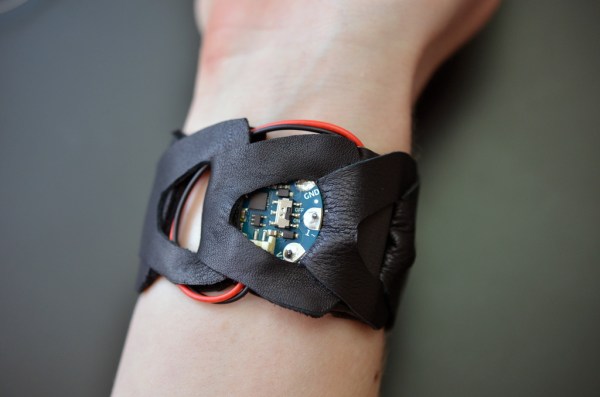
[Becky Stern] has created the mindfulness bracelet, a wearable which looks great and serves an important purpose. The bracelet buzzes every hour to remind you to stand up and take a break from work, soldering, gaming, or whatever it is you may be doing. The bracelet is made up of interlinked figure 8 shapes of leather, though [Becky] says rubber from a bicycle inner tube works great as well. The final shape reminds us of the link belts sometimes found on lathes or other industrial equipment. The links are the perfect size to slip an Arduino Gemma in, along with a battery and vibrating motor. A NPN transistor, diode, and resistor round out the entire bill of materials for this design. This bracelet is a heck of a lot cheaper than the Apple watch feature which inspired it!

The time interval is set in the code to 1 hour, and can be adjusted by the user. Although the times are stored in milliseconds, the design does use the ATtiny85’s Watchdog Timer (WDT) to conserve power. This means the time can drift up to 30 seconds per hour, which is fine in this application.

Click past the break to see the bracelet in action!

Continue reading “Get Up, Stand Up. With A Little Help From The Mindfulness Bracelet”

Gemma-Powered NeoPixel Sound Reactive Drums

adafruit_products_drum-slide-out

This tutorial from Adafruit shows how to create a custom interactive drum set that lights up with sound. It uses a mic amp sensor that is connected to a miniature Arduino Gemma board to detect when the instrument is being hit by the sticks. Neopixels then illuminate into a range of colors creating a beautifully synced up music presentation.

The container that houses the electronics is 3D printed. The entire circuit is integrated into the snare, mid-tom, hi-tom and a drum kick. All the code and step-by-step instructions can be found on Adafruit’s website. Now imagine something like this being packed up in a suitcase and carried from venue to venue as an up-and-coming band travels from state to state on tour; especially at Drum n’ Bass raves or electronic based music festivals. A video of the kit being used is below.

Continue reading “Gemma-Powered NeoPixel Sound Reactive Drums”