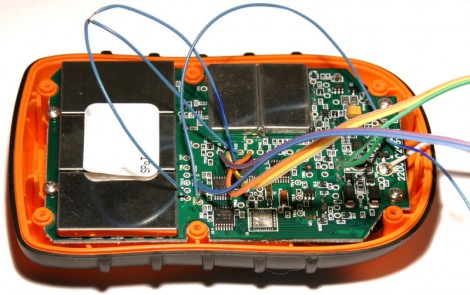
Hacking SPOT Personal Satellite Tracker To Pass More Information

For less than $100 you can buy a little tracking module that will upload your location to a satellite. But you’ll only get latitude and longitude information. [Natrium42] spent some time reverse engineering the hardware, and the communications protocol, to allow custom data to be transferred using a SPOT module.

The flat fee for the hardware includes a one-year service plan allowing you to tack your device on the SPOT website. [Natrium42] started poking around in the transmitted data packages, and figured he could push custom messages like altitude data if he had some way to encode it as a valid latitude/longitude package. He found that location data is transmitted as two sets of three bytes each. The four least significant bits of each set get rounded by the server, leaving a total of 40 usable bits between the two data sets. He wrote encoding and decoding functions that will allow you to transfer whatever information you want.

So what is this good for? To get the process working he removed the MSP430 microcontroller from the board and is using his own replacement. So you can transmit GPS data from the onboard module, your own module, or sensor data for anything you’re able to hook up the to the replacement uC.
Make Your Own GPS Receiver!

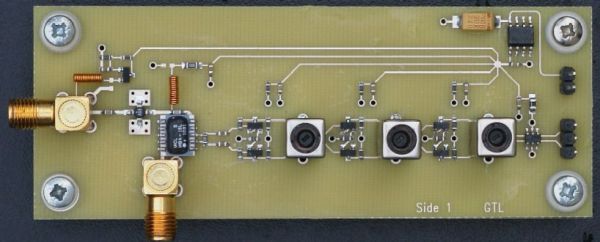
GPS receivers may be available for well under $100 these days, but what’s the fun in buying one when you can build it yourself? According to [Andrew], the creator of this device, he was inspired by Matjaž Vidmar who developed a GPS receiver from scratch over 20 years ago. His article can be found here and includes some nicely hand-drawn diagrams as well as a lot of theory.

However, [Andrew’s] article is a bit more up-to-date and features plenty of theory itself. He explains how he built his four-channel GPS receiver, able to track four satellites at the same time. This is the minimum number of satellites needed to track your position using such a device.

GPS technology is quite incredible, and the amount of soldering as well as the understanding of the theory behind it required to build such a device is astonishing. Interestingly (sadly?), it seems we are beyond the time of LORAN hacks, but if you have an old one to share, be sure to send it in! For something a bit easier, maybe one could try making a GPS “cateye” to track what your pet does all day!

Fake PS3 Tracks Thieves All The Way Home

ps3_tracking_system

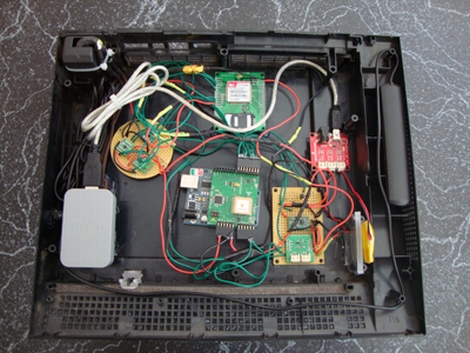
One of [Wayne’s] relatives had their house robbed during a blizzard/extended power outage, and as is typically the case, none of the stolen items were recovered. His nephew’s PS3 was among the pilfered belongings, which didn’t sit well with him. Taking a cue from police “bait cars”, he thought it would be cool to fit a dummy game console with a tracking device, should anything similar happen in the future.

He bought a hollowed out PS3 shell on eBay, filling it with an Arduino, an accelerometer, a GPS sensor, a small GSM modem with a prepaid SIM card, and a reasonably sized LiPoly battery. The system usually sits in a sleeping state, but when the accelerometer senses motion, the Arduino powers up the GSM modem and sends an SMS security alert to his mobile phone. Using his phone to control the tracking system via SMS, he can request GPS coordinates and directional information, which can then be relayed to the police.

His tracking system is a great idea since hawking stolen game consoles are easy money for thieves. If there happens to be a string of robberies in your neighborhood, you could certainly rest a little bit easier knowing that your Playstation doppelganger will let you know if someone is looting your house.

Flip Off Your Alarm Clock!

flipclock

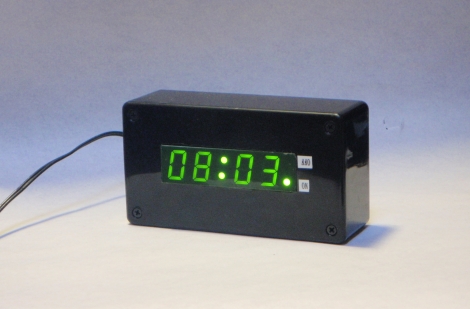
[Corbin] hates fumbling around in the dark with his alarm blaring, looking for the off switch. He was so annoyed with regular alarm clocks that he decided to build his own simpler timepiece.

The FlipClock resides in a simple black plastic case lacking any buttons whatsoever. When the alarm goes off, all one needs to do is flip the clock over to disable it. The digits automatically right themselves using an accelerometer to detect when the clock has been turned upside down, and an indicator LED lets you know that the alarm has been turned off.

The clock is based around a Propeller chip, which manages all of the clock’s operations. Instead of using a real time clock IC, [Corbin] is using a GPS module to keep accurate time, something we don’t recall seeing in an alarm clock  before. That’s a good thing though, since there are no buttons with which to set the clock. In fact, there are no buttons to set the alarm either – the clock is configured to sound the alarm at the same time each day.

While this clock would certainly be too dangerous for a chronic snooze button abuser like myself, it’s an interesting concept nonetheless!

Check out the video below to see the FlipClock in action.

Continue reading “Flip Off Your Alarm Clock!”

Space Camera Streams Data During Flight

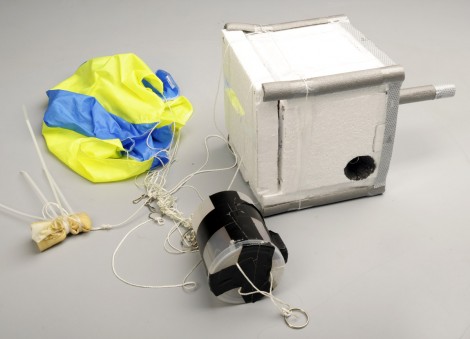
Take the risk of not recovering your hardware out of a near-space camera launch by streaming the data during flight. [Tim Zaman] is part of a team that developed the rig seen above. It sent 119 image back during the recent balloon launch. This included transmissions from as high as 36 kilometers.

The main hardware included a BeagleBoard with connected Webcam housed in a Styrofoam cooler for thermal protection. Pair that with a GPS module for location tracking, and a GPRS module for data transmission and you’re in business.

But that’s not all that went up. The team built a backup hardware module in case the primary failed. This one also had a GPS and GPRS radio, but was driven by an Arduino.

The radio connection made it easy to recover the hardware. GPS data led the team directly to the landing site. The package came to rest on the roof of a building, but we guess that’s more convenient than getting snagged at the top of a huge tree.

Don’t miss the hardware detail video that we’ve embedded after the break.

Continue reading “Space Camera Streams Data During Flight”

JGPX Keeps The Bachelor Party Moving In The Right Direction, Regardless Of BAC

jGPX_bachelor_party_navigator

[Davy] and his friend [Chris] were tasked with putting together a bachelor party for their friend [J], and had a little more in mind than the standard drunken revelry. To earn the privilege of partying his brains out, they decided that [J] would have to fulfill a series of tasks and challenges before joining up with the rest of his friends for the evening’s events. [Davy] didn’t specify what these tasks were, lest he spoil the surprise, but he did let us in on a little device that he and [Chris] built to help guide the bachelor through his day.

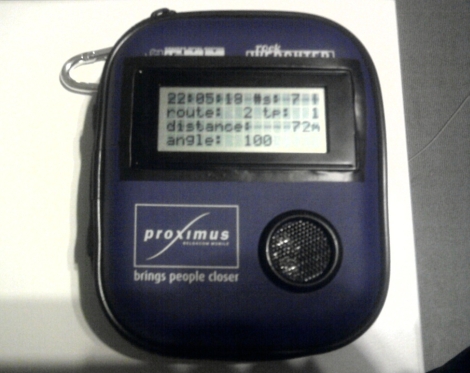
They were a bit worried that the bachelor would get sidetracked during his journey if he happened to imbibe along the way, so they built a device called jGPX that would ensure [J] stayed on track and on time. jGPX is a custom GPS navigator consisting of an Arduino, a GPS module with built-in antenna, and a compass.  The pair created a set of routes in Google Earth, exporting the data to KML for interpretation by their device. The jGPX is meant to guide [J] along via a small LCD screen that shows him the distance to his target as well as the proper direction of travel to get there.

It looks like [J’s] friends put a lot of effort into his party, and although there are no details as to how things went, we’re sure it was a blast!

GPS Audio Tour Brought To You By Surface Speakers

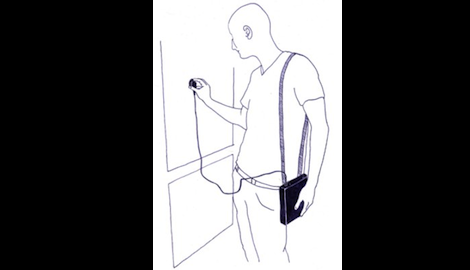
The team at Eschelle Inconnue wanted to “trace a sound cartography of Islam” in Marseilles, France, so they came up with a clever little GPS walking tour powered by an Arduino, MP3 playback module, and a surface transducer speaker.

The team used a Processing app to define geographic areas where each MP3 file would play. An Arduino on the build queries a GPS module and selects the audio file from an MP3 playback module. This isn’t uncommon, and a lot of large outdoor museums (think battlefields) have similar setups.

Determining which audio to play at what location is fairly easy, but that’s not what makes this build special. Instead of simply hooking up a pair of headphones to the build, the team decided to use a surface speaker that turns just about any solid material into a speaker. From the writeup, this is supposed to, “diffuse sounds by giving the illusion to collect them, to listen to the words of the walls, the whisperings through the materials” but we think it’s just a great way to have several people listen to the same audio file at the same time.