Hackaday Links: July 24, 2011

Plasma speakers

Apparently if you run AC and DC currents through a welding torch flame you can use the resulting plasma as a loudspeaker. [Thanks Cody]

Power metering

The Google Power Meter API is no longer in development but that didn’t stop [Pyrofer] from finishing his metering hardware. It uses a reflectance sensor to read the meter instead of using clamp-based current sensing.

Music videos from inside the instrument

Filming from inside of a guitar creates the camera effect seen above which looks like the waveform you’d see on an oscilloscope. [Thanks Philleb]

Hidden messages in audio files

GhostCoder lets you encrypt and hide audio files within other audio files. The thought is, you can piggyback your own data into Torrents that are circling the interwebs.

2×4 Chair

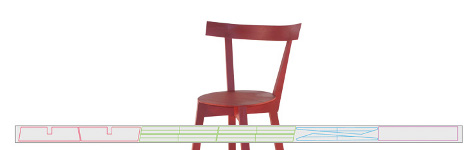
If you’re skilled with a Skill saw you can make a chair out of one 2 by 4. You can see the pattern you’ll have to cut out from the board in the image above, wow!

Guitar Becomes An Improved Color Organ

[Charles] wanted to put some LEDs in his guitar. He also wanted individual notes to output certain colors, but he couldn’t find any projects with tone-based algorithms to convert sound into colors. After about a year of work, his ColorChord guitar was born.

Unlike every other color organ build we’ve seen, the color of a note does not relate to the absolute pitch of the note. Instead, the colors are mapped within a musical key. A I chord will always be Yellow, a IV chord will always be purple, and a V chord will always be blue. Playing in the key of C will have the LEDs output yellow, purple, and blue for a C, F and G chord, respectively.

Continue reading “Guitar Becomes An Improved Color Organ”

Creating Music From GPU Noise

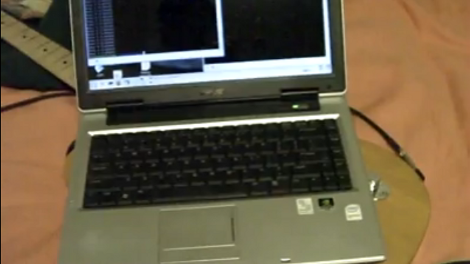
Yep, that’s a picture of a Laptop rocking out on an electric guitar. In what can only be described as a truly bizarre hack [CNLohr] discovered that the RF noise from the computer can be used to play music through the guitar’s pickup.

Check out the clip after the break to hear an annoying, but very discernible rendition of Jingle Bells. Once [CNLohr] stumbled onto the fact that changes in what the graphic processing unit is doing was affecting the pitch detected by the pickup he started writing some code. Now he’s got a program that automatically calculates the size of the window, and produces a white square on a black background to dial in the GPU at the right frequencies.

He mentions in the notes accompanying his video that he had to turn off Vsync to get this to work right. We don’t understand why but we’d love to hear what you think in the comments.

Continue reading “Creating Music From GPU Noise”

Million Volt Guitar Rocks The House…for Science!

science_brothers_tesla_hero

[Bill Porter] and his friend [Dan Flisek] work together to put on a science-related educational stage show called “Science Brothers”, in which the pair try to convince school children that their field of expertise is the cooler science. While the two are competitive on stage, the main goal of the program is to get kids interested in science, no matter what the specialty.

The pair currently finance the project out of pocket, so they are always looking for ways to make things interesting while also keeping costs in check. With that in mind [Bill] came up with an awesome way to show off the Tesla coil he built a while back. His most recent educational creation is a little something he calls “Tesla Hero”.

Since he already had a solid state Tesla coil hanging around, he dug up a PS2 Guitar Hero controller and got busy getting the two acquainted. The guitar connects to the coil via a fiber optic isolator board, playing one of five notes as he strums along. A series of Arduino-driven LED strips adorn the guitar, flashing various colors while he plays, as you can see in the video below.

It’s quite a cool project, and we’re sure that his audience will be impressed!

Stick around to see a video of  Tesla Hero in action, and if you’re interested in learning more about the Science Brothers, be sure to check them out here.

Continue reading “Million Volt Guitar Rocks The House…for Science!”

Guitar Pickup 101

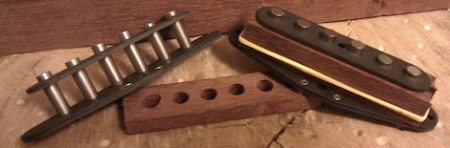
[Dino Segovis] is at it again!  For this week’s installment of his “Hack A Week” series [Dino] is holding a guitar pickup winding 101.  Professional guitar pickups can cost hundreds of dollars, but are all essentially a permanent magnet wrapped in a bunch of wire. Using some cheap headphones, magnet wire, and a spare bolt [Dino] produces his own pickup and throws it in a one string blues guitar. This is a great beginner’s project as it involves only a few very easy to find parts and touches on some interesting concepts such as inductance and magnetic flux.

The premise is really simple:  Sandwich the headphone magnet between two plastic discs to make a spindle, hot glue a 1/4″ bolt to the spindle, connect to a power drill, and wind a few thousand loops of magnet wire onto the thing.  Hook your coil up to an amp and lay down a jam.

We might be tempted to add a counter to the rig using a reed switch connected to the “=” key of a cheap pocket calculator, and a magnet glued to the bolt.  We have also seen a more complicated automated spool winder but [Dino] is keeping it nice and simple.

Check out the video after the jump to hear [Dino] go all Seasick Steve on us.

Continue reading “Guitar Pickup 101”

Adding Remote Touch Control To The Kaoss Pad

touchosc_kaoss

[Munki] enjoys using his Kaoss Pad MIDI controller to add a new dimension to his music while playing guitar. The only thing that bothers him about the Kaoss Pad interface is that it can be difficult to trigger or alter effects in the middle of a bitchin’ guitar solo. He started looking around to see if there was a way to control the Kaoss Pad wirelessly via a touchscreen and found that with a little tweaking, his iPhone was a perfect candidate for the job.

He grabbed a copy of TouchOSC from the AppStore and configured it to communicate with his computer. After building an interface for his iPhone, he taped it to his guitar and gave it a try. Everything seemed to work pretty well, but he didn’t stop there – he also wanted to control Ableton Live and Max MSP from his iPhone. It took a bit of research and some tinkering with the Live API, but he eventually got everything working together nicely as you can see in the video below.

If you are interested in trying this out yourself, he has several useful links throughout his article, and he has made his TouchOSC/Max MSP patch available for download as well.

Continue reading “Adding Remote Touch Control To The Kaoss Pad”

Guitar Teaches You To Play Using LEDs

guitarduino

[Andrew] is an electrical engineering student at UIC, and decided that he would build a MIDI guitar for his senior design project. After tinkering for awhile, things were not looking good, and the MIDI guitar idea was scrapped. With his deadline creeping up, he came up with a new idea, the Guitarduino. His new project is a guitar that teaches you how to play chords and scales by showing you the proper notes to play via LEDs embedded in the guitar’s neck.

He removed the neck, and carefully drilled the holes that would eventually house his 130+ LEDs. The LEDs were wired to his Arduino via some multiplexing circuitry that resides on the back of the guitar’s body. The Arduino was mounted on the front of the guitar along with a shield used for communicating with his LED array. He built another shield that serves as the LCD display as well as the input board for his guitar.

The final result of all his work is fantastic. The user simply needs to dial in the chord or scale that he wants to learn, and the guitar lights up, showing the proper finger positions on the fretboard. We could see this coming in quite handy for anyone just starting to learn how to play.

Check out the video below to see a demonstration and walkthrough [Andrew] put together highlighting his guitar’s features.

Continue reading “Guitar Teaches You To Play Using LEDs”