DIY Electron Accelerator

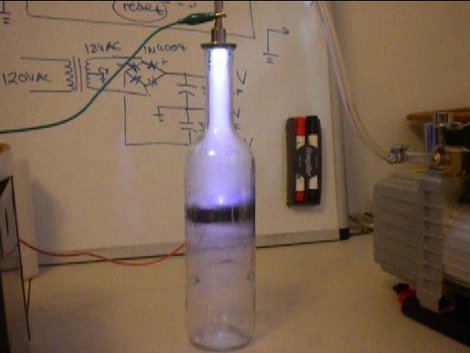
Reader [Xellers] sent in his newest instructable: DIY Electron Accelerator: A Cathode Ray Tube in a Wine Bottle. While not exactly what you might think of a cathode ray tube, the basics are in place. A wine bottle is used as a vacuum chamber and a 9kv neon transformer is attached to a stopped in the top. A cathode is placed mid way, the air is sucked out with a pump, and high voltage is applied.

Naturally as more air gets pumped out the electric arc intensifies into a pretty solid plasma filling the space between the two contacts. While mixing drilled glass with a vacuum and high voltage sounds like an awesome hospital story [Xellers] does cover some safety points including the possibility of this thing putting out some nasty waves.

One thing that is not mentioned (that I saw)  is this is very similar to how florescent light tubes work and without florescent material lining the chamber it will spit out quite a bit of UV light (notice germicidal UV lights are clear). So you will want to watch your eyes!

Join us after the break for a quick video.

Continue reading “DIY Electron Accelerator”

High Voltage Hacks Finale: Do Not Try This Under Any Circumstances

Over the last two weeks, we’ve seen some pretty crazy and potentially dangerous stuff, like a stun glove and modern day alchemy. For our high voltage theme finale, we couldn’t pass up [Photonicinduction]’s YouTube channel.

Best known for his self-destructing washing machine (the source of this animated .gif), [Photonicinduction] is also the brainchild behind the hair dryer flame thrower and his homemade fifty thousand amp transformer.

While we do like his Not Safe For Work ammeter (yes, it really is NSFW), some of [Photonicinduction]’s videos – charging a car battery in 4 minutes, making a kettle boil without a heater element, pressurizing coconuts to over 200 psi, and exploding rabbits – are hilariously dangerous and should not be attempted by anyone.

We need to say you should not attempt to emulate [Photonicinduction]’s hijinks under any circumstances. Cleaning up a puddle of burning gasoline with a vacuum cleaner may sound like fun, but copying [Photonicinduction] will eventually get you killed. This man must know his stuff, because we’re honestly shocked he hasn’t exploded yet. The best way to enjoy three hundred thousand volts is probably grabbing a coffee and watching [Photonicinduction]’s YouTube channel.

High Voltage Hacks: A 1000 Watt Tube Amp

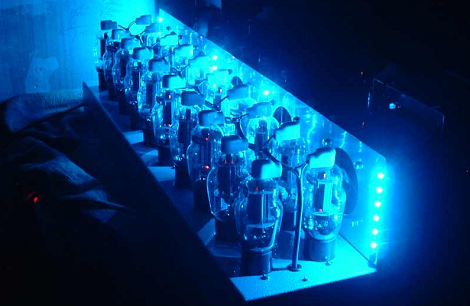
Normally when we hear of a Champ guitar amp, we think of a sweet-sounding rig that puts out 6 Watts through an 8-inch speaker. [John Chambers] of Champ Electronics wanted to build a true champion for the field of battle and came up with The Champ 1000 Watt Tube Amp, an amplifier that probably puts out enough heat to keep an igloo warm.

The amp is based on 807 valves. With some clever engineering [John] managed to coax 100 watts out of a pair of 807s, so the entire amp “only” requires 20 power tubes. The build log shows some pretty impressive examples of electrical prowess. We can’t recall the last time we featured a build with point-to-point wiring on tagboard, and [John]’s work is some of the best we’ve ever seen.

[John] has been working on this amp off and on for a few years now, but he should be wrapping up the build sometime soon. We haven’t seen this amp in action, but we imagine it would look something like this 36×10 monstrosity. Send us a message or post a comment if you can find a video and we’ll put it up.

High Voltage Hacks: All About Electroluminescence

Although many might not know it, electroluminescent materials use high voltage, and thus qualify for our featured topic. Many may assume that these sheets work in the same way as LED lights, using low-voltage DC power.  This, however, is not the case, as they need around 100 volts of AC current to allow them to light up.

For a battery-powered solution, this means converting the battery’s DC power to AC. Adafruit has a good tutorial about working with EL wire and powering it up using a portable inverter. One should obviously be careful to properly insulate any clothing using this material as being shocked is generally not fun.

The video after the break is pretty long, but is well produced and will give you a good background of EL use. If you don’t have 30 minutes to dedicate to this, be sure to at least skip to 2:43 to see one of the coolest EL shirts we’ve seen. Continue reading “High Voltage Hacks: All About Electroluminescence”

High Voltage: Build Your Own 84 KV Lightning Stick

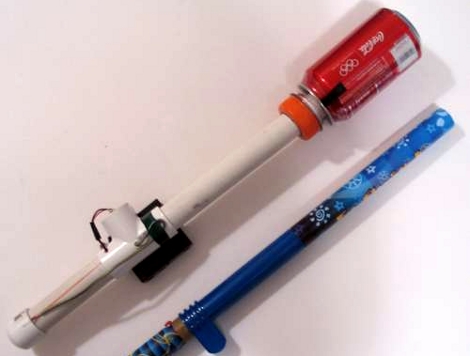
There’s a proverb that says ‘Speak softly and carry a big stick’. Now that stick can come in a high-voltage form factor. The device above, which reminds us of a side-handled baton with a coke can stuck on the end, is a portable Van de Graaff generator.

Although debated in the comments, the creator of this hack claims you can shock someone with 84 kV of electricity using the device. Of course as a weapon it’s lacking since we’re talking about static electricity; the voltage can be through the roof but the current is extremely low. Despite that, there are some fun things you can do with them. The video after the break show it throwing off sparks with the lights dimmed. [Yardleydobon] also includes a few other tricks at the end of his tutorial. He makes a set of Franklin Bells using two more soda cans with the aluminum tab from one suspended in between them. As he charges it up, the tab dances back and forth, ringing the ‘bells’ it runs into. Once they are charged, the ringing can be restarted by discharging just one of the cans.


Continue reading “High Voltage: Build Your Own 84 KV Lightning Stick”

High Voltage: Lightning Simulator Can’t Send You Back To The Future

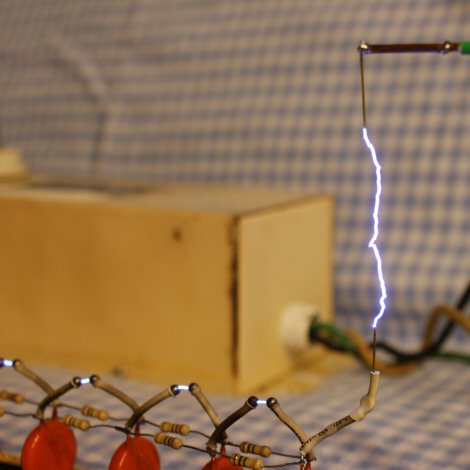
Continuing on with our high-voltage theme, today we have a page describing Marx generators by [Grenadier]. Marx generators are devices that produce pulses of very high voltage with fast rise times. For most of us, that means that they can make neat sparks. For the more serious types out there, that also means that they are great for driving some high-powered lasers, simulating lightning strikes, and even igniting the conventional explosives surrounding the core of a nuclear weapon! His page includes a video of his Marx generator producing some pretty sparks for those of us who aren’t so serious.

We have featured several of [Grenadier’s] projects in the past. This one doesn’t deviate from his normal style of taking a subject and clearly describing it with lots of well-taken pictures.

Recently, he has been working on improving one of his projects that deviates from what he normally does. He is calling it “The Junkbox”. The Junkbox is something like a free online swap meet where you can sell your electronic parts.

High Voltage: Controlling A Flyback Transformer With An Arduino

If you’d like to build a Jacob’s ladder, an ignition system for a flamethrower, or for some ungodly reason you need 15 kilovolts for a prop replica or cosplay build, this one is for you. It’s an easy to build high voltage power supply that interfaces with an Arduino.

After harvesting a flyback from the power board of a CRT, [Andrew Moser] added a new primary coil to the transformer. This boosts 12 volts that can be easily controlled by an Arduino to something that will arc an inch and a half. The next step building the flyback driver. [Andrew] used a MOSFET and MOSFET driver for this circuit (although he says this guy works without the driver). After that, all that’s left to do is write some software and test it out.

Of course this comes with the boilerplate warning, “If you don’t know what you’re doing, you might die.” That being said, if you ever wanted to test out an Arduino’s resistance to EMP, this is the project for you. Check out the flyback powering a Jacob’s ladder after the break.

Continue reading “High Voltage: Controlling A Flyback Transformer With An Arduino”