Quadcopter Stabilization System Using Wii Motion Plus

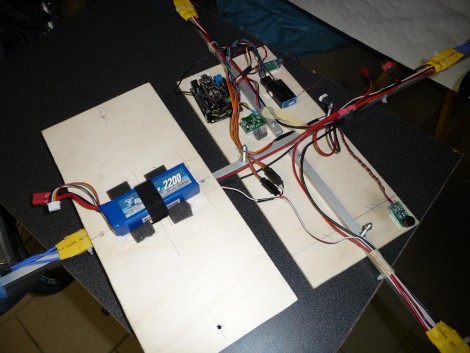
If you’re contemplating a quadcopter build here’s a way to add stabilization hardware without breaking the bank. The BaronPilot project uses an Arduino and a Wii Motion Plus module to ensure an even keel for your flying projects. The hardware inside of the Motion Plus includes two gyroscopes, which the BaronPilot monitors for changes in your flying rig’s orientation. The project serves as a co-pilot by differentiating between movements caused by the remote control, and changes due to wind or other outside factors (like hitting the quadcopter with a stick as seen in the video after the break). It should all translate to less chance of crashing due to operator error.

You can pick up a Motion Plus for less than twenty dollars, a deal when compared to the IMU boards that we usually see in quadcopter builds which usually run more than twice that amount. It’s an I2C device which makes it easy to hook up to just about anything. This project has native support for Teensy, Arduino Nano, and Arduino clones using an ATmega328 chip. But the portability of the Arduino platform should make it easy to tweak the code for use with just about any microprocessor.

Continue reading “Quadcopter Stabilization System Using Wii Motion Plus”

One Really Big Quadcopter That Is Following In The Steps Of The Spruce Goose

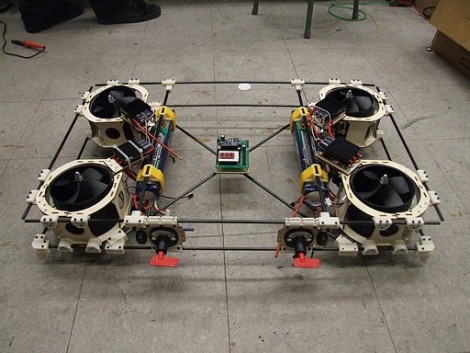
Behold the Land-Bear-Shark, a quadcopter on a rather grand scale. At a full eight kilograms it’s an easy target to compare the [Howard Hughes] behemoth, but in addition to the weight, this still has yet to make its first flight.

To give you some scale to the image above, the board at the center is an Arduino. It controls the beast, along with the help of a SparkFun IMU board which rides atop. Really, if any quadcopter of this size has a chance of working, this should be the one. The construction is beautiful, making use of carbon fiber rod along with 3D-printed connectors to assemble the frame. A lot of thought has gone into small things like conserving weight used on the landing gear, which are incorporated into the bottom corner brackets. The batteries are connected in a manner that makes them easy to adjust, acting as ballast for balancing the craft.

We’re keeping our fingers crossed that this will be more than the tongue-in-cheek title of the post which calls it a Quadrotor-shaped sculpture.

[via Adafruit]

Wii MotionPlus + Arduino

wiimoteplus

[knuckles904] was able to use the new Wii MotionPlus with an Arduino. Nintendo has released the WM+ in order to detect the motion of the controller better. The Wiimote only detects acceleration, whereas the WM+ detects rotation along 3 axes. The Arduino communicates with it over I2C, the same protocol that is used with the Nunchuk. To connect the two devices, he used jumper wires, but breakout boards are also available. He was able to create some example code with help from wiibrew.org. When paired with a Nunchuk, which contains a 3-axis accelerometer, you can have a 6 degrees-of-freedom IMU for under $40, perfect for controlling your robots or logging data.

[via adafruit]