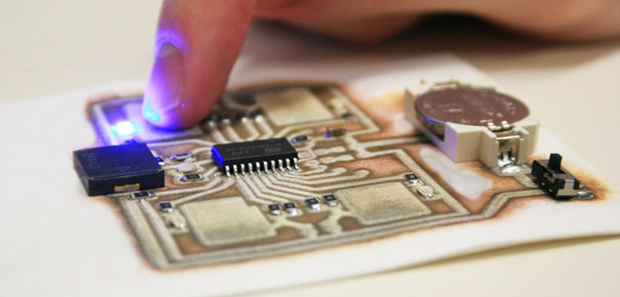
Printing Printed Circuit Boards

circuit

We really respect the old timers out there and their amazing ways of crafting PCBs; they used black tape on clear acetate sheets to create single layers of PCBs with a photoetching process. Now creating a PCB is a simple matter of opening up a CAD package, but like the old timers we’re still dealing with nasty chemicals or long shipping times from China.

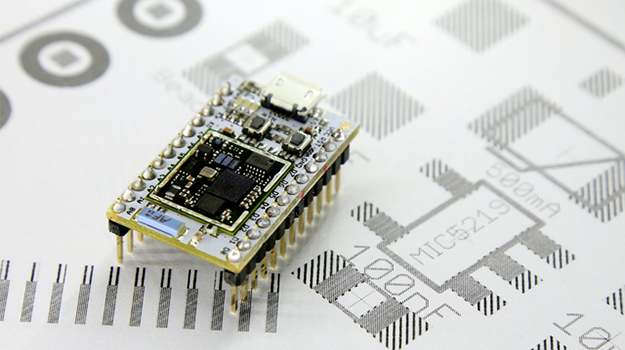
The EX¹, a new robot on Kickstarter – hopes to change that. They’ve created a PCB fabrication process that’s as simple as printing something with an inkjet printer. Just put in a piece of substrate – anything from Kapton to acrylic to fabric – and in a few minutes you have a single-sided PCB in your hands.

The printer dispenses two chemicals, silver nitrate and ascorbic acid, that react and produce traces and pads for the circuit. Right now, the EX¹ is limited to single-side boards, but experiments on creating multi layer boards are ongoing.

In any event, we’re really impressed with how simple the EX¹ setup actually is. Inkjet is a mature, well understood technology with more than enough resolution for simple homebrew circuits, and the AgNO3 + Vitamin C formula could easily be adapted to an inkjet printer modification.

5 Year Mission Continues After 45 Year Hiatus

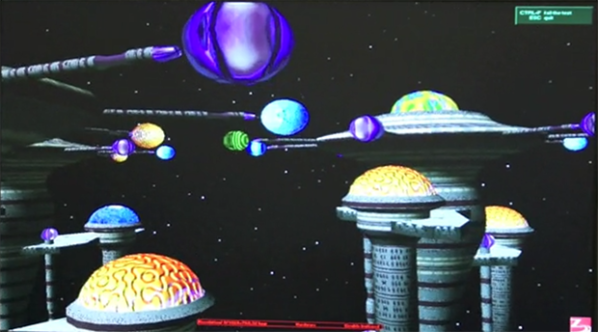
There have been many iterations of the Star Trek franchise since the original Star Trek 5 year mission series aired in 1966 including a cartoon series in 73, a new television series in 87 and many movies on the big screen. Those series and movies inspired many youngsters to pursue a career in the fields of science, engineering, technology and cinema. Now the franchise is coming full circle with a fan based Kickstarter funded web series. Those inspired fans are attempting to complete the original 5 year mission “to boldly go where no man has gone before”, which ended after only three seasons on the air. The fan based and fan supported reincarnation is cleverly titled “Star Trek Continues” and has CBS’s consent.

The production company behind this effort, [Far From Home, LLC], is owned and operated by [Vic Mignogna], who also plays Kirk in this web series. They have already finished the first amazing 51 minute web-isode titled “Pilgrim of Eternity“. The film may seem campy, but it’s not. They are sticking to the original format and using the sets that were used in the sixties, rightfully so being this is the continuation of the mission. This new web series has some very interesting actors. One is the well-known Mythbuster [Grant Imahara], who plays the role of Mr. Sulu. The actor playing Mr. Scott is [Chris Doohan] the son of [James Doohan], who played Mr. Scott in the original Star Trek series.

There are more details and episode 1 after the break.

Continue reading “5 Year Mission Continues After 45 Year Hiatus”

3Doodler In The Wild

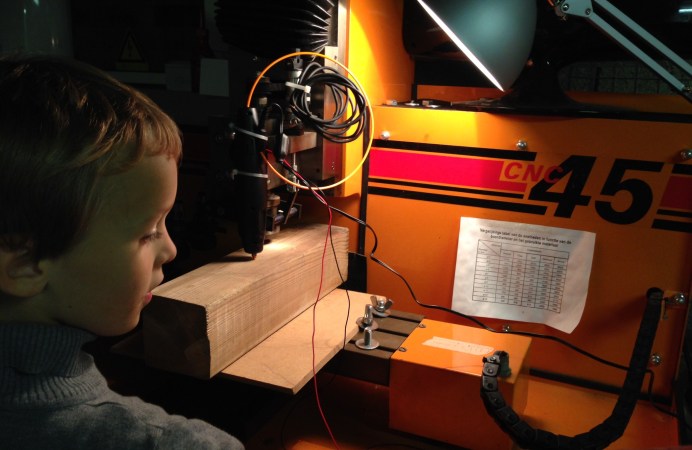
Remember the Kickstarter for the 3Doodler? Well they have just started shipping, and a hackerspace called Open Garage in Belgium just got theirs! Like any good hackerspace after playing with it they took it apart and posted pictures.

This is great because in our original coverage on the 3Doodler, we wondered what it looked on the inside, and whether it could be adapted to use with a CNC machine to make a giant 3D printer. Garage Lab delivered on both.

Stick around after the break to see the innards, and the first test print using a CNC mill!

Continue reading “3Doodler In The Wild”

An Open Source GPU

Unless you’re bit-banging a CRT interface or using a bunch of resistors to connect a VGA monitor to your project, odds are you’re using proprietary hardware as a graphics engine. The GPU on the Raspberry Pi is locked up under an NDA, and the dream of an open source graphics processor has yet to be realized. [Frank Bruno] at Silicon Spectrum thinks he has the solution to that: a completely open source GPU implemented on an FPGA.

Right now, [Frank] has a very lightweight 2D and 3D engine well-suited for everything from servers to embedded devices. If their Kickstarter meets its goal, they’ll release their project to the world, giving every developer and hardware hacker out there a complete, fully functional, open source GPU.

Given the difficulties [Bunnie] had finding a GPU that doesn’t require an NDA to develop for, we’re thinking this is an awesome project that gets away from the closed-source binary blobs found on the Raspberry Pi and other ARM dev boards.

Why Kickstarter Projects Are Always Delayed

Most Hackaday readers may remember the Spark Core, an Arduino-compatible, Wi-Fi enabled, cloud-powered development platform. Its Kickstarter campaign funding goal was 10k, but it ended up getting more than half a million. The founder and CEO of Spark [Zach Supalla] recently published an article explaining why Kickstarter projects are always delayed as the Spark core project currently is 7 weeks behind schedule.

[Zach] starts off by mentioning that most founders are optimistic, making them want to embark in this kind of adventure in the first place. In most presentation videos the prototypes shown are usually rougher than they appear, allowing the presenters to skip over the unfinished bits. Moreover, the transition from prototype to “manufacturable product ” also adds unexpected delays. For example, if a product has a plastic casing it is very easy to 3D print the prototype but much harder to setup a plastic injection system. Last, sourcing the components may get tricky as in the case of Spark core the quantities were quite important. Oddly enough, it was very hard for them to get the sparkcore CC3000 Wifi module.

X-Winder: Carbon Fiber Wrapping

ScreenShot035

One of our readers just sent us a tip about this interesting kickstarter project. [Turner Hunt] is bringing carbon fiber manufacture into the hands of makers — at considerable cost savings!

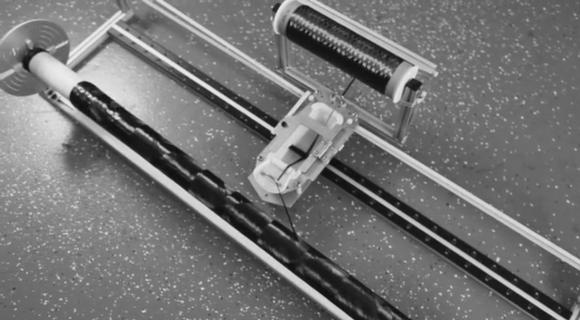
So how does it work? The machine wraps the filament around the workpiece, not unlike a CNC lathe in reverse. Actually it’s kind of a new breed of 3D printer! As the machine feeds the filament, it dips it through a bath of epoxy resin before being wrapped around the workpiece. A finishing step wraps heat shrink tape around the finished project using a heat gun, which then provides a glossy surface finish very similar to commercial carbon fiber products.

By purchasing carbon fiber filament and epoxy resin and using this machine, you can create structural carbon fiber tubes for about 80% less than they would cost commercially. The system comes with its own software that controls the machine via g-code, and you can also specify different wrapping patterns for different applications. While tube-shapes work best, you can also wrap other shapes including flat bars, wing skins, turbine blades and more — anything that is wrappable and under 6″ in total diameter. Is anyone else thinking about custom wrapped quadcopter frames?

[Thanks Alannah!]

Smoothieboard, The Be-all, End-all CNC Controller

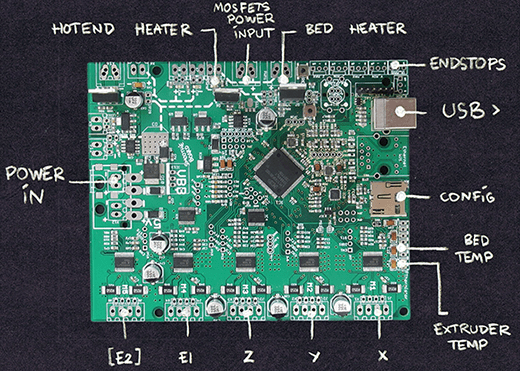
A while back we took a look at electronics boards for 3D printers, going over the cost and benefits of the most common electronics boards for printers, laser cutters, and mills. One of the most impressive boards was the Smoothieboard, but finding a supplier back then was a little difficult. Now, the Smoothieboard is up on Kickstarter, giving everyone the opportunity to get their hands on this very cool CNC control board.

While most RepRap and 3D printer controller boards use an ATMega or other 8-bit microcontroller, the Smoothie uses a 32-bit ARM chip in the form of an NXP LPC Cortex-M3 chip. Not only does this allow the Smoothie to do some very cool things with your machine – native arcs and circles, for example, but this better hardware also allows for Ethernet, drag-and-drop firmware, and exposing the USB port as both a serial port or mass storage device.

The Smoothie comes in three flavors, with either 3, 4, or 5 stepper motor drivers. These Allegro A4982 drivers are good enough for any 3D printer, laser cutter, or small mill, but the broken out pins allow for stepper drivers supplying more than 2A of current.

Everything on the Smoothieboard is modular, meaning this board is equally capable of powering a RepRap, mill, laser cutter, or plotter. There’s even a planned control panel called the Smoothiepanel, making this a great choice for your next CNC build.