unbelievably simple

Home Made T.E.A. Lasers

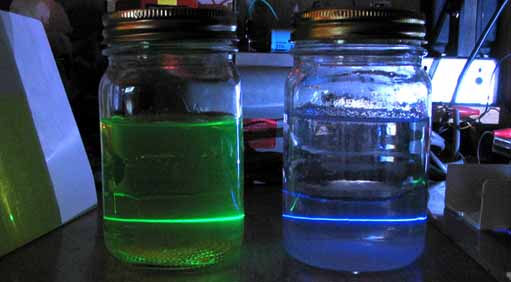
[Nyle] was interested in building lasers at home but felt that the exotic parts list was just too daunting. That was, until he discovered T.E.A. lasers. T.E.A. lasers can be constructed from a few bits of aluminum and some high voltage. They emit UV light, as you can see in his examples where he shoots them through a jar full of water with highlighter ink mixed in.

He has posted several variations of different sizes as well as numerous images of them in action. You can see a video of one in action after the break. We also have to point out the fantastic music in the video. It reminds us of those school videos left over from the 50s.
Continue reading “Home Made T.E.A. Lasers”

Constructing A CO2 Laser Cutter

angler

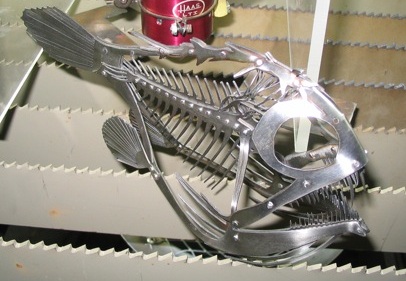
[Owen] contacted us to show us his site dedicated to his CO2 laser cutter build. He spent about 2 years and roughly $15,000 putting it together, so this is not small build. The laser and optics alone were $9,000. This site isn’t necessarily meant to be a template to build your own, but he shares so much information that we would certainly suggest you read it before digging into a build. He does have some downloadables, like the tool paths and the emc2 configuration files as well as a copy of the entire website. Great job [Owen].

Laser Cutter Doubles As A 3D Printer

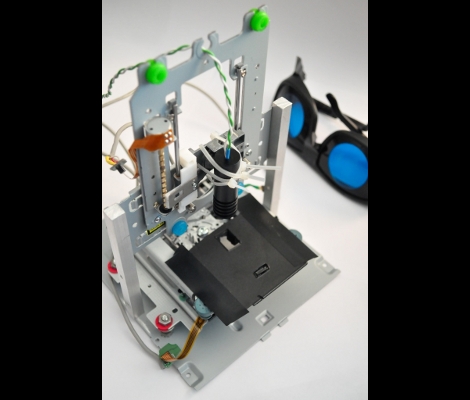
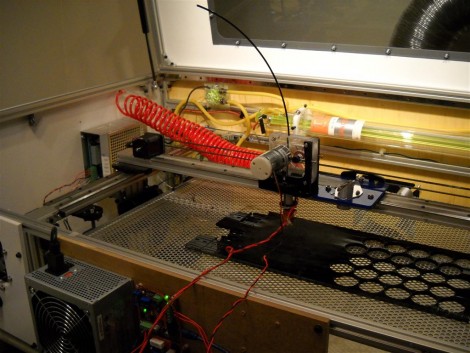
[Bart] figured out how to use his laser cutter as a 3D printer. We’ve checked in on his open source laser cutter in the past and we’re happy to see he’s now done with the build. But rather than stop there he took it a step further. For less than $200 he built an extruder head and added RepRap circuitry. You can see in the image above the laser tube is in the background and the extruder head with a line of black filament is mounted on the gantry. [Bart] has other plans for extensibility as well, including a knife cutter, a pen plotter, and a Dremel mount.

Projectile Speed Sensor

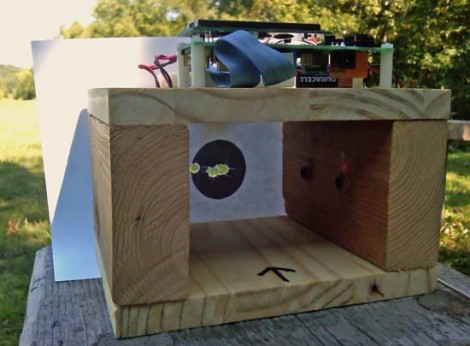
[Mike] built a sensor rig to measure projectile speed. The setup uses a tunnel with two sensors in it. Each consists of a laser diode on one side focused on a photodiode in the other. The two are monitored by an op amp and measured by an ATmega128 microcontroller. When the beams are broken the elapsed time between the two events is measured in order to calculate speed. There is a setting to adjust the calibration for a range of speeds, which came in quite handy as [Mike] initially tested the device with rubber bands before moving on to a pellet gun and then a rifle.

It seems like he’s tempting fate by shooting a target just a few inches below his exposed circuitry but his marksmanship prevailed. We’ve seen bullet speed detectors in the past, used just for the delight of seeing how fast the projectile is moving, and also to capture an impact at just the right instant.

Building A Laser Cutter From A Weak Laser

We covet laser cutters and this diy model with a 1 Watt IR diode may be well within our price range. Most commercially available laser cutters, and some homemade ones, work in the 20-100 Watt ranges, using a CO2 laser. They have more than enough power to cut right through a lot of materials so how can a 1W diode compare? It seems that the weaker laser is still quite powerful right at its focal length, so moving that point along the Z axis will let you burn away a larger depth of material. The test rig seen above uses optical drive components for the three axes and managed to cut a rectangular piece out of the black plastic from a CD case.

This isn’t [Peter’s] first try with CNC lasers. He’s the one that’s be working on an open source selective laser sintering platform.

[Thanks Osgeld and Vesanies]

Another Home-built Laser Projector

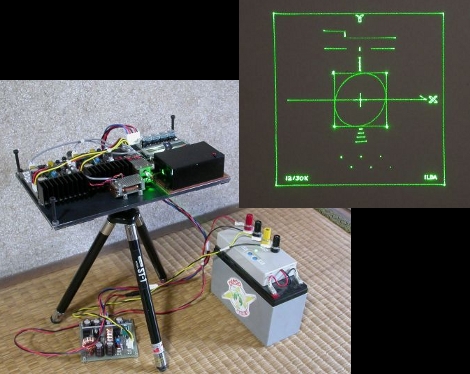
[Jarrod] sent us a link to this home-built laser projector after seeing a different projector that we featured yesterday. This system is fundamentally different. [ChaN], who finished the project several years ago, didn’t use a loudspeaker to move the mirrors, but instead build his own closed-loop Galvanometers. Two of these are controlled by an ATmega64 to produce incredibly clean and accurate vector images. It’s not just the images that are impressive, his hardware is laid-out with skill and forethought that make hiding it in a case a sacrilege.

Vector Plotter With Lasers

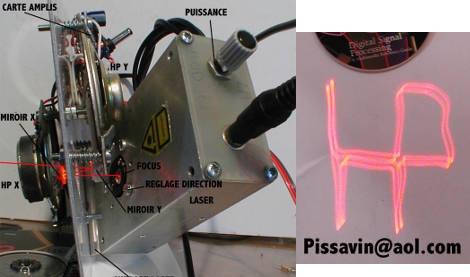
[Hubert] sent in his experiments using HDDs, CDROMs, speakers, and other components to make an XY laser plotter. Those carefully reading will note, its not all three to make one plotter, but rather three plotters each using a separate system. The setups have their advantages and disadvantages, and [Hubert] is sure to point them out; including circuit diagrams and pictures to help you on your own trials.

There is a little difficulty in reading English not so good, but considering we’ve never seen a single-laser vector plotter done before (spirographs come close, and no one wants to wait 85 seconds) it’s still very impressive.

[Thanks TJ]