
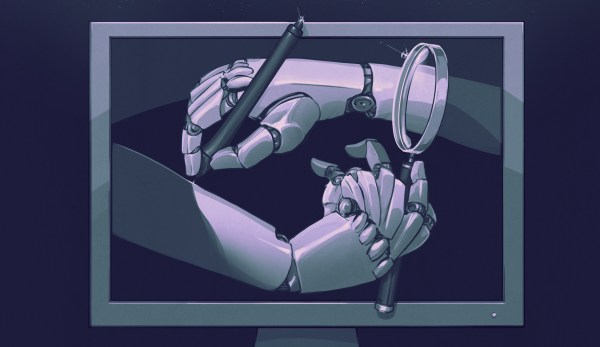
Star Trek Was Right About Prompt Injection, Sorta

This following statement is a lie: “I am telling the truth”. Okay, now that it’s just us meatbags, let’s get down to brass tacks. Captain Kirk’s logic bombs couldn’t possibly work on modern LLMs, right? Surely that was just a bit of 1960s silliness from when computers filled rooms and were esoteric magic even to most sci-fi writers?

Well, not entirely, according to a recent article in IEEE Spectrum. While you might not be able to make a data center explode, you certainly can use  a lot of tokens by making an LLM overthink with your prompt.

It comes down to the much-vaunted ‘reasoning’ ability of the new models — which isn’t really reasoning the way we think of it, but does involve breaking the stated prompt down into smaller problems. That’s part of what lets the new models tackle such involved tasks as porting MicroPython to the SNES with a prompt like “Please make this [stuff] work now!” It’s also a weakness, because with the right prompt you can get that virtual ‘reasoning’ to tie itself in knots with mutually incompatible smaller steps.

The models seem to be able to break out of it, but they burn a lot of tokens along the way, which is an attack in and of itself if you’re found a way to inject prompts into someone else’s API. It’s a little more subtle than what Kirk got up to, but underneath it’s essentially the same thing. At scale, it could serve as a DDoS attack on LLM servers. (Un)Fortunately, modern computers are better designed than their imaginary 23rd-Century counterparts, and there’s no way to craft a logic bomb into something that will let out the magic smoke.


Hackaday Links Column Banner

Hackaday Links: August 31, 2025

Back in March, we covered the story of Davis Lu, a disgruntled coder who programmed a logic bomb into his employers’ systems. His code was malicious in the extreme, designed as it was to regularly search for his Active Directory entry and fire off a series of crippling commands should it appear he had been fired. His 2019 sacking and subsequent deletion of his AD profile triggered the job, wreaking havoc on servers and causing general mayhem. Whatever satisfaction Lu drew from that must have been fleeting, because he was quickly arrested, brought to trial in federal court, and found guilty of causing intentional damage to protected computer systems.

Lu faced a decade in federal prison for the stunt, but at his sentencing last week, he got four years behind bars followed by three years of supervised release. That’s still a pretty stiff sentence, and depending on where he serves it, things might not go well for him. Uber-geek Chris Boden has some experience in the federal prison system as a result of some cryptocurrency malfeasance; his video on his time in lockup is probably something Mr. Lu should watch while he can. Honestly, we feel bad for him in a way because we’ve been there; we certainly toyed with the logic bomb idea when we were coding for a living, without actually ever doing it. Maybe he thought it would just get treated as a prank, but that was probably never in the cards; as we’re fond of telling our kids, the world just doesn’t have a sense of humor anymore.

Continue reading “Hackaday Links: August 31, 2025”

Hackaday Links Column Banner

Hackaday Links: March 16, 2025

“The brickings will continue until the printer sales improve!” This whole printer-bricking thing seems to be getting out of hand with the news this week that a firmware update caused certain HP printers to go into permanent paper-saver mode. The update was sent to LaserJet MFP M232-M237 models (opens printer menu; checks print queue name; “Phew!) on March 4, and was listed as covering a few “general improvements and bug fixes,” none of which seem very critical. Still, some users reported not being able to print at all after the update, with an error message suggesting printing was being blocked thanks to non-OEM toner. This sounds somewhat similar to the bricked Brother printers we reported on last week (third paragraph).

Continue reading “Hackaday Links: March 16, 2025”








