An HO Model Power Bogie For Not A Lot

For people who build their own model trains there are a range of manufacturers from whom a power bogie containing the motor and drive can be sourced. But as [Le petit train du Berry] shows us in a video, it’s possible to make one yourself and it’s easier than you might think (French language video with truly awful YouTube auto-translation).

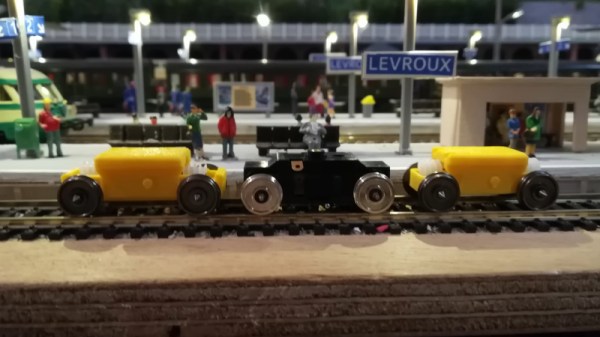
At the heart of the design is a coreless motor driving a worm gear at each end that engages with a gear on each axle. The wheelsets and power pickups are off-the-shelf items. The chassis meanwhile is 3D printed, and since this is an ongoing project we see two versions in the video. The V5 model adds a bearing, which its predecessor lacked.

The result is a pretty good power bogie, but it’s not without its faults. The gear ratio used is on the high side in order to save height under a model train body, and in the version without a bearing a hard-wearing filament is required because PLA will wear easily. We’re guessing this isn’t the last we’ll see of this project, so we hope those are addressed in future versions.

We like this project and we think you will too after you’ve watched the video below the break. For more home-made model railway power, how about a linear motor?
Continue reading “An HO Model Power Bogie For Not A Lot”

I’ve Been Printing On The Dragon Railroad…

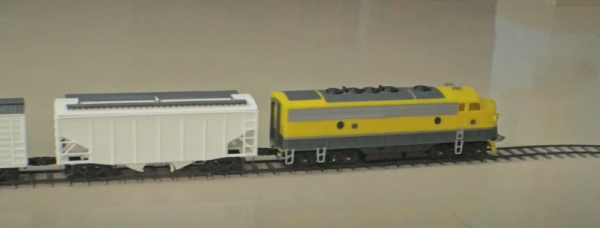
We know many people who put much effort into building model train setups. But [Rambros] has an entire set 3D printed, and the files are open source, so you can print your own or modify it to suit you. When we first read “complete open source ecosystem,” we thought it might have been a bit of hyperbole, but it isn’t. The S-scale set includes two locomotives, a tanker, a box car, a hopper car, and a gondola car. There are different sections of track, customizable with Fusion 360. The “Dragon Railway” takes a few mechanical parts and electronics, of course. You can see one of several videos about the system below.

You can control the whole system using Bluetooth and a smartphone. The electronics are pretty simple, consisting of an ESP32 board, some motor drivers, N20 motors, and a few miscellaneous parts. We expect it would be compatible with other off-the-shelf S scale tracks and cars, but we don’t know that for sure.

Although you’ll need Fusion 360 to customize, there are plenty of ready-made STL files if you want to get started quickly. Some of the track items, like the crossing and turnout are not customizable, anyway. One particularly  impressive item is a printed auto-coupler; while a small item, getting that to work reliably with printed parts seems like it may be the most difficult part of the whole thing.

Maybe an OLED display would be the next thing? We’ve seen other printed trains, but this seems like a real labor of love.

Continue reading “I’ve Been Printing On The Dragon Railroad…”

A model train car carrying a camera

2022 FPV Contest: Get The Train Driver’s View In Your N-Scale Railway

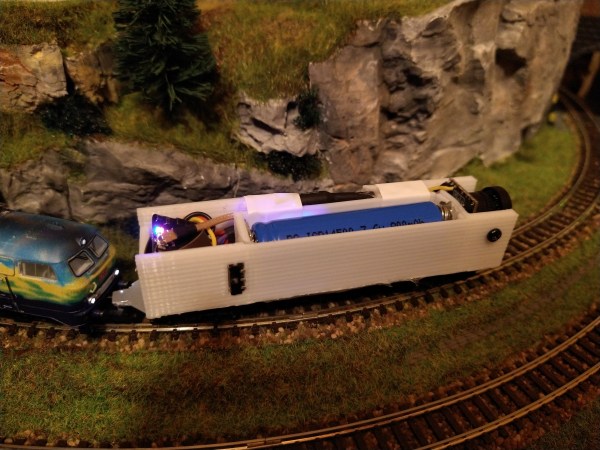
Model railroaders typically observe their project from high above. It would be neat to see what the world looks like to the residents of your little town, but getting down to their point of view is difficult, especially if you’re working in one of the smaller scales. For those working in the N scale, there’s now an easy way of observing your project as the train driver would see it: [Vassily98] managed to squeeze a wireless camera into an N-scale railcar.

The main challenge here was the extremely limited space available: the track in N-scale layouts is 9 mm wide, meaning that the whole system had to fit in just 23 x 20 mm2, the frontal area of a typical train car. One of the few cameras that fit within that profile was the RunCam Nano 4, which [Vassily98] connected to an ultra-tiny Team BlackSheep 5.8 GHz video transmitter.

Continue reading “2022 FPV Contest: Get The Train Driver’s View In Your N-Scale Railway”

A Concealed Model Railway Rises To The Occasion

Occasional pieces of furniture serve little purpose other than to fill a space and maybe display a prized ornament or two. Who hasn’t got a relative with one two many small tables or display stands overfilling the available space!

If you visit [Peter Waldraff]’s house though, those pieces of furniture may not be what they seem. His display pedestal for example hides an N gauge railway layout that rises from the depths on a system of pulleys, with the action triggered by moving the vase displayed on its top. The vase conceals a magnet, which operates a reed switch that in turn controls the winch motor.

The layout is a loosely Batman themed train chase, with concentric spirals of track forming a continuous loop on which two trains run. There’s an ingenious arrangement with a reed switch and a piece of dead track to ensure that the chasing train is always held to ensure a gap between them. The landscaping is of a set of cliffs with a model of Wayne manor at the top, and there’s even a LED-lit Batmobile. One of the locomotives is recognisably based on a character from the Thomas the Tank Engine books.

All in all we like the ingenuity of this layout, but if you like it too then we’ve got a treat for you. Sharp-eyed readers will remember that this isn’t the first such project from Peter.

Continue reading “A Concealed Model Railway Rises To The Occasion”

linear motor pcb model railroad track

PCB Linear Motors For Model Trains

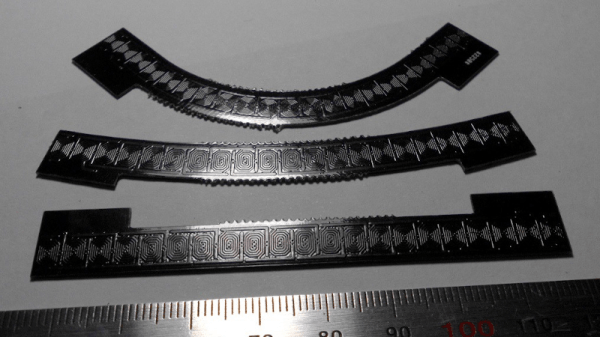
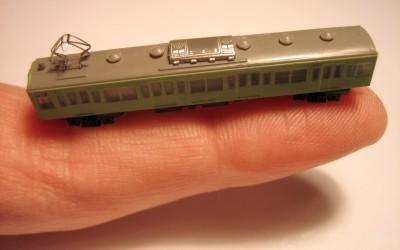
Modeling a railroad is hard. Railroads are large, linear pieces of civil engineering. So many modelers are drawn to the smallest scale they can use. Recently a new scale, named T, at 1:450 has been pushing this barrier. But fitting a reliable mechanical drive mechanism and MCU board in a package this size is a challenge. In practice, even more of a problem is getting reliable electrical contact through a metal wheel on metal track (about the worst possible design for a contact).T scale electric locomotive held on a human finger

T always seemed to us a long way out on the bleeding edge. But all that may have changed. In a recent Hackaday.io writeup, author [Martin] describes a PCB technology based linear motor system to externally drive T scale locomotives.

The system uses 4mm planar coils. The underside of the PCB has another coil, so the effective pitch is 2mm. With microstepping, a step of 0.25mm is possible, and trains run smoothly. Current is 3-400mA. Continue reading “PCB Linear Motors For Model Trains”

This End Table Conceals A Close Encounter

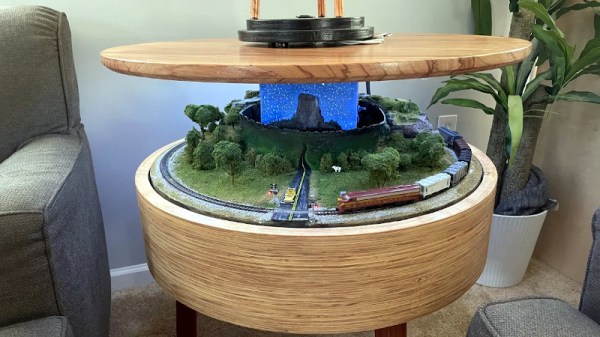
If you’re of a Certain Age, perhaps you had a train set as a child. An oval of track, a loco, and some rolling stock; it matters not whether it was Thomas the Tank Engine or a large express train — they were at the time a pretty cool toy. Move forward a few decades, and model railways have become either super-expensive room-filler layouts, or have sunk low as novelty Christmas ornaments, so that the basic loop of track is in dire need of rescue. Perhaps [Peter Waldraff] can help, with a beautifully-constructed N gauge circular layout concealed in an end table. Even better, when you examine it closely, it becomes apparent that this is no ordinary train set, it’s a scene from Close Encounters Of The Third Kind.

This is a project of two equally well-made parts, the piece of furniture and the train. The former is entirely scratch-built, with a cylindrical outside made from carefully cut rings of plywood and a sliding riser mechanism in the centre with a concrete counterweight. Slide the cylinder upwards, and the layout is revealed — a scratch-built hill in the centre of the ring of track and the lit-up underside of the UFO above it. As the train goes round the track, it even triggers a set of crossing lights and sounds for extra realism. The full story can be seen in the video below the break, and is well worth a watch.

We’ve covered more than one concealed model railway layout in the past, and it comes as no surprise when browsing to find that [Peter]’s work has featured here before.

Continue reading “This End Table Conceals A Close Encounter”

N-scale model railroad hidden in wall art

Hidden Model Railroading Taken To The Nth Scale

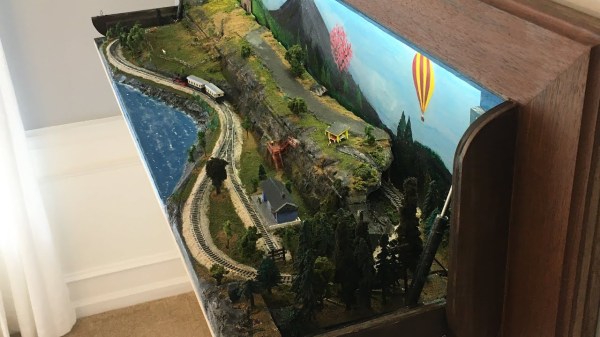
Most of us would be pretty happy with ourselves if we made one of those neat “epoxy river” types of art for our home. Not so with prolific maker [Peter Waldraff]. [Peter] is a skilled craftsman with a penchant for hiding model railroads in everyday furniture and fixtures. To this end, he’s created what he calls the Hidden Epoxy Railroad, which you can see in the video below the break.

The project starts with basic woodworking to build the frame, hinges, and the hinged epoxy river with its colored epoxy pour. Instead of stopping there, [Pete] continued by building a full N scale model railroad into the piece. The frame doubles as a backdrop complete with a beautifully painted scene with what we’re guessing is an N scale hot air balloon, too.

Of course, the skeptics among us might doubt whether the model railroad is fully hidden when closed. But one detail that Pete shared with us is that his wife never knew about the train portion of the build until their daughter pointed it out. She thought it was merely a piece of art for the dining room. Truly a great hack!

The entire build is documented on [Pete]’s YouTube channel, with its own 15 part build series. It’s definitely worth checking out. We’ve covered one of [Pete]’s hidden railroad builds before, so make sure you check that out, too!

Continue reading “Hidden Model Railroading Taken To The Nth Scale”