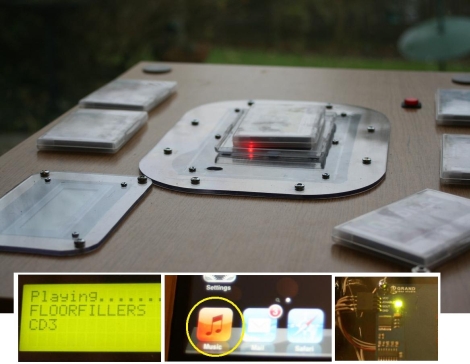
Improved FPGA Synth

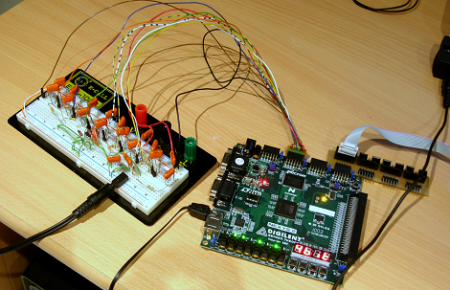
A week or so ago we featured an FPGA MIDI interface. Since then the builder has gone crazy with his FPGA and revised his code to include polyphony and PWM output, and posted a polyphony demo.

In our previous coverage of the build, the synth was monophonic, and the MIDI implementation was pretty shaky. After realizing the hard work was done, [Mich] re-wrote the MIDI interpretation module to keep 8 voices in memory. Now the synth can play 16th note arpeggios at 999bpm.

The original build used 8 pins to output the audio with an R/2R ladder for a digital to analog converter. This didn’t work well with a polyphonic synth (everything was clipped or noisy), so [Mich] moved to PWM output.

Continue reading “Improved FPGA Synth”

DIY Guitar Fuzz Pedal

diy_fuzz_pedal

Instructables user and Community Manager [Randy Sarafan] recently put together a tutorial on how to build an ages-old musical standard, the “Fuzz Pedal”. He says that the secret to rocking out is fuzz, so if you can handle both a soldering iron and a guitar, this project is for you.

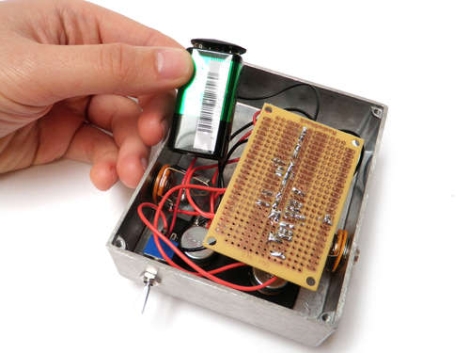
When you take a close look, the pedal’s components are actually quite simple. The distortion is created by a pair of transistors, which in his case are vanilla NPNs from RadioShack. We have covered other distortion pedal builds before, and they have used germanium transistors to obtain a ‘creamier’ sound – you should be able to swap these cheap ones for uprated models with little trouble.

The handful of components were soldered neatly to a piece of perf board, and placed into a sturdy metal case that looks like it can withstand even the harshest abuse. He’s got schematics and a BOM in his writeup, so all that’s keeping you from a rocking weekend is a little bit of time and a soldering iron – what are you waiting for?

Stick around to see a quick video of [Randy’s] fuzz pedal being built.

Continue reading “DIY Guitar Fuzz Pedal”

Humanoid Robot Listens To Music, Plays Along On His Theremin

robot_playing_theremin

Researcher and YouTube user [mspetitegeek] along with her lab mate [Tatsuhiko Itohara] have been fortunate enough to spend some time working with the HRP-2 humanoid robot from Kawada Industries. Their research has seemingly been focused on using the robot to create real-time interactions with humans for entertainment purposes, at the very least.

The program they created allows the HRP-2 to listen and watch its human counterpart while he plays the guitar in order to recognize a beat pattern. Once the robot catches on, it plays along on his Theremin, matching both notes and rhythm perfectly. Since the human operator is clearly playing at a fairly relaxed pace, we are curious to see a demonstration where the robot required to match a snappier tune – it could be quite interesting.

In the meantime, we’re content to just sit back and enjoy the Mogwai-esque tones of the HRP-2 rocking the Theremin.

Keep reading to see a short video of the HRP-2 in action.

Continue reading “Humanoid Robot Listens To Music, Plays Along On His Theremin”

FPGA MIDI Interface

Hacking and digital music seem to be very much related arts. This very well built hack goes through the process of creating a MIDI synthesizer using a field programmable gate array (FPGA) and several other components.

A laptop is used as the MIDI interface which runs through a filter and then to the FPGA. This translated signal then goes through a digital to analog converter and finally to the amplifier and speakers. The FPGA is especially interesting as this chip is an array of logic gates that can be programmed however one wants. In this case, the wavetable principle is used to generate sound.

Although this is no Kaossilator yet, this device is a great start and very functional. If you’ve ever wanted to build your own electronic instrument, check out this hack. Also, check out the video after the break! Continue reading “FPGA MIDI Interface”

Synapse Turns Your Kinect Into A Dubstep Theremin

kinect_dubstep_theremin

[Ryan Challinor] is part of a group constructing a display for this year’s Burning Man festival that includes the Kinect, Ableton Live, and Quartz Composer. As the programming guru of the project, he was tasked with creating a method for his partners to utilize all three products via an easy to use interface.

His application is called Synapse and was inspired by videos he saw online of people controlling individual Dubstep beats or sound effects with the Kinect. Synapse allows you to map multiple effects to each limb, sending joint positions, hit events, and image depth data to both Ableton and Quartz Composer via OSC. The user interface looks fairly easy to work with, enabling musicians and artists to create awesome audio/visual displays using their bodies as instruments, in a very short period of time.

Check out the pair of videos below to see a brief walkthrough of the software interface as well as a quick video demonstration of what Synapse is capable of.

[via KinectHacks]

Continue reading “Synapse Turns Your Kinect Into A Dubstep Theremin”

An Instrument That Plays Along With You

muse

The crew over at Teague Labs was talking about musical instruments and how digital music creation seems to get bogged down under user interfaces littered with increasing numbers of buttons, knobs, and sliders. They decided to build a musical device that has its own musical inclinations and personality, while also allowing for two-way interaction with the user.

The resulting creation is Muze, a simple musical instrument with only a single user input. Muze has been programmed with a palette of notes that it can combine and remix into a nearly infinite number of musical combinations. Muze is perfectly happy composing on its own, and will create music that evolves over time, if left alone long enough.

As with all musicians, not every tune is a hit, so Muze can be gently nudged away from cacophonous melodies with a simple twist of a knob. Each of the device’s knobs represent a blend of functions, which are used to influence Muze when placed on the board. The interaction does not send Muze flying into a completely different direction, rather it tells Muze to shake things up a little bit, much like you would ask your guitarist to pick up the tempo during a jam session.

It’s a neat little instrument, and we can imagine it would be a big hit with kids and adults alike. Keep reading to see a video demonstration of Muze in action.

Continue reading “An Instrument That Plays Along With You”

The Jazari Robotic Jazz Enesmble

As anyone who’s been to Chuck E Cheese’s knows, robotic bands have been under development for years. Patrick Flanagan’s cyborg percussion ensemble, Jazari seems to take things to a new level.

As Patrick describes it, Jazari “fuses African rhythms,
algorithmic composition, computer music, and electro-mechanics into
beat-driven steamfunk.”  The controls are quite unique as well.  Originally, the controller was simply a Wiimote. This was limited, since one needs three fingers to hold on to it, so a new “springbok” device was born allowing all five fingers to be used to play music.  The vocal part of the music is created using an Android program called “voloco”.

The video after the break should explain everything a little better, and the music itself is pretty cool.  Patrick will be doing more programming and hardware work over the summer rather than touring much, but “they” should give an awesome concert once all the bugs are worked out. Continue reading “The Jazari Robotic Jazz Enesmble”