The Casio F-91W As A Contactless Payment Device.

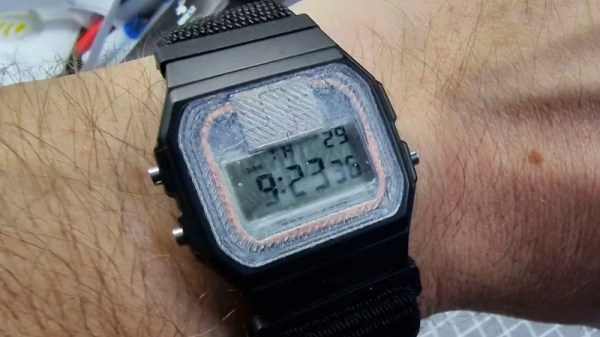
The Casio F-91W digital watch is perhaps one of the most successful pieces of consumer electronics ever made, having quietly supplied the essential function of an inexpensive and accurate LCD digital timepiece for many decades. As a result it has a huge following, and we’ve seen plenty of projects based upon it. [Matteo P] has one that we think you’ll like, he’s turned his Casio into a contactless payment device. We missed it when it came out, but sometimes a good project needs sharing.

If you’re a long-time Hackaday reader you may remember our investigation of 13.56 MHz NFC cards in which we showed you a disassembled card in which he antenna was a tuned circuit covering most of the card, with a small coupling coil for the chip. It’s this kind of card he uses, and ends up with an SLA printed front face for the watch that places the chip above the display and puts a pick-up coil around the outside. The most interesting part of the write-up though isn’t in the build, instead it’s the deep-dive into designing the RF parts and ensuring a good coupling at something close to resonance. Read it, if you fancy trying NFC-enabling any other random items.

Meanwhile, if this NFC bug has caught you, don’t forget our rather silly one transistor 125kHz NFC reader challenge.

Thanks to Hackaday alum [John Elliot V] for the tip!
A Music Box Commanded By NFC Tags

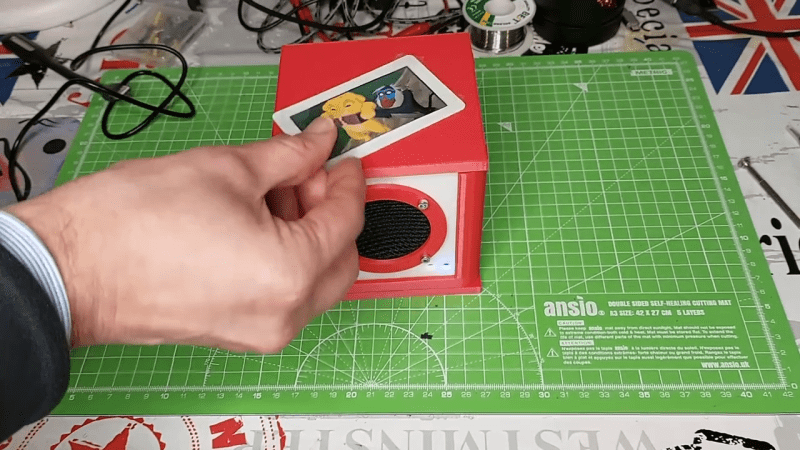
[Luca Dentella] recently encountered a toy, which was programmed to read different stories aloud based on the figurine placed on top. It inspired him to build an audio device using the same concept, only with music instead of children’s stories.

The NFC Music Player very much does what it says on the tin. Present it with an NFC card, and it will play the relevant music in turn. An ESP32 WROOM-32E lives at the heart of the build, which is hooked up over I2S with a MAX98357A Class D amplifier for audio output. There’s also an SD card slot for storing all the necessary MP3s, and a PN532 NFC reader for reading the flash cards that activate the various songs. Everything is laced up inside a simple 3D-printed enclosure with a 3-watt full range speaker pumping out the tunes.

It’s an easy build, and a fun one at that—there’s something satisfying about tossing a flash card at a box to trigger a song. Files are on Github for the curious. We’ve featured similar projects before, like the Yaydio—a fun NFC music player for kids. Video after the break.

Continue reading “A Music Box Commanded By NFC Tags”

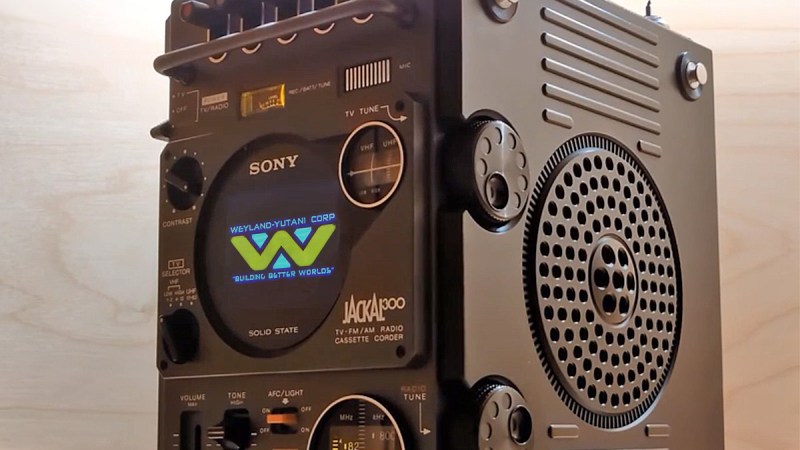
Close up of a Sony FX-300 'Jackal' radio

Packing Even More Features Into A Classic Radio

When it comes to hacking niches, breathing new life into vintage devices is always an exciting challenge. [t0mg]’s recent project exemplifies this with his 1978 Sony FX-300 ‘Jackal’ radio. He’d already upgraded the radio in 2021 and turned it into a feature-packed marvel, but there’s always room for improvement.

[t0mg]’s initial 2021 build had its quirks: noisy sound, a subpar display, and a non-functional radio module. Determined to enhance these aspects, he sourced an IPS version of the original 3.2″ ILI9431 LCD, significantly improving viewing angles. To tackle the audio issues, he integrated an M5Stack Atom microcontroller, utilizing its Bluetooth A2DP capabilities to deliver cleaner digital sound via I2S to the Teensy audio board. The Teensy itself got a complete wire overhaul just for the sake of good craftmanship.

The new setup also enabled the display of song metadata. Additionally, [t0mg] incorporated a dedicated Arduino Nano clone to manage inputs, streamlining the overall design. The revamped ‘Jackal’ now boasts a bunch of impressive features such as displaying RDS data for FM stations, voice recording, and an NFC reader for personalized playlists.

If you’re into radio makeovers, look into this post for a real golden oldie, or start out with the basics. For [t0mg]’s earlier improved version of this Jackal, read our article on it here.

Continue reading “Packing Even More Features Into A Classic Radio”