Board Lets You Know When To Hold ’em; Know When To Fold ’em

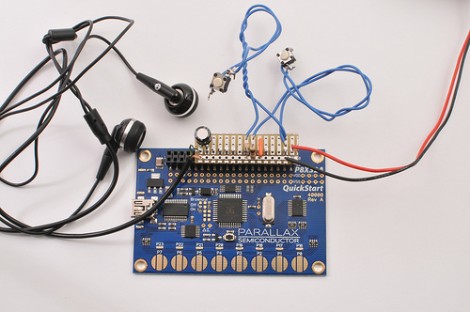
Don’t mind me, I’m just listening to some tunes during our poker game. Well, that and getting some electronic coaching about poker odds. This board lets you wiggle your toes to input the upcards, and those in your hand. After each entry the gadget will tell you your odds of winning the hand. Take it easy with this kind of stuff, if Rounders was at all realistic, getting caught cheating is a painful mistake.

The thing we find interesting about the system is that it doesn’t use a stored odds database. Instead, the Propeller chip runs a simulation of 1000 hands of poker based on the cards you have entered and uses the results to calculate the odds. [Nick] says that this runs quickly because he’s using multiple cores for the calculations, and it cuts down on the data that the device needs to have on board. Right now the feedback uses a text-to-speech generated voice, but you can customize the audio clips if you’d like. Check out a demo of the device in the clip after the break.

Not looking to get the beat down for cheating? Here’s a poker tournament timer that we assure you is on the up-and-up. Continue reading “Board Lets You Know When To Hold ’em; Know When To Fold ’em”


Tannenbaum Ticker, Even Though The Markets Close For Christmas

Maybe we’re a little bitter because we held on to our pumpkin futures well into November, but we’ve got to respect [Nick]’s stock ticker ornament. It’s an Internet-connected Christmas ornament that queries stock prices and displays the change with an RGB LED.

The build uses a Propeller Platform USB and the Propeller E-Net Module to pull stock quotes down from Google. With the attached source, selecting any traded company is easy enough; all that’s needed is to select a company is changing a line in the code. The Propeller pulls the quote every 30 seconds during the trading day, and parses it into a ‘percent changed’ format. The ornament glows red if the change is more than a 4% negative change, green for within 0.2% of open, and blue if more than a 4% positive change.

[Nick] is more of a ‘set it and forget it’ investor, so this ornament is a handy, passive way to keep an eye on his investments. Check out the demo vid after the break.

Continue reading “Tannenbaum Ticker, Even Though The Markets Close For Christmas”

Rudolph Toy Hacked To Announce Incoming Email

email-reading-reindeer

Tis the season for hacking, and [Nick McClanahan] at the GadgetGangster is certainly showing off his Christmas spirit with his most recent creation. He had an animatronic Rudolph the Red Nosed Reindeer toy sitting around and thought it would be fun to convert him into an email reading machine.

He tore open the toy, removing its innards, disconnecting the built-in speaker and servos from the original PCB. He then extended wires from those components outside of the body before reassembling the toy. The reindeer is controlled primarily using a Propeller Platform, with an E-Net module and a small audio amp taking care of network communications and audio output, respectively.

Most of the work is done by the software [Nick] is using, which allows Rudolph to periodically check his Gmail inbox for new messages. When the message count increases, the reindeer springs into action, moving and lighting up his nose before announcing the sender’s name.

He’s using a phonemic voice synthesizer for the output, which does the job, though we would go mad if we had to listen to it all day. Since the reindeer is connected to his LAN, it might be feasible to run the data through a more robust voice synth on a PC, returning a better-sounding audio clip for playback.

Check out the video below to see a short clip of Rudolph in action.

Continue reading “Rudolph Toy Hacked To Announce Incoming Email”

Adding Sound And Light To Your Radio Controlled Vehicles

[Nicholas] wanted to add some flair to his RC car. In addition to the headlights that you see above, there’s brake lights, and a horn that plays “Dixie” like the General Lee in the Dukes of Hazard. All of this is triggered by the wireless controller, but he figured out a way to monitor the servo signals in order to add the additional features.

The hack is driven by a Propeller chip. [Nicholas] patches into the servo lines by adding a servo-in and servo-out header to his prototyping shield. With that in place he’s able to tap into the voltage and ground pins to power the microcontroller. By attaching a 4k7 resistor to the control line, he can listen in on the servo signals using the Propeller.

This RC car has a throttle servo. So when the throttle is opened all the way up the Propeller chip flashes some white LEDs in the headlights, and uses an LM386 audio amplifier to play a tune. When the throttle is pulled all the way back the brake lights are activated. Don’t miss the test footage of this which is embedded after the break.

Continue reading “Adding Sound And Light To Your Radio Controlled Vehicles”

Electronic Recorder Conversion

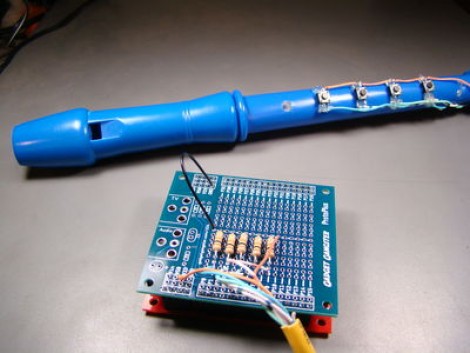
As we wrote the title to this feature we can see why [Jeff Ledger] calls it an electronic flute and not a recorder; this is a musical instrument and not something for archiving audio. Confusion aside, we’re all familiar with these plastic ‘musical’ instruments. Many elementary schools in our area require students to buy one as part of music class. So it shouldn’t be hard to find one if you want to try this for yourself (heck, [Jeff] grabbed his a the dollar store).

Basically, he’s replaced the finger holes with momentary press switches, then uses a Propeller dev board to turn the button presses into music. It’s simple and quick, but what does it for us is the breath actuator. Sure, you can set this up to play whenever a button is depressed, but [Jeff] went that extra mile and added a piezoelectric element to the bottom. When you blow through the instrument it flexes slightly, generating a tiny current that can be measured by the microcontroller. Check out the short clip after the break.

Do a little more work and you could turn this into some type of musical game controller. We’re thinking Zelda!

Continue reading “Electronic Recorder Conversion”

Toilet Buddy Helps Cover Up Bathroom Noises

toilet-buddy

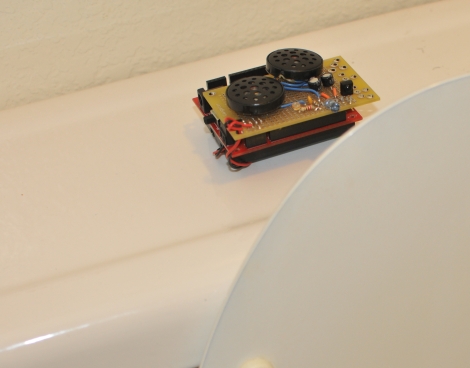
When it comes to bathroom etiquette, [Nick] and the crew at Gadget Gangster are nothing less than proper gentlemen. Inspired by a Japanese toilet that automatically plays a “courtesy flush” noise in an effort to conserve water while masking sounds, they created the Toilet Buddy.

While the Toilet Buddy does nothing to cover up any aromas, it does provide some sound cover for those louder times. Not only that, it also helps serve as a reminder for other bathroom courtesies as well. When mounted on the tank lid, the Toilet Buddy alerts the last occupant to put the seat down and shut off the lights before leaving the bathroom. Built with a Parallax Propeller board, it uses IR and ambient light sensors to determine the position of the toilet seat and the status of the bathroom lights, playing an audio notifier when necessary. Now if it only sprayed air freshener automatically!

[Nick] points out that the Toilet Buddy is not limited to bathroom duty, and can be used in a variety of projects where light/motion sensing is required. Be sure to check out his writeup for some usage suggestions if you’re thinking of building one.

In the meantime, continue reading to see a video of the Toilet Buddy in action.

Continue reading “Toilet Buddy Helps Cover Up Bathroom Noises”

Mimicing A Heartbeat In Sound And Electrical Pathways

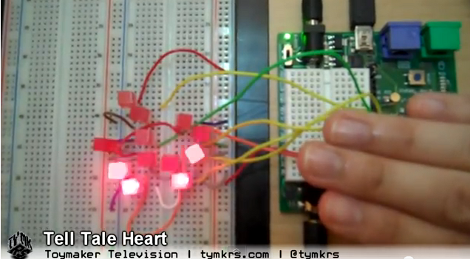
If you set a cardiac nurse loose on a Propeller microcontroller and some parts you might not know what to expect. But we’re intrigued by the outcome of this project which looks to mimic a heartbeat’s audible and electrical traits. The post about the project is in four parts which are not linked to each other, but you can find them all, as well as a video segment demonstrating the rig after the break.

It seems that this was intended as a Halloween project, but we don’t see why it wouldn’t be interesting any time of year. The Propeller demo board is used to mimic a heartbeat with a pulsing LED. But that doesn’t seem all that awesome, so the sounds of a heartbeat were added to the program to coincide with the blinky light. Here’s where the medical training comes in: the next phase of the process was to lay out an array of LEDs on a breadboard in the shape of the human heart’s electrical system. Now you’ve got a pulsing LED, heart sounds, and a lighted animation showing how the electricity travels through the organ.

To add a little [Poe] to the project there’s also a CdS light sensor. As you approach the project you block some light from getting to the sensor and the heart rate increases.

We think the next logical step is to add a heart rate sensor, so that this can illustrate what your own heart is doing. Boom! Another project ready for the Children’s museum.

Continue reading “Mimicing A Heartbeat In Sound And Electrical Pathways”