All About VLF Radio

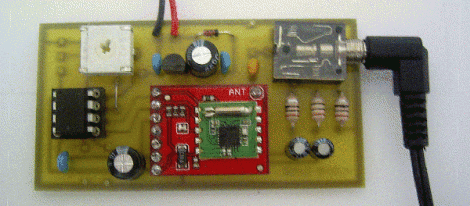
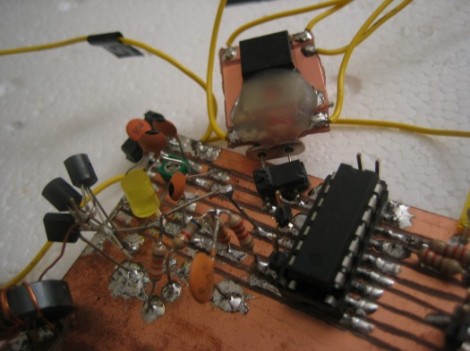
If you’re interested in learning about Very Low Frequency communications take a look at what Larry has to offer on his site. He’s put together a guide to VLF receivers that is short enough to read and clear enough to understand with rudimentary knowledge of circuits. He builds a simple receiver as a working example and a high-powered transmitter that can put out over 2600 watts. Let’s face it, radio operators were the original electronic hackers. Get back to our roots and learn the ways of the transistor.

[Thanks Buddy]

Internet Radio Player Wins Propeller Design Contest

It’s got a NIC, a remote, a character display, and can record and play back streaming audio. Thumper is [Harrison Pham’s] contest-winning Internet radio player.His finished board is roughly the same size as the 16×2 character display and piggy-backs the device for a small form-factor. It can be controlled via an infrared remote control, or through a remote web interface. Source files are available from the link at the top, but the really juicy details are included in the shockingly comprehensive PDF writeup.

The photo above is a bit misleading. The board has a micro SD slot on the back even though a USB card reader is shown. This project would need USB host control for Propeller chips in order to use that reader. Don’t forget to check out some of the other submissions to the the contest once you’ve had your fill of this one.

[Thanks Drone]

DIY Diodes

[H. P. Friedrichs], the creator of the Static Bleeder has created his own diodes. Using household chemicals, a film of cuprous oxide was made on a copper pipe cap. Cuprous oxide has been one of the first known semiconductor substances, has a low forward drop but is an otherwise asymmetrical conductor, odd V-I curves, and some neat photovoltaic action. The apparatus seen above is used to bring a piece of lead (in this case, solder) into contact with the salmon-colored cuprous oxide while electrical connections can be made to the binding posts at the front. What are your thoughts on this device?

Radio Cabinet Media Center

old-time-radio-mediacenter

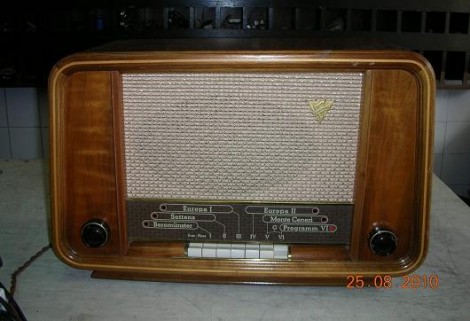
[Jon] picked up an old Philco radio from a pawn shop for $81. The electronics were shot and the controls had seen better days. So he set to work giving this old beast a makeover, turning it into a beauty of a media player.

The face plate for the controls had seen better days. His solution was to replace it, which gave him more options for mounting a display and controls. A menu system was implemented on the LCD display using a PIC18F4450 microcontroller. The chip also takes care of the three rotary encoders for the user interface and integrates the whole thing with the PC backend.

We’ll be the first to admit that a full PC is overkill in this situation. That being said, this was slow, unused system that is seeing new life. But is it worth the added noise and energy costs? Who knows, we think this leaves a lot of room for future revisions. Perhaps an NAS and wireless controls via iPhone or a similar device?

We’re a bit disappointed that [Jon] didn’t do some work to get better sound out of this. With a great big cabinet like this, the right speakers with a tube amp will produce some sweet sound. Certainly most things would be better than just using a pair of computer speakers. We’ll keep our eye out for an update that adds a tube kit to the project.

Monome Case Mod: Vintage Radio

monome_vintage_radio

We’ve seen a lot of the Monome, a USB based controller often used as a sampler, here at Hack a Day. This is one of the more creative hacks. [brothernigel] took a Monome 40h kit and fit it inside the case of a vintage radio. The faceplate was a custom order to fit his purposes and incorporates the original radio frequency display. The USB port was well placed in the side of the wooden housing. For extra “soul”, pen and ink art adorns the insides. His work log gallery takes you through the process from start to finish.

We never noticed before, but the Monome makes a great vintage-looking-electronics project. All the lighted buttons are straight out of a ’60s military command center.

[Thanks Antonio]

Wireless RGB Light Bulb

img_3953

Want to make the above yourself? [Sprite_tm] did a thorough job documenting the build step by step (complete with pics, schematics, graphs, and links to the parts used). In summary, [Sprite_tm] busted open an Ikea CFL bulb to reuse the housing. Inside, he installed a scavenged power supply, ATtiny44, RGB LED module, and a radio receiver. A remote control allows [Sprite_tm] to change the lighting of his room to nearly any color. The cost of the project is a little under $30. The price tag isn’t so steep when one considers the insanely long lifetime of LEDs.

Hard Rock Radio

rock_radio

[Guus] sent in his project where he put a radio inside of a rock. He started with a 1970’s car stereo and encapsulated it in cement by wrapping it in duct tape, building a wooden form around it, and pouring in the wet cement. Three ports are included on the back for power, antennae, and speaker. He included an outline of how he did this but we’d love to hear some tips on how he made it look like a rock and not just a brick of concrete.