Alternative Morse Code Keys

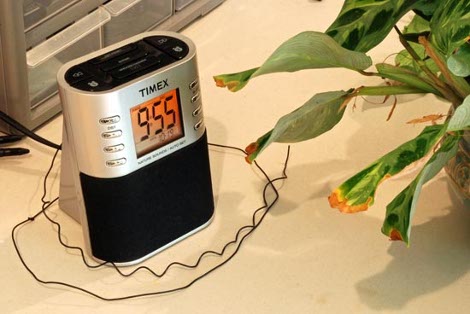
Add a bit of interest to your radio equipment with one of these unorthodox CW keys. [OH6DC] has been hard at work posting almost sixty of these hacks. Above you can see an alarm clock whose snooze button acts as the key, and a nail clipper used as a key. There’s a banana , a cross-country ski shoe , and a toaster key. The rest you’ll have to see for yourself. Any of these would work perfectly with that Morse code keyboard you’ve been wanting to build.

Terminal Node Controller In A Router

[Andrew] used a DSL router to make his own Terminal Node Controller. This will become part of an APRS-IS network, an Internet-based network built by amateur radio operators. The router used here is a Dlink DSL-502T with an AVR based TNC module attached to the serial port header. The phone line connector and its accompanying hardware have been removed to make room for the TNC module, which is supplied with 12V via that red wire. When the router boots up it sends data to the serial port header so the firmware on the TNC needed some tweaking to accommodate this (yay for open source).

Want some more APRS goodness? Check out this AVR APRS tracker.

Texting With Some Walkie-talkies

[Travers Buda] is giving new life to his abandoned childhood toys. He cracked open a set of Family Radio Services radios he had received for a birthday which work up to 2 kilometers apart. With just a bit of extra circuitry he was able to get them to act as wireless modems. The system functions but it looks like it would benefit from some more refinement, including error correction. In the end [Travers] manages to send and receive ASCII based messages at a whopping baud rate of 10.

Radio-Walkman-megaphone Hybrid

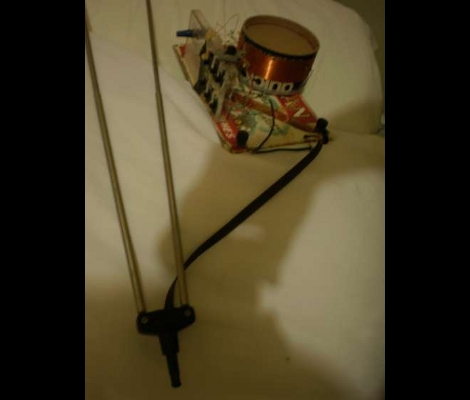
[Erich] rethought the use of a megaphone and ended up with this Mega-Tape-O-Phone. His first move was to ditch the megaphone’s amplifying circuitry in order to add his own based on an LM386 chip. From there a radio receiver joined the party followed by the guts of a tape player. He relocated the head of the tape deck to the end of a flexible cable and coated the outside of the megaphone bell with magnetic tape. Now he’s surfing the airwaves and scratching away happily.

The use of the tape head has been seen here before, but it was never in a mobile package like this is. Join us after the break for some video of this in action.

Continue reading “Radio-Walkman-megaphone Hybrid”

Resurrecting ISA Hardware

[Alex] had an old FM radio tuner card come his way. It used an ISA connector, a standard that went the way of the dodo in the mid-nineties. With the challenge of implementing an ISA-bus to configure the card he set out on his mission. What he came up with is a working radio using the ISA card and driven by a PIC 16F877. Join us after the break for schematic, code, and a few details. Continue reading “Resurrecting ISA Hardware”

Building Air Variable Capacitors

In keeping with our opinion that radio operators were the original electronic hackers here’s a guide to building your own transmitting air variable capacitors. Using some roof flashing, Plexiglas, and various fasteners [David Hammack] was able to make it work. It’s not a perfect solution but he has some ideas to make the next one better. Give this a try after you’re done tweaking your crystals and building input devices.

[Thanks Rich]

RF Transmission In The 9 KHz Band

[W1VLF] is on a quest to communicate over long distances with a 9 kilohertz transmitter. He built this giant coil with that in mind. A round concrete form was used as a base and wound with magnet wire by hand. We’d recommend building an automated winding device, but this method seems to have worked. Operating at 50 Watts on the air-core coil at 8.97 KHz he was able to pick up the signal at a distance of 5 kilometers. It’s not breaking any overall distance or portability records, but on a project like this the quest is where the fun is at.

[Thanks Drone]