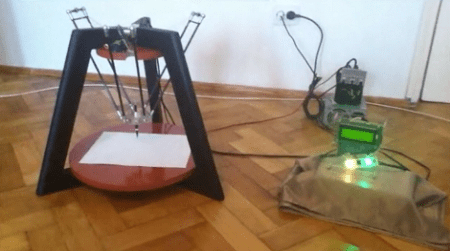
ArduDelta Would Make A Great Pick And Place Machine

[Bogdan] sent in a great build of a delta robot he originally posted on the Arduino forum, but he didn’t receive much feedback there. We think a build like this deserves a lot more credit.

After working for 7 months on his robot, [Bogdan] has a pretty stable (and very classy) platform made out of wood. The platform and arms in delta robots are usually extremely light to reduce the inertia of the tool so [Bodan] crafted these out of carbon fiber tubes and plexiglas. Everything is controlled by an Arduino Mega2560 encased in a plexiglas enclosure with a 20×4 LCD, status LEDs, and an infrared receiver.

Continue reading “ArduDelta Would Make A Great Pick And Place Machine”
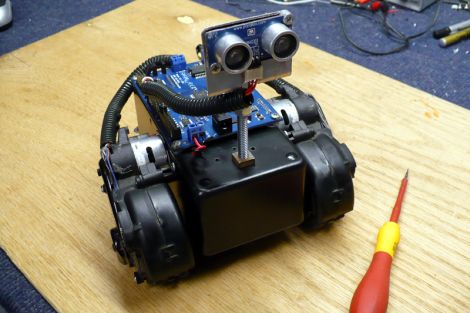
Propeller-based Robot With Basic Object Avoidance

propeller_development_robot

The Parallax Propeller is a pretty powerful MCU as [Dino] recently discovered in his latest Hack a Week installment. He wanted to build a simple robotics platform that he could use for testing out various sensors, and he figured he might as well learn about a different type of micro controller in the process.

He pieced together his robot using a pair of old Roomba motors he had sitting around, mounting them on a standard RadioShack project box. A Propeller MSR1 control board runs the show, and a Propeller PING sensor is used to get an idea of what the robot’s surroundings look like. He is an admitted newbie when it comes to using Propeller micro controllers, but [Dino] was able to give his robot some rudimentary object avoidance abilities fairly easily. A few small bugs aside, he had the robot up and running in short order, a testament to how easy it is to work with the Propeller platform.

Stick around to see a brief video covering the robot’s construction we have embedded below.

Continue reading “Propeller-based Robot With Basic Object Avoidance”

The Party Popper “Security” Robot

This “security” robot is based around the Lego Mindstorms NXT platform. As shown in the video after the break, this robot is capable of firing a “popper” at any intruder the owner of the robot sees fit.  It takes a decent amount of force to fire a popper, so this is pretty impressive with a Lego components by itself. If you’ve been looking for components to build your next robot, Lego might be worth a look.

This bot also features, according to the 14 year old Australian that built this, an HD webcam person ID system that sends him an email when it sees someone.  It uses bluetooth for control. Lego designs have come a long way since the grey castles some of you may have built in the 80s and 90s. Be sure to check out the video after the break. Continue reading “The Party Popper “Security” Robot”

Modifying A Cheap Robot Arm For Arduino Control

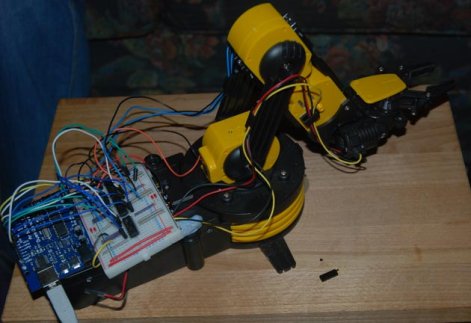
Many a hacker has put together one of those cheap $30 robot arm kits you can get in just about any store with a section labeled, “science”.  In an ongoing search for a cheap robot arm, [Larry] decided to modify one of them to be controlled with a PC through an Arduino. The article doubles as a really basic tutorial on dc motor control. On the site he gives a brief explanation of how to use H-bridges and a good explanation of how he wired them up for this purpose. He eventually goes on to add a processing interface to the project. The next step would be figuring out how to add some kind of position feedback, such as encoders. Though, if modifying an arm is not your style, [Larry] has another cool article on rolling your own robot arm cheaply with some foam board and hobby servos.

The WALL-E Robot

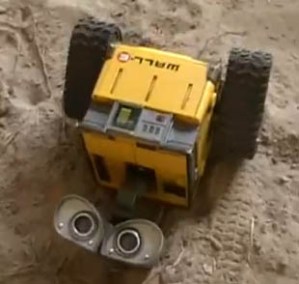
[Dino’s] latest Hack a Week project, the WALL-E Robot shows quite simply what you can create from a few dollars worth of toys from garage sales and cheap stores. When he found the WALL-E toy at a garage sale, Dino decided that he had to give it a brain. Using the geared motors from some Rumble Robots, the H-bridges from some $5 remote control cars (after his own H-bridges cooked themselves), an ultrasonic sensor and an Arduino, WALL-E was brought to life.

The WALL-E Robot might not be the brightest bot, or the most stable, but the project definitely demonstrates some effective scrounging for parts that would have done WALL-E proud. It also shows how even the most simple projects can cause the most headaches when they don’t go right. Check out the video after the break for the build details, a demonstration and to see a man talk to a toy robot.

Continue reading “The WALL-E Robot”

AVRcam For Small Robot Machine Vision

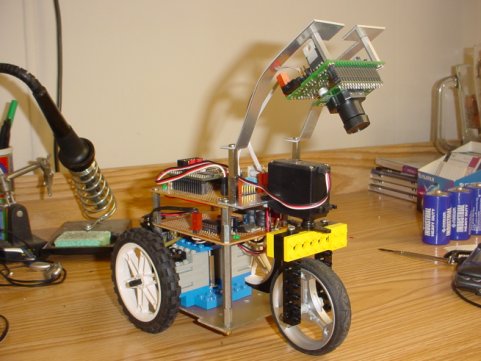
It’s neat how a project from 2004 can still be relevant if it’s done really well. This is the case with AVRcam.  It uses an Atmel AVR mega8 and can do some pretty impressive things, like track up to eight objects at 30fps. The hardware and software is also open source, so it should be possible to build one yourself. There are many projects like it on the internet, though often they require much beefier hardware. Although, these days you can fit a computer inside a match box, so we see more and more projects just throwing a full USB camera on a robot to do simple things like line following.  It’s debatable which solution is more elegant, but maybe not which one is more impressive.