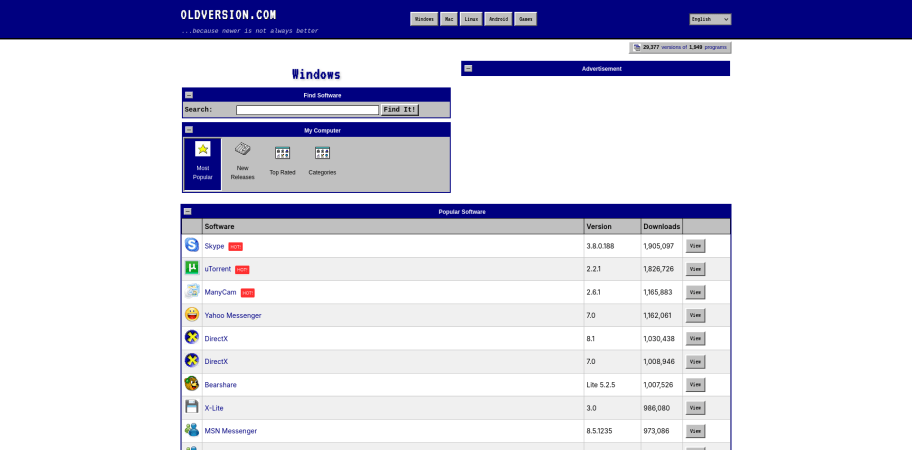
OldVersion Is Back, And Better Than Ever

You know what they say — you can’t keep a good website down. OldVersion.com, the repository of outdated software that has been serving up old versions of tools you need for the last twenty-five years, is not going away as we reported last year. Not only is it sticking around, it’s gotten a retro facelift inspired by Windows 3.1 or OS/2. Mostly Windows, given the screensaver, but we’ll let you find that for yourself.

We’re thrilled to see that OldVersion has gotten the support they need to keep going after running into financial troubles. According to founder Alex Levine, some of that support came as a result of the Hackaday article reporting on the then-upcoming closure, so kudos to you guys for stepping up.

While we absolutely love the retro redesign of the new website, that’s one thing notably lacking — an obvious donation button. Well, that and old-school HTTP support so you can get on with your retromachines, but that, at least, is in the works according to the site roadmap. It’s a little weird that in this year of the common era 2026 you have to do extra work to give up on HTTPS functionality, but it is the way it is.

In the meantime, the site is fully usable as long as you have HTTPS capability, or go through a proxy. Perhaps you could use this ESP8266 code to get started making one, if you don’t want to embarrass your old computer by using something more powerful than it as a pass-through.

Speaking of proxies, if old versions of software aren’t enough for you, how about an old version of the internet? We heard you like old versions, so you can visit an old version of OldVersion!


Note that if you’re reading this after 01/04/2026, the look-and-feel of OldVersion.com may not match what’s depicted here.


OldVersion.com Archive Facing Shutdown Due To Financing Issues

Finding older versions of particular software can be a real chore, all too often only made possible by the sheer grace and benevolence of their creators. At the same time older versions of software can be the only way to dodge undesirable ‘upgrades’, track down regressions, do historical research, set up a retro computer system, and so on. This is where an archive like OldVersion.com (HTTP only so your browser may shout at you) is incredibly useful, offering thousands of installers for software covering a number of platforms.

Unfortunately, as noted on the website, they recently lost their main source of income in the form of Google advertising. This means that after launching in 2001, this archive may soon have to be shut down before long. Confusingly, trying to visit the blog throws a HTTP 503 error, and visiting the forum currently forces a redirect to a random news site unless you can mash that Esc button really fast, perhaps as alternative advertising partners are being trialed, or due to a hack.

Although these days we have sites like Archive.org to do more large scale archiving, OldVersion.com is special for being focused and well-organized, along with a long and rich history that would be a shame to lose. We have referenced the site in the past for old versions as far back as 2008. Hopefully we’ll soon find out more about what is going on with the archive and what its future will be.

Thanks to [Philip Perry] for the tip.

Video Game Preservation – Stop Killing Games!

It’s been an ongoing issue for years now. People who buy video games, especially physical copies, expect to be able to play that game at their leisure, no matter how old their console gets. This used to be a no-brainer: think about the SNES or Genesis/Mega Drive from the late 80s and early 90s. You can still buy one today and play the games without any issues. Not so with many modern, internet-connected games that rely on communication with servers the publishers own, whether or not the online features are necessary for gameplay. Stop Killing Games is a new initiative in the EU and worldwide to get enough valid petition signatures to force the issue to be brought up in parliaments all over the world, including the EU Parliament.

An increasing number of videogames are sold as goods, but designed to be completely unplayable for everyone as soon as support ends. The legality of this practice is untested worldwide, and many governments do not have clear laws regarding these actions. It is our goal to have authorities examine this behavior and hopefully end it, as it is an assault on both consumer rights and preservation of media.

StopKillingGames.com

Why now? Well, Ubisoft recently killed a popular videogame called The Crew by taking down the servers that support the game. Without these servers, the game is completely useless. France and many other European countries have strong consumer protection laws which, in theory, should prevent companies from pulling stunts like this, but this particular situation has never been tested in court. Besides this, the group are also petitioning governments around the world, including France (where Ubisoft is based), Germany, Canada, the UK, the US, Australia, and Brazil, and also options for anywhere else in the EU/world.

If you’re a gamer, and especially if you play video games which use online components, it’s definitely worth reading through their website. The FAQ section in particular answers a lot of questions. In any case, we wish them luck as the preservation of media is a very important topic!

[Thanks to Jori for the tip!]

Examples of ZX81 computer game screens

The Labor Of Love That Is Recovering Lost Software

At the beginning of the home computer revolution, the humble compact cassette was far and away the most popular choice for microcomputer data storage, especially on the European continent. As a volunteer at the Museum of Computing, [Keith] was instrumental in recovering and archiving the early works of Roger Dymond, a pioneering developer of early computer software in the United Kingdom.

In his video, [Keith] goes to great lengths detailing the impact that Roger Dymond had on the early home computing scene. After being let go from his council apprenticeship, Roger turned his attention to developing games for the ZX81, and later the ZX Spectrum. With the help of his family, he went on to run a moderately successful mail-order games publishing venture for several years. Increasing advertising costs and a crowded development scene saw Roger’s business become nonviable by 1983, but not before developing several gambling-style games and a standout Space Invaders clone.

Fast forward to 2021, and while some of Roger’s Spectrum software had been archived, much had been marked as ‘missing’ by online archivists. After further research, [Keith] realized that another potentially important tape had been forgotten about. ‘Games Compendium’ for the ZX81 had been completely lost to time, with the only evidence that it had ever existed coming from a 1983 advert in ‘Sinclair User’ magazine. Being written for the earlier model ZX81, the compendium would undoubtedly be of interest to software archivists and game historians.

Continue reading “The Labor Of Love That Is Recovering Lost Software”