
Reverse-Engineering A Handheld Car Tire Pressure Gauge

The SDIC 8-bit MCU. (Credit: electronupdate, YouTube)

In this wonderful world of MEMS technology, sensor technology has been downsized and reduced in cost to the point where you can buy a car tire pressure sensor for less than $3 USD on a site like AliExpress. Recently [electronupdate] got his mittens on one of these items to take a look inside, and compare it against his trusty old mechanical tire pressure gauge.

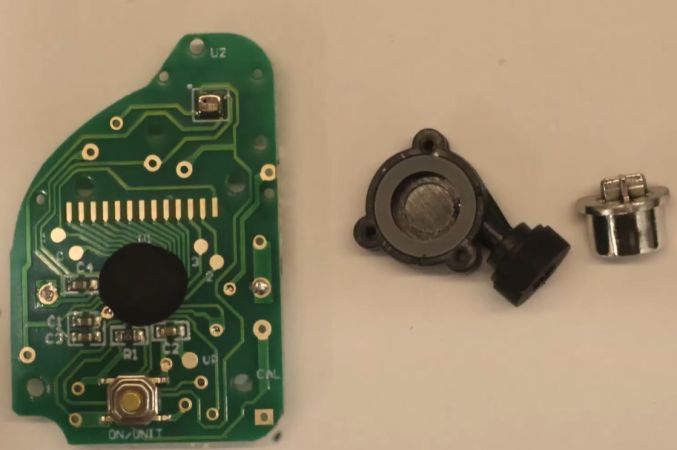
Perhaps unsurprisingly, there isn’t a whole lot inside these devices once you pop them open to reveal the PCB. The MEMS device is a tiny device at the top, which has the pressurized air from the tire guided to it. The small hole inside the metal can leads to the internals that consist of a thin diaphragm with four piezoresistors that enable measurements on said diaphragm from which pressure can be determined.

Handling these measurements and displaying results on the small zebra connector-connected LCD is an 8-bit MCU manufactured by Chinese company SDIC. Although the part number on the die doesn’t lead to any specific part on the SDIC site, similar SDIC parts have about 256 bytes of SRAM and a few kB of one-time programmable ROM.

This MCU also integrates the clock oscillator, thus requiring virtually no external parts to work. Finally, its sigma-delta ADC interacts with the MEMS device, rounding out a very simple device that’s nevertheless more than accurate enough for a spot check as well as quite portable.

Continue reading “Reverse-Engineering A Handheld Car Tire Pressure Gauge” →
Teardown Of A 2026 LEGO SMART Brick

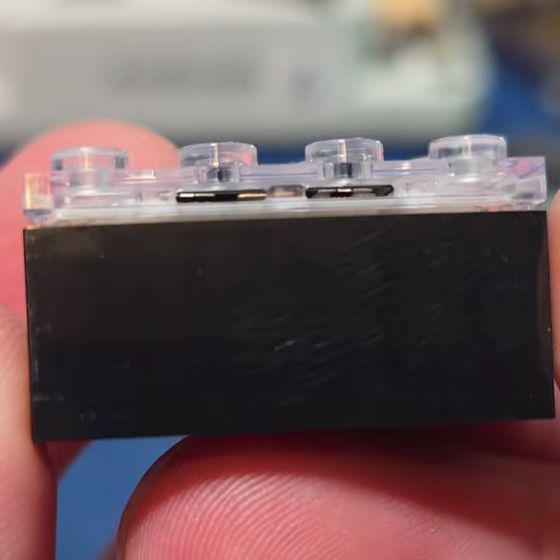
LEGO SMART brick from its side. (Credit: EvilmonkeyzDesignz, YouTube)

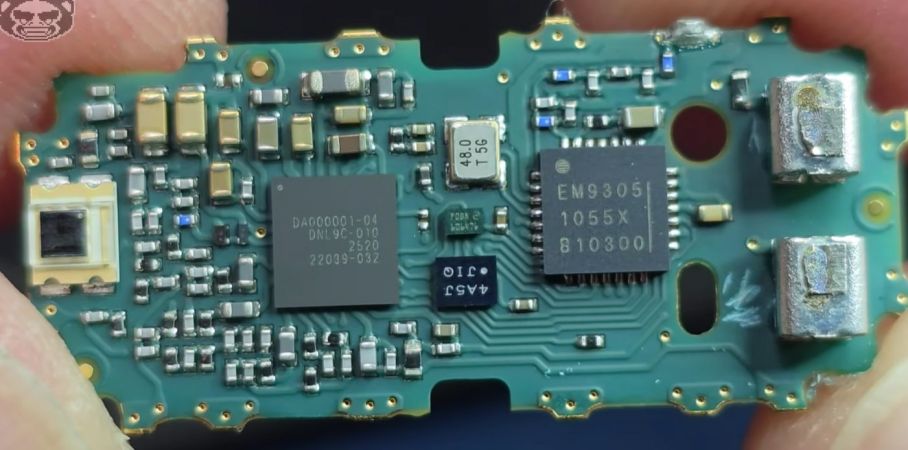
At the beginning of March this year LEGO released their new SMART brick, which looks like a 2×4 stud brick and is filled to the brim with sensors, LEDs, NFC and Bluetooth functionality, as well as a purported custom ASIC. The central idea behind it appears to be to add a lot of interactivity to LEGO builds while allowing for mesh-style communication with other SMART bricks. Naturally, this makes it a great subject for a teardown, which is what [EvilmonkeyzDesignz] over on YouTube did in a recent video.

Normally the only way you can purchase one of these new bricks is by buying them as part of a ‘Smart Play’ set, but someone was selling singular bricks on EBay. As the brick is inductively recharged, it’s pretty well-sealed, requiring a fairly destructive opening method.

Directly below the transparent top is a speaker, with the opposing PCB on the main body containing a microphone as well as a number of RGB LEDs. On the opposite side of this PCB we find the photo sensor, but to get to this part of the PCB the copper wires that wrap around the entire main assembly have to be disconnected from the PCB’s side pads with some force as they’re apparently pressed in place without the use of solder.

Continue reading “Teardown Of A 2026 LEGO SMART Brick” →

AirTag Has Hole Behind The Battery? It’s Likely Been Silenced

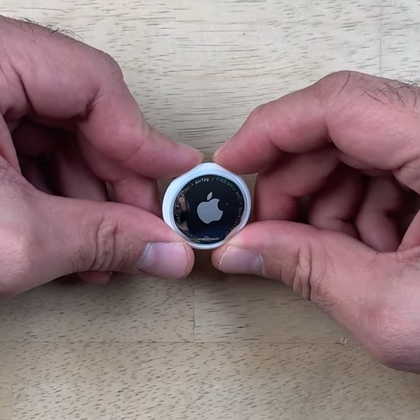
Apple AirTags have speakers in them, and the speaker is not entirely under the owner’s control. [Shahram] shows how the speaker of an AirTag can be disabled while keeping the device watertight. Because AirTags are not intended to be opened or tampered with, doing so boils down to making a hole in just the right place, as the video demonstrates.

By making a hole in just the right place, the speaker can be disabled while leaving water resistance intact.

How does putting a hole in the enclosure not compromise water resistance? By ensuring the hole is made in an area that is already “inside” the seal. In an AirTag, that seal is integrated into the battery compartment.

Behind the battery, the enclosure has a small area of thinner plastic that sits right above the PCB, and in particular, right above the soldered wire of the speaker. Since this area is “inside” the watertight seal, a hole can be made here without affecting water resistance.

Disabling the speaker consists of melting through that thin plastic with a soldering iron then desoldering the (tiny) wire and using some solder wick to clean up. It’s not the prettiest operation, but there are no components nor any particularly heat-sensitive bits in that spot. The modification has no effect on water resistance, and isn’t even visible unless the battery is removed.

In the video below, [Shahram] uses a second generation AirTag to demonstrate the mod, then shows that the AirTag still works normally while now being permanently silenced.

Continue reading “AirTag Has Hole Behind The Battery? It’s Likely Been Silenced” →

Teardown Of Boeing 777 Cabin Pressure Control System

Modern passenger airliners are essentially tubes-with-wings, they just happen to be tubes that are stuffed full with fancy electronics. Some of the most important of these are related to keeping the bits of the tube with humans inside it at temperatures and pressures that keeps them alive and happy. Case in point the Boeing 777, of which [Michel] of Le Labo de Michel on YouTube recently obtained the Cabin Pressure Control System (CPCS) for a teardown.

The crucial parts on the system are the two Nord-Micro C0002 piezo resistive pressure transducers, which measure the pressure inside the aircraft. These sensors, one of which is marked as ‘backup’, are read out by multiple ADCs connected to a couple of FPGAs. The system further has an ARINC 429 transceiver, for communicating with the other avionics components. Naturally the multiple PCBs are conformally coated and with vibration-proof interconnects.

Although it may seem like a lot of hardware just to measure air pressure with, this kind of hardware is meant to work without errors over the span of years, meaning significant amounts of redundancy and error checking has to be built-in. Tragic accidents such as Helios Airways Flight 522 involving a 737-300 highlight the importance of these systems. Although in that case human error had disabled the cabin pressurization, it shows just how hard it can be to detect hypoxia before it is too late.

Continue reading “Teardown Of Boeing 777 Cabin Pressure Control System” →

Hackaday Links Column Banner

Hackaday Links: December 21, 2025

It’s amazing how fragile our digital lives can be, and how quickly they can fall to pieces. Case in point: the digital dilemma that Paris Buttfield-Addison found himself in last week, which denied him access to 20 years of photographs, messages, documents, and general access to the Apple ecosystem. According to Paris, the whole thing started when he tried to redeem a $500 Apple gift card in exchange for 6 TB of iCloud storage. The gift card purchase didn’t go through, and shortly thereafter, the account was locked, effectively bricking his $30,000 collection of iGadgets and rendering his massive trove of iCloud data inaccessible. Decades of loyalty to the Apple ecosystem, gone in a heartbeat.

Continue reading “Hackaday Links: December 21, 2025” →

Teardown Of A 5th Generation Prius Inverter

The best part about BEV and hybrid cars is probably the bit where their electronics are taken out for a good teardown and comparison with previous generations and competing designs. Case in point: This [Denki Otaku] teardown of a fifth-generation Prius inverter and motor controller, which you can see in the video below. First released in 2022, this remains the current platform used in modern Prius hybrid cars.

Compared to the fourth-generation design from 2015, the fifth generation saw about half of its design changed or updated, including the stack-up and liquid cooling layout. Once [Otaku] popped open the big aluminium box containing the dual motor controller and inverters, we could see the controller card, which connects to the power cards that handle the heavy power conversion. These are directly coupled to a serious aluminium liquid-cooled heatsink.

At the bottom of the Prius sandwich is the 12VDC inverter board, which does pretty much what it says on the tin. With less severe cooling requirements, it couples its heat-producing parts into the aluminium enclosure from where the liquid cooling loop can pick up that bit of thermal waste. Overall, it looks like a very clean and modular design, which, as noted in the video, still leaves plenty of room inside the housing.

Regardless of what you think of the Prius on the road, you have to admit it’s fun to hack.

Continue reading “Teardown Of A 5th Generation Prius Inverter” →

The Fascinating Waveguide Technology Inside Meta’s Ray-Ban Display Glasses

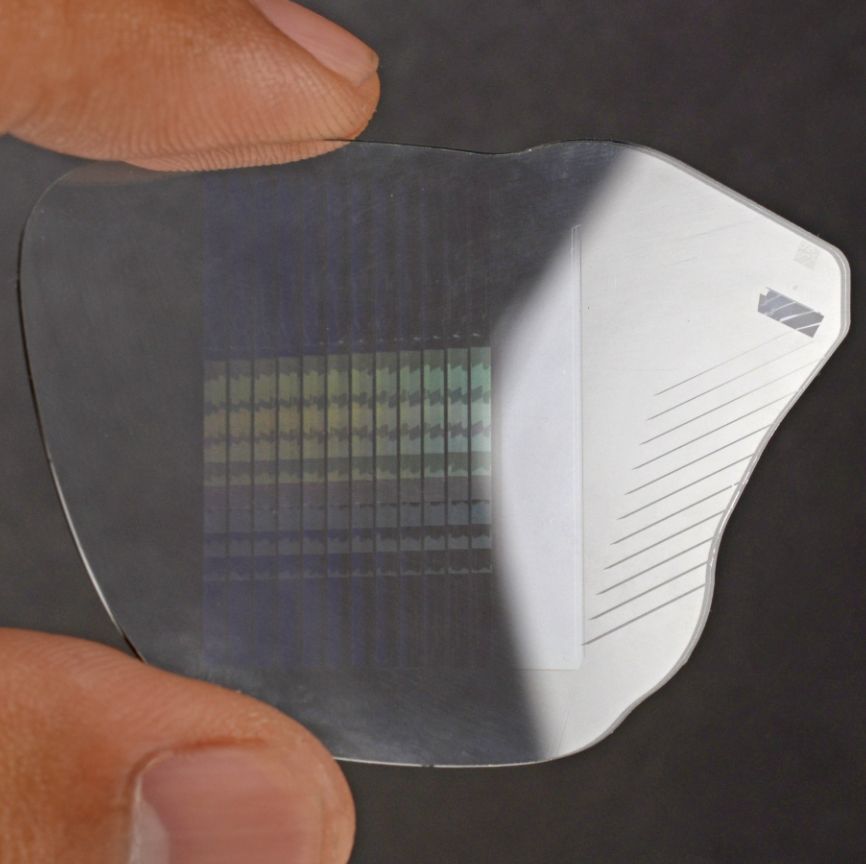
The geometric waveguide glass of the Meta Ray-Ban Display glasses. (Credit iFixit)

Recently the avid teardown folk over at iFixit got their paws on Meta’s Ray-Ban Display glasses, for a literal in-depth look at these smart glasses. Along the way they came across the fascinating geometric waveguide technology that makes the floating display feature work so well. There’s also an accompanying video of the entire teardown, for those who enjoy watching a metal box cutter get jammed into plastic.

Overall, these smart glasses can be considered to be somewhat repairable, as you can pry the arms open with a bit of heat. Inside you’ll find the 960 mWh battery and a handful of PCBs, but finding spare parts for anything beyond perhaps the battery will be a challenge. The front part of the glasses contain the antennae and the special lens on the right side that works with the liquid crystal on silicon (LCoS) projector to reflect the image back to your eye.

While LCoS has been used for many years already, including Google Glass, it’s the glass that provides the biggest technological advancement. Instead of the typical diffractive waveguide it uses a geometric reflective waveguide made by Schott, with the technology developed by Lumus for use in augmented reality (AR) applications. This is supposed to offer better optical efficiency, as well as less light leakage into or out of the waveguide.

Although definitely impressive technology, the overall repairability score of these smart glasses is pretty low, and you have to contest with both looking incredibly dorky and some people considering you to be a bit of a glasshole.

Continue reading “The Fascinating Waveguide Technology Inside Meta’s Ray-Ban Display Glasses” →