Catching Those Old Busses

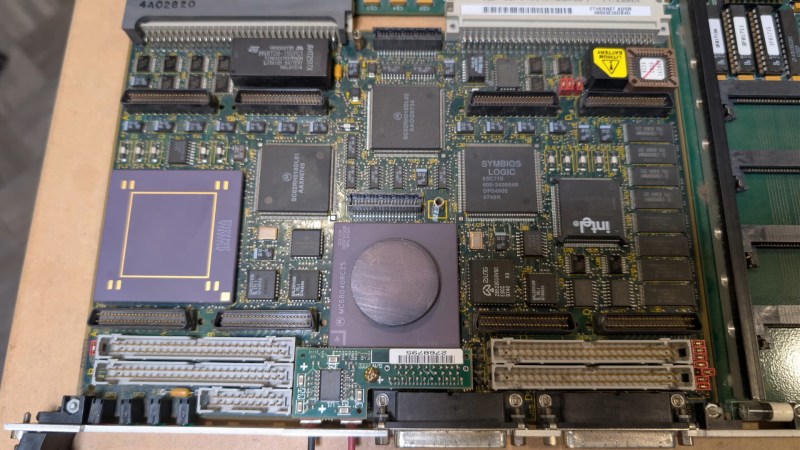
The PC has had its fair share of bus slots. What started with the ISA bus has culminated, so far, in PCI Express slots, M.2 slots, and a few other mechanisms to connect devices to your computer internally. But if the 8-bit ISA card is the first bus you can remember, you are missing out. There were practically as many bus slots in computers as there were computers. Perhaps the most famous bus in early home computers was the Altair 8800’s bus, retroactively termed the S-100 bus, but that wasn’t the oldest standard.

There are more buses than we can cover in a single post, but to narrow it down, we’ll assume a bus is a standard that allows uniform cards to plug into the system in some meaningful way. A typical bus will provide power and access to the computer’s data bus, or at least to its I/O system. Some bus connectors also allow access to the computer’s memory. In a way, the term is overloaded. Not all buses are created equal. Since we are talking about old bus connectors, we’ll exclude new-fangled high speed serial buses, for the most part.

Tradeoffs

There are several trade-offs to consider when designing a bus. For example, it is tempting to provide regulated power via the bus connector. However, that also may limit the amount of power-hungry electronics you can put on a card and — even worse — on all the cards at one time. That’s why the S-100 bus, for example, provided unregulated power and expected each card to regulate it.

On the other hand, later buses, such as VME, will typically have regulated power supplies available. Switching power supplies were a big driver of this. Providing, for example, 100 W of 5 V power using a linear power supply was a headache and wasteful. With a switching power supply, you can easily and efficiently deliver regulated power on demand.

Some bus standards provide access to just the CPU’s I/O space. Others allow adding memory, and, of course, some processors only allow memory-mapped I/O. Depending on the CPU and the complexity of the bus, cards may be able to interrupt the processor or engage in direct memory access independent of the CPU.

In addition to power, there are several things that tend to differentiate traditional parallel buses. Of course, power is one of them, as well as the number of bits available for data or addresses. Many bus structures are synchronous. They operate at a fixed speed, and in general, devices need to keep up. This is simple, but it can impose tight requirements on devices.

Continue reading “Catching Those Old Busses”

Fancy Adding A Transputer Or Two To Your Atari ST?

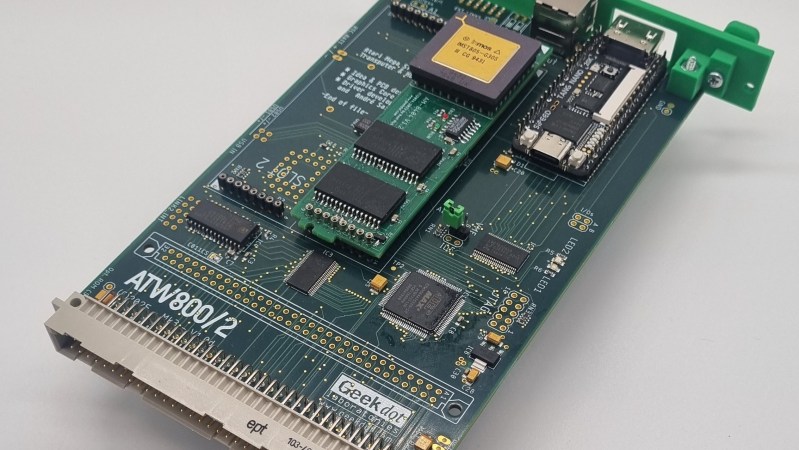
Has anybody heard of the ATW800 transputer workstation? The one that used a modified Atari ST motherboard as a glorified I/O controller for a T-series transputer?  No, we hadn’t either, but transputer superfan [Axel Muhr] has created the ATW800/2, an Atari Transputer card, the way it was meant to be.

The transputer was a neat idea when it was conceived in the 1980s. It was designed specifically for parallel and scientific computing and featured an innovative architecture and dedicated high-speed serial chip-to-chip networking. However, the development of more modern buses and general-purpose CPUs quickly made it a footnote in history. During the same period, a neat transputer-based parallel processing computer was created, which leveraged the Atari ST purely for its I/O. This was the curious ATW800 transputer workstation. That flopped as well, but [Axel] was enough of a fan to take that concept and run with it. This time, rather than using the Atari as a dumb I/O controller, the card is explicitly designed for the Mega-ST expansion bus. A second variant of the ATW800/2 is designed for the Atari VME bus used by the STe and TT models—yes, VME on an Atari—it was a thing.

Continue reading “Fancy Adding A Transputer Or Two To Your Atari ST?”

Visual Mandela Effect: You Don’t Know Iconic Images As Well As You Think

Pop quiz, hotshot: does the guy on the Monopoly box (standard edition) wear a monocle? Next question: does the Fruit of the Loom logo involve a cornucopia? And finally, does Pikachu have a black-tipped tail? If you answered yes to any of these, I am sad to say that you are wrong, wrong, wrong.

So, what’s the deal? These are all examples of the visual version of the Mandela effect (VME), which is named after the common misconception/mass false memory that anti-Apartheid activist Nelson Mandela died decades ago in prison, despite leading South Africa in the latter half of the ’90s and living until 2013. Many people even claim having seen TV coverage of his funeral, or say they learned about his death in school during Black History Month. The whole thing has VICE wondering whether CERN is causing these mass delusions somehow with the LHC.

The more attention VME gets, the more important it seems to be to study it and try to come to some conclusion. To that end, University of Chicago researchers Deepasri Prasad and Wilma A. Bainbridge submitted an interesting and quite readable study earlier this year purporting that the VME is ‘evidence for shared and specific false memories across people’. In the study, they conducted four experiments using crowd-sourced task completion services.

Continue reading “Visual Mandela Effect: You Don’t Know Iconic Images As Well As You Think”