Gaming on an IBM XT using an NES controller

posted Dec 24th 2010 7:27am by
filed under: nintendo hacks, pcs hacks, peripherals hacks

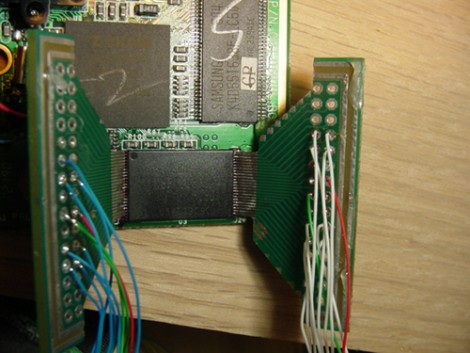
[Frode] felt that using the keyboard for gaming on his old IBM XT computer was simply too noisy. He came up with a much quieter way to game by building an XT adapter for an original NES controller. If you haven’t explored the communication protocol used by the NES peripherals this is a great way to learn. Inside you’ll find a CMOS shift register that captures button states when it receives a latch signal. With that in mind [Frode] came up with a circuit to gather the bits from the controller, and generate input commands using the XT keyboard protocol without using a microcontroller. All of this is explained in the demo after the break.

Most of the NES controller hacks we see permanently alter the hardware. It’s nice to see one used without cracking it open.

Read the rest of this entry »

Repairing a broken RC ceiling fan

posted Dec 23rd 2010 12:54pm by
filed under: home hacks, repair hacks

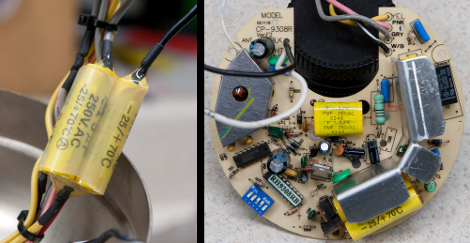
The ceiling fan in [Steve Vigneau's] bedroom started giving him trouble. It is normally operated using a remote control but that functionality had become pretty spotty. He cleaned the contacts on the remote but still had troubles that could only be fixed by power-cycling the fan itself. When it finally died he set out to repair the unit himself. Above you can see the controller board from the fan. It was a bit too complicated for [Steve] to troubleshoot so he figured why not just stop using the remote control and make it work with a couple of switches? A bit of research led him to some basic fan schematics that he used for a reference. He need to remove a couple of capacitors and wire them up with one switch for the fan and another for the light. Sure, there’s no settings for speed or direction, but [Steve] thinks he doesn’t need to change them and always has the option to add them in the future.


Cobbling together a CNC mill

posted Dec 23rd 2010 9:31am by
filed under: cnc hacks

[Howard Matthews] never throws anything away, and because of it he was able to build this CNC mill using parts that he already had on hand. He pulled stepper motors out of broken stage light, precision rod and bearings from old dot matrix printers, and other various bits from his junk bin. We’ve seen [Howie's] handi-work before, and this project is just as fun as his Land Rover’s replacement speedometer. Some highlights include manufacturing the nuts for the precision rod, and building a rail system for the bed of the machine. The latter looks a bit suspect, as any milling debris on the rails will cause you Z-axis problems, but now that he has bootstrapped a working mill perhaps he’ll machine an upgrade.

Update: Fixed the link, added video after the break.

Read the rest of this entry »

Teensy can school you at Guitar Hero

posted Dec 23rd 2010 7:17am by
filed under: playstation hacks

[Johnny Chung Lee] put together a system that is perfect at playing Guitar Hero. He’s using the PlayStation 2 version and, as you can see above he’s combined a controller connector and a Teensy microcontroller board to communicate with the console using its native SPI protocol. This custom guitar controller receives its signals via USB from a computer that is monitoring the video from the console and calculating the controller signals necessary for perfect gameplay. [Johnny] wrote an OpenCV program that monitors the video, removes the perspective from the virtual fretboard, and analyzes color and speed of the notes coming down the screen.

As you can see after the break it works like a charm. It’s fun from a programming standpoint, but if you want a hack you can actually play maybe you should build your own Banjo Hero.

Read the rest of this entry »

Guerilla guide to CNC machining

posted Dec 22nd 2010 3:09pm by
filed under: cnc hacks

[Ian] wrote in to tell us about the Guerilla Guide to CNC Machining and Resin Casting. He came across it in the reference links to another project and says he wish he knew about it a long time ago. We took a look and there’s a mountain of useful information in the guide, which is written by [Michal Zalewski]. We won’t pretend that we’ve read the whole thing, there’s days worth of information here. But we will. The range of topics includes types of milling machines, milling materials, software options and use, safety, and the list goes on. Bookmark this (don’t forget the second volume), it might be just the thing to get you through the holiday with your family.


Didn’t See The Lunar Eclipse, Make One!

posted Dec 22nd 2010 1:00pm by
filed under: arduino hacks, led hacks

Lunar eclipse simulator

Last night was a lunar eclipse meaning that most people would have been out gazing up at the sky watching it. For some the eclipse evaded them using cloud cover, but instead of giving up, they got innovative. [Garrett] decided to build a moon simulator to keep track of the eclipse using a few spare parts and some quick code. The parts that were required for this project includes an Arduino UNO, a singular ShiftBrite Shield, a ShiftBar, ChronoDot and a Satellite Module 001. This is the perfect project for the Arduino to be used in because he had to toss it together very quickly and it is meant to be a temporary solution. If he were to make this permanent, we would guess that he would make a smaller and more cost effective version of the electronics.  He documents his experience on Macetech.com in more detail and the outcome is pretty amazing. Code is yet to be posted but hopefully it is forthcoming soon as well as a video of the simulator working.

Bi-color LED matrix clock uses point-to-point construction

posted Dec 22nd 2010 11:33am by
filed under: clock hacks

[Daniel] wanted his child to stay in bed until a semi-decent time each morning. The problem is the kid doesn’t know how to read a clock, so [Daniel] built him a clock. Yeah, doesn’t make much sense to us either, but we’ve used our own shaky premises for projects so who are we do judge?

He used a bi-color 8×8 LED matrix as the clock display. What caught our eye is the point-to-point soldering he used for the three strip boards that make up the device. Note the use of a drill-bit to break the traces when needed. Each board has its own purpose; the matrix drive, the logic board, and the power board. A PIC 18F4550 lets [Daniel] control the clock via USB, and takes care of lighting up the hour as a red number when it’s time to sleep, and a green one when it’s okay to arise. There’s a flashing pixel for seconds, and a binary readout of minutes along the bottom.

We’ve asked [Daniel] to post a schematic and an image of the clock face when displaying the time. No word yet but we’ll keep our eye on it. In the mean-time, check out this clock that uses an RGB 8×8 LED matrix.

Add explosive power to your hi-five

posted Dec 22nd 2010 9:00am by
filed under: arduino hacks, wearable hacks

It’s been a while since there was any advances made in the field if celebratory high-five-ing. [Eli Skipp] just finished her contribution, moving the art forward by adding the sound of explosions to her high-fives. Ignore the audio sync problems in the video after the break to see her Arduino and Wave Shield based offering. It uses a flex sensor to detect a high-five and has a bit of software filtering to avoid misfires when moving your hand or setting it down on a flat surface. It may look a bit ridiculous right now because of the bulk, but we could see a sleeker, cheaper version hitting toy and novelty stores everywhere.

Less useful than a sign-language translating glove, but easier to code and some would say more fun too. Read the rest of this entry »


Hack a Day serves up fresh hacks each day, every day from around the web as well as hacking related news.

Send us your hacks


Hacks

Resources