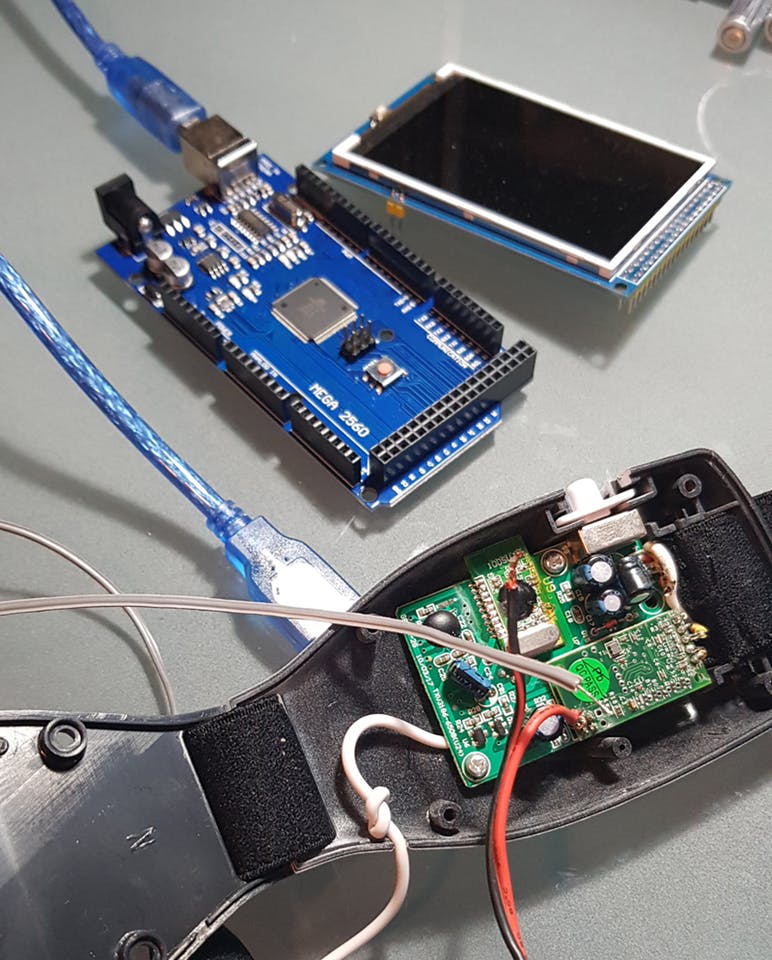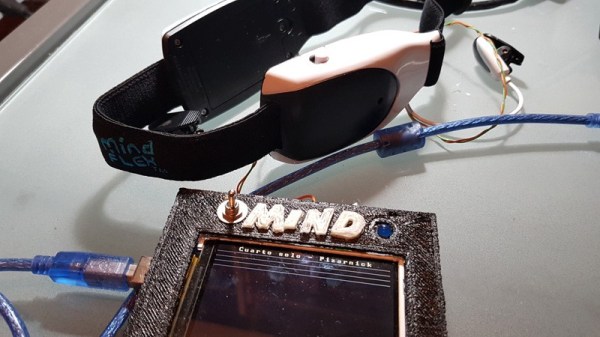
No, really. He is aware of all the thoughts that come and go, but he wanted to know what was going on in his brain below his conscious thought stream. Armed with a MindFlex headset and a Teensy, he set out to decode what really was going on inside his head.
He spent a month crawling 35 million Google profiles, downloading each user’s pictures into a MySQL database. The Teensy was attached to the MindFlex sensor board, and collects all of the headset’s output over a serial connection.
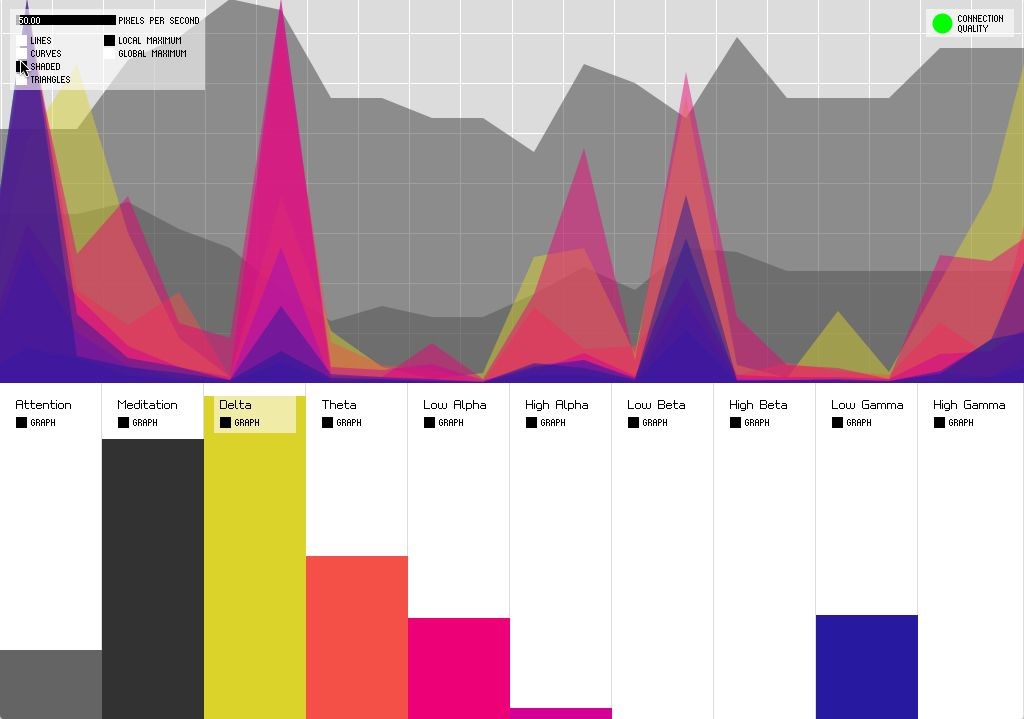
His experiment consisted of flashing each of the profile pictures on his monitor for one second, recording 2 of the 11 available brainwave channels from the MindFlex. These values were then plotted out so that he could visualize the “Attention” and “Meditation” values captured by the headset. At the end of the day he discovered, interestingly enough, that looking at dogs relaxed him the most!
We would love to see what correlations could be drawn from his collected data, and what sorts of “hidden” thoughts are coursing through others’ brains. It could certainly end up being a double-edged sword, uncovering subconscious biases and other such things, but it’s an incredibly intriguing experiment to say the least.
Be sure to check out the video below of the experiment in progress.
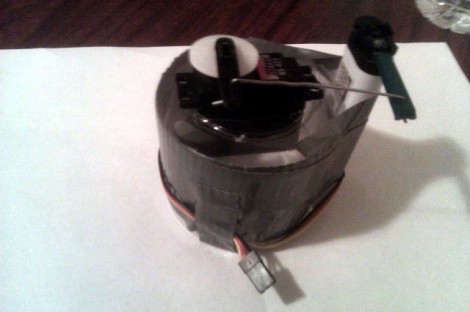
Many will remember the Mindflex from this shockingly awesome hack. But [TechB's] approach follows in the footsteps of this Arduino interface for the device. He’s using the Arduino Brain Library to read data from the head-mounted EEG and sending commands to his own fire control system. Said system is composed of a cigarette lighter and a servo motor. The motor connects to the gas regulator on the lighter, opening it up when you concentrate and closing it when your mind wanders. The result is a higher flame to show more organized brain function. The only problem with the prototype is the burns you’ll get on your thumb from depressing the lighter’s valve while trying to get your thoughts in order.
Check out the video after the break to see this in action. [TechB] is looking a bit like the Borg at the beginning of the clip, making us wonder what other Mindflex hacks he’s already performed.
Master EEG hackers [MOG] and [Tim] over at the Makers Local 256 have been working on creating a Bluetooth EEG listener made from a Mattel Mindflex. This build is based on an earlier build of a group called [Frontier Nerds] (thanks for the heads up [Nathan]!), but this version ditches the Arduino in favor of a basic serial to bluetooth adapter for the sake of power efficiency (as well as not having to keep an Arduino strapped to you head). We have covered a few Mindflex hacks before, but this seems to be the most useful in a practical sense. They have included the code for a Bluetooth serial data logger, and the earlier build shows a good example of captured data visualization.
Finally, a good use for those EEG headsets. [Andrew] has set up a system that will turn his TV on and off if he focuses hard enough. He’s got the software set to trigger an IR LED when the “strength” gets high enough. When the action starts, around 4:30 in the video, you can see that when he raises his arm the meter on the screen begins to raise and the TV turns on. Though not immediately useful, we can’t help but get a little excited seeing him literally turn his TV on with a thought.
Reader [Eric] sent us a powerfully informative, yet super simple hack for the MindFlex toy. Don’t worry, it’s not another worthless shock ‘game’, And it’s using an actual interface instead of the built-in LEDs.
With two wires for the serial protocol, and an Arduino, you’ll be able to view “signal strength, attention, meditation, delta, theta, low alpha, high alpha, low beta, high beta, low gamma, high gamma” brainwaves. While it’s not medical grade, it’s a lot more intuitive than previous interfaces.
The original intent was for a system called MentalBlock, but we’re wondering what would you do with brainwave data?
We love to see eloquent hacks but this isn’t one of them. [Aaron] and his fellow sadists are using a Mindflex game with an electric shocker. If your brain is idle you’ll be fine, but too much activity inside the noggin and you’re in for nasty shock to the arm. Take a look at the video (bleeped but probably NSFW) after the break.
We’ve seen the Mindflex before, they’re using its interface in the same ways we’ve seen the Force Trainer used, by tapping into the LEDs. The shocks are provided by a Qkit, so hopefully there’s enough engineering behind it to keep the ‘contestant’ safe.
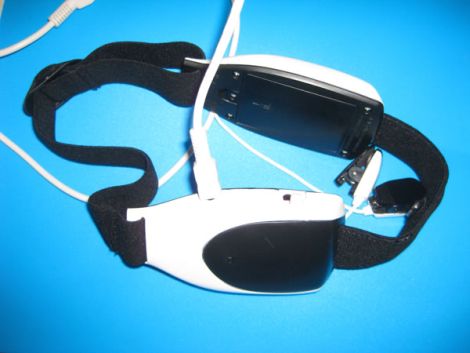
Maybe we’re just imagining things, but it seems to us like brainwave control is the latest trend in toys. Similar to Uncle Milton’s Force Trainer, Mattel has recently released the MindFlex, a game that involves moving a plastic ball up and down through an obstacle course that you control using your brainwaves. Naturally when [Alpha] saw this, he decided to take it apart and document what he found. After disassembling both the headset and the base, he found that most of the chips were covered in black resin making them unidentifiable. However, he was able to find identify one chip, the NeuroSky TGAT1-L64 D498Q-010 0924. Judging by the name alone, we would guess that this is the chip that makes the brainwave control possible. While there’s no mention as to whether you’ll be able to interface with this like you can with the Force Trainer, we’re sure that it’s only a matter of time before someone figures out how to use this to control more than just a floating plastic ball.