Building An RGB Mood Lamp Using An IKEA Mylonit

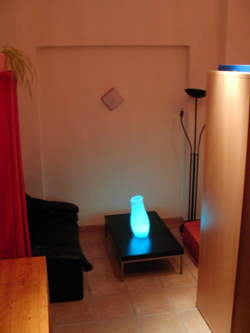
[Toon Beerten] had been experimenting with LED lamp construction. He had already built a pretty neat pyramid of LEDs as a mood lamp but wanted something a little higher quality for his living room. He ran out and picked up an IKEA lamp, which you can see above. From the store, the lamp can only display one color, and has a clear construction. [Toon] wanted RGB and an opaque finish, so he sanded the lamp and built a custom circuit.

He tore out the lamp circuit and replaced it with his own, consisting of a 3W LED, a heatsink, and a PIC 16F628 (and the supporting components). The main circuit actually fits underneath the lamp pretty well. You can download the full schematics and code from his site if you’d like to replicate it.

As you can see in the video, the effect is quite nice.

Continue reading “Building An RGB Mood Lamp Using An IKEA Mylonit”
PCB Manufacturing Tutorial

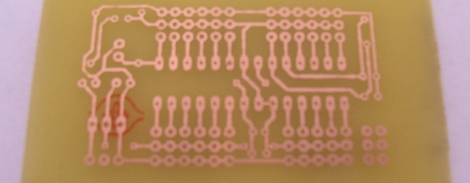
There comes a time in every maker’s career where solderless breadboards won’t do, perfboard becomes annoying, and deadbug is impossible. The solution is to manufacture a PCB, but there’s a learning curve. After learning a few tricks from [Scott]’s awesome DIY PCB guide, it’s easy to make your own printed circuit boards.

There are a few basic steps to making a PCB. First is designing the board in Eagle or KiCad. The next step, putting the design into copper, has a lot of techniques to choose from. Photo transfer, direct printing, and CNC milling have huge benefits, but by far the most common means hobbyists produce boards is with toner transfer using a laminator.

Unless you’re doing SMD-only circuits, a drill is required. Most people can get away with a Dremel or other rotary tool, but Hackaday has a favorite drill press that is perfect for drilling holes in FR-4. In part two of [Scott]’s tutorial, he goes over solder masks, silk screens before jumping into vias. These small bits of copper conducting electricity through a circuit board are extremely hard for the garage-bound builder to achieve on their own, but there are a few solutions – copper rivets (anyone have a US source for these?) and copper foil can be used, but sometimes the most effective solution is just hitting the board with a lot of solder and heat.

Thanks [Upgrayd] for the title pic.

Manga Guide To SMD

For those that have always felt a bit treppidatious when approaching SMD, you can relax. Here’s a simple guide to walk you through your first shaky steps into surface mount devices. Distributed freely under the creative common license, the Manga Guide to SMD is an 18 page comic that has a goal of making SMD producers out of all of us. There’s a good visual explanation of what SMT is and why we use it, as well as a thorough walk through of how to solder the tiny devices with your soldering iron. They don’t go into dealing with a small reflow oven in this issue.

If this fits well with your learning style, you might also be interested in the Manga Guide to Electricity.

Charting The Efficiencies Of Boiling Water

Water takes a lot of energy to heat up. If you’d like evidence of this, simply jump into a 50° F swimming pool on Memorial Day. Despite the difficulty of heating water, that simple act accounts for a lot of industrial processes. From cooking a steak to running a nuclear reactor, there isn’t much that doesn’t involve heating water.

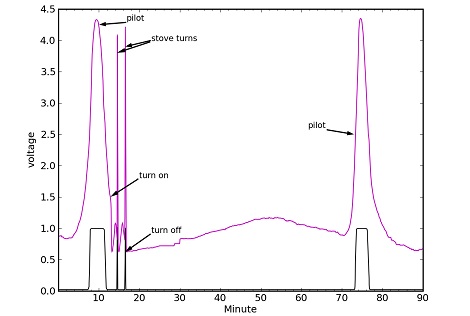
[Tom Murphy], Physics prof at UCSD decided to test out exactly how efficiently he could boil water. Armed with a gas stove, electric kettle, microwave, and a neat laser pointer/photodiode setup on his gas meter to measure consumption, he calculated exactly how much energy he was using to make a cup of tea.

The final numbers from [Tom]’s experiment revealed that a gas stove – using a pot with and without a lid on large and small burners – was about 20% efficient. A gas-powered hot water heater was much better at 55% efficiency, but the microwave and electric kettle had a miserable efficiencies of around 15 and 25%, respectively. There is a reason for the terrible inefficiency of using electricity to heat water; if only the power from the wall is considered, the electric kettle put 80% of energy consumed directly into the water. Because the electricity has to come from somewhere, usually a fossil-fueled power plant that operates at around 30% efficiency, the electric kettle method of turning dinosaurs into hot water is only about 25% efficient.

The take-home from this is there’s a lot of power being wasted every time you run a bath, make some coffee, or wash the dishes. We would all do better by decreasing how much energy we use, much like [Tom]’s efforts in using 5 times less power than his neighbor. Awesome job, [Tom].

[Easton’s] Robot Arm Takes 2nd Place In The International Science And Engineering Fair

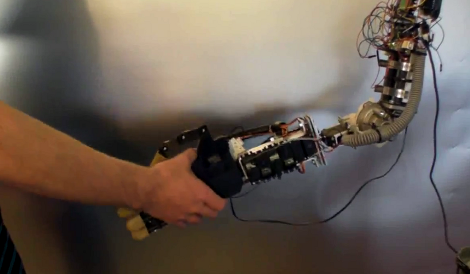
Here we see [Easton LaChappelle] getting a congratulatory handshake from the robotic arm he built. This project is aimed at human prosthetics, and we’re happy to report that [Easton] won second place in Electrical and Mechanical engineering division of this year’s International Science and Engineering Fair (PDF listing the winners).

In the video he gives us a great look of the state of the project. Since we checked in with him last he’s added a body for the arm to mount to. The arm now has shoulder movement, which uses geared DC motors along with some potentiometers for orientation feedback. For the elbow he wanted to have the same setup but ran into trouble mounting the potentiometer. His solution was to use some shapelock to mold a bracket (shapelock is the plastic you melt in water to form any shape). In addition to the aforementioned joints, the wrist, fingers, and hand have all seen improvements in how they are supported and in their performance.

We think this is amazing work for anyone, especially a 16-year-old High School student. Great job [Easton]!

Continue reading “[Easton’s] Robot Arm Takes 2nd Place In The International Science And Engineering Fair”

Shoulder Robot For The Forever Alone

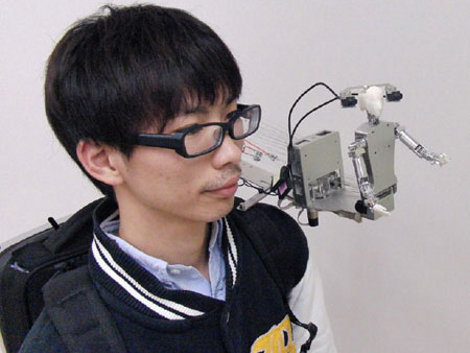
Don’t have anyone to share activities with? Forget Siri, she’s just a disembodied voice in a box. You need to get yourself a shoulder-mounted robot pal.

The idea behind this design actually has something to do with telepresence. Let’s say you and your best friend want to go check out the local Hackerspace. The problem is that you met your best friend on the Internet and they live thousands of miles away. Well just strap on your shoulder robot and have your friend log on. There’s a camera to give him or her feedback, and twenty degrees of freedom lets them control the torso, arms, and head of the bot in a realistic and creepy way. This works much like a marionette, with motors pulling wires to actuate the robot’s movements. You can get a very brief look at this in the clip after the break.

Continue reading “Shoulder Robot For The Forever Alone”

Visualizing Sound Without A Computer

[Emre] sent in a cool art piece he’s been working on that visualizes your voice without the use of a microcontroller.

The project is called Visible Voice only consists of a laser, mirror, audio speaker and a phosphorescent disk. The laser shines onto a mirror mounted on the speaker and is reflected onto the disk. When an audio signal is played through the speaker, the light bounces off the mirror and produces a waveform on the disk. Think of it as the lowest tech way of building a model of a CRT; the laser is the electron gun and the speaker is a deflection coil.

Right now, [Emre]’s project displays a waveform along a circular path on the slowly rotating phosphorescent disk. Anyone wanting to copy this project could use a moving belt of the same material giving a much more linear (and straighter) waveform trace.

After the break you can see [Emre]’s friend [Ivan] testing out the glowing laser waveform visualizer.

Continue reading “Visualizing Sound Without A Computer”