Hackerspace Intros: Null Space Labs In Los Angeles California

[Charlie] from Null Space Labs in Los Angeles, California sent in this fun little video as an introduction to their hackerspace. Going a bit  askew from the traditional “walk through” method of a tour, they decide to first attempt semi-successfully to fly a quadcopter, film some police commotion, then show off some projects in progress. Don’t worry, you do get to see a fair bit of the space and the copious piles of parts as well.

You may recall seeing some of the previous projects coming from this hackerspace  such as the time red bull sent them a mystery object and how they salvaged a pick and place machine.

Remember, we want to promote all the hackerspaces we can! We don’t care if you’re just 3 hackers in a basement with a single project, a multimillion dollar facility, or anything in between. Send us those video tours!

Continue reading “Hackerspace Intros: Null Space Labs In Los Angeles California”
Reverse Engineering A Plasma Dot Matrix Display

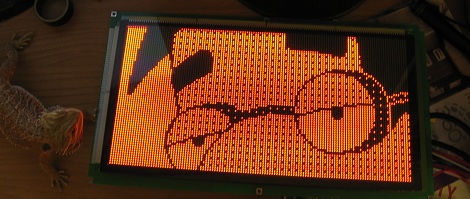
A while back, [DragonMinded] picked up a bunch of old arcade and pinball parts from a guy on Craigslist. These parts sat around for a while until a really neat plasma dot matrix display was found in the corner of a box in his garage. Doing the only reasonable thing, [DragonMinded] figured out how to interface this ancient display with a microcontroller.

After extensive Internet research on his display, [DragonMinded] could only find a one page datasheet for his APD-128G064A-1 display. Luckily, this datasheet had voltage requirements, and since the display only had six input pins he could probe the circuit to see what goes where.

After generating a crude schematic, [DragonMinded] prototyped a driver circuit with an Arduino. When the function of each pin was discovered, the Arduino libraries were discarded and replaced with raw register access.

It was a fair amount of work, but [DragonMinded] eventually got to the point where he could draw anything he wanted on the screen. Next on the to-do list is turning it into a terminal or Twitter machine, as with all good display hacks.

Turning A Light Off Over The Internet

Because reaching over a few feet to turn off a switch is too much to bear for [Bruce], he connected his desk lamp to the Internet. It’s a pretty cool build that’s the perfect tutorial for connecting just about anything to the internet.

For his build, [Bruce] used an Arduino with a relay attached to an output pin. When the Arduino receives a signal on its serial port, a tiny voltage is applied to the relay, turning on the light.

This could have been done with an Arduino Ethernet, but the PHP script [Bruce] went with is a little more versatile. Whenever someone pulls up this digital light switch web page, they can turn [Bruce]’s desk lamp on and off.

For an introduction to connecting bare bones projects to the Internet, we’re really liking [Bruce]’s build. Just try no to go crazy with that link and leave the failure testing to the professionals. You can check out the demo video after the break.

Continue reading “Turning A Light Off Over The Internet”

Meet Stompy, Your New Robotic Overlord

In case you weren’t already depressed about not starting a summer project already, a couple of guys are building a gigantic rideable hexapod they call Stompy.

The project leaders, [Gui Cavalcanti], [Dan Cody], and [James Whong] have worked on a few crazy robotics projects before like PETMAN and BigDog. Stompy won’t be a military-backed project like the others (we sincerely hope), so they’re enlisting the help of fellow makers at Artisan’s Asylum to complete a 15-foot diameter, 1-2 ton rideable hexapod before the end of August.

Right now, the team is still in the planning and preliminary testing stages. So far, they’ve built a 1/2 scale model of one leg to figure out the control systems, and getting the repurposed forklift motor up and running. It may not look like much now, but we’re sure the team is going to have a very fun time building Stompy.

You can check out the updates and progress of Stompy on the Project Hexapod blog

A Fantastic Acrylic Light Display

As a retired industrial designer, [Dave] has a lot of time to do what we’d all like to do: sit around in a workshop and make stuff. His latest project, an acrylic light display of an Indian motorcycle looks fantastic and betrays his designer heritage.

The base of the light display is made up of a laminate of a few 1/4″ pieces of Poplar carved on [Dave]’s CNC machine. These pieces were glued together with a slot routed into the top for the arcylic panel. Instead of going with a few LEDs for the light source, [Dave] used a small cold cathode fluorescent lamp with the requisite inverter tucked away inside the base. This is the same setup he used in an earlier project, and judging from that the Indian motorcycle display looks great on the inside.

After giving the wooden base a few coats of lacquer, [Dave] milled a piece of acrylic with an Indian motorcycle motif he created himself. It’s a great piece of work, sure to brighten up his very awesome workshop.

Using An NES Controller With An Atari 2600

Instructibles user [Danjovic] managed to get his hands on an Atari 2600, but all the joysticks were damaged beyond repair. Instead of building an atari joystick from scratch, he looked to a slightly newer generation of gaming and decided to us an NES controller instead. This was done fairly easily with the aide of an Arduino.

This seems like a nice easy mod that could breathe a little new life into some old games, but we just can’t imagine playing without that original joystick!

Arduino Can Program PIC Too!

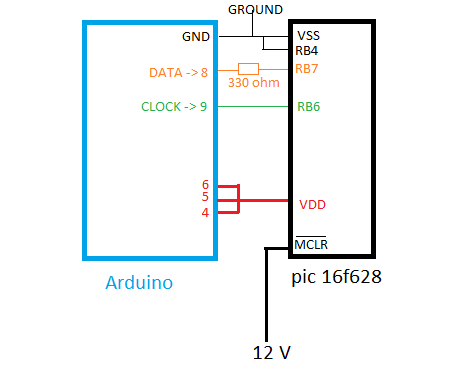
This is a wiring diagram that [Soranne] put together when developing a method of programming PIC microcontrollers using an Arduino board. You can see that he takes care of the 12V issue by connecting the Master Clear (MCLR) pin to an external source. This comes with one warning that the Arduino should always be reset just before making that connection.

He’s tested this with a 16F628 and is happy to report that he can successfully flash the program memory, but hasn’t implemented a way to write to the EEPROM as of yet. This should work for any of the 16F family of chips, but we’d bet this will be extended if some knowledgeable folks decide to lend a hand.

On the PC side of things [Soraane] has been working on a program to push code to the Arduino via the USB connection. He’s developing it in C# and even has a GUI worked up for the project. You can get your hands on the software in the second post of the thread linked above but you’ll have to be logged into the Arduino forum to see the download link.

We think the 12V issue is why we don’t see more roll-your-own programmers for PIC. But there are a few solutions out there like this ATmega8 version.