Checking Out The Temperature Of A Raspberry Pi

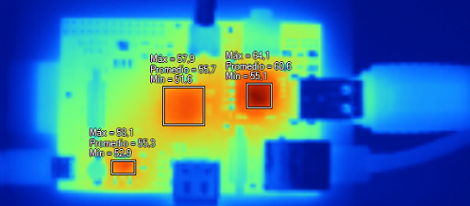
[Remy] has access to a very nice Fluke thermal camera, so when his Raspberry pi came in he pointed the thermal camera at the Raspi (Spanish, Google translation) to see how far this neat computer could be pushed before it overheated.

There are three main sources of heat on the Raspberry Pi: the voltage regulator, the USB/Ethernet controller and the Broadcom SoC. At idle, these parts read 49.9° C, 48.7° C and 53° C, respectively; a little hot to the touch, but still well within the temperature ranges given in the datasheets for these components.

The real test came via a stress test where the ARM CPU was at 100% utilization. The Broadcom SoC reached almost 65° C while the Ethernet controller and regulator managed to reach the mid-50s. Keeping in mind this test was performed at room temperature, we’d probably throw a heat sink on a Raspberry Pi if it’s going to be installed in an extreme environment such as a greenhouse or serving as a Floridian or Texan carputer.

Thanks [Alberto] for sending this in.
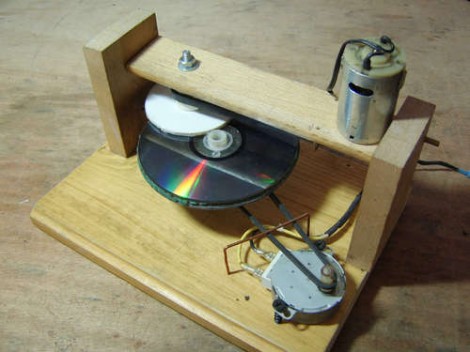
CD/DVD Polisher May Save Your Backups Someday

CD and DVD payers can often keep the music or movie going despite a small scratch. But occasionally you’ll have to skip to the next chapter/track or the player will just give up. But with data back-ups, a scratch can bork a whole set of files. We think that most of the time these headaches can be cured with this simple polisher.

[Wotboa’s] thrift store finds yielded almost all of the components needed to build the device. It’s made up of a couple of motors and a jig. One motor slowly rotates the upturned optical disc while the other spins the polishing pad. That pad is made from felt weather-stripping and is helped along with some plastic polishing compound. [Wotboa] asserts that five minutes in the noisy contraption will work wonders on any disc. You can get an idea of what it’s capable of by watching the video clip after the break.

Continue reading “CD/DVD Polisher May Save Your Backups Someday”

DEFCON 20 Tamper Evident Contest Signup

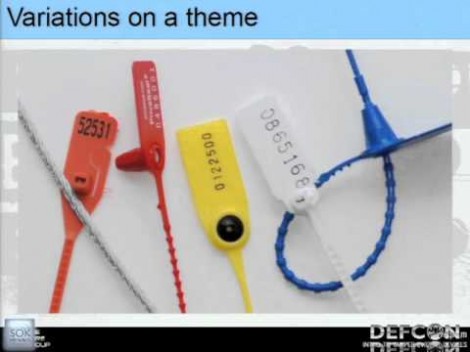
DEFCON 20 is on its way and if you want to put a team together to compete in the Tamper Evident competition now is the time! The idea of the contest is simple: your team needs to break into something without anyone every knowing. The payload is protected by the best of modern tamper evident techniques. One of the things we really like about the competition is that there are multiple levels so if it’s your first time you DO stand a chance. The number of teams accepted is limited, so don’t wait too long and miss your chance to register.

There’s a ton to be learned from the contest RULES. But perhaps a better primer is going to be [Datagram’s] fifty-two minute talk which we’ve embedded after the break. He was one of the winners of all four contest levels at DEFCON 19 last year.

Continue reading “DEFCON 20 Tamper Evident Contest Signup”

Amateur Radio Field Day Is Upon Us

Looking for something to do this fine Saturday morning? For the US and Canadian readers out there, the fourth weekend in June is amateur radio field day, a day when all the amateur radio and ham geeks get together, string up a few antennas, and do their yearly community outreach/contact as many other radio heads as possible.

This weekend, there are more than 1600 field day events taking place all across the US and Canada. Odds are, you’re not more than a half hour drive from a field day event; you can find the closest one with the AARL’s handy Google Map of field day locations.

Since last year, we’ve seen a whole host of cool stuff to do with radio including a $20 software defined radio. If getting your license is too big of a step for you right now, you could at least plug a USB TV tuner dongle into your computer and see what is possible with radio. As a neat little bonus, you don’t even need a license for SDR. You might need a better antenna, and the ham guys at field day will be more than happy to point you into the right direction.

A Primer On Dynamic Loading

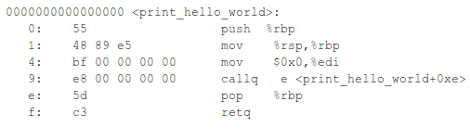
[Graphitemaster] is helping to demystifying the process of tailoring functions for dynamic loading. His tutorial shows how make a dynamic function that prints “Hello World” to the standard output. This is of course rudimentary, but if you have no prior experience with the topic you might be surprised at what actually goes into it.

Normally your compiled code has addresses in it that tell the processor where to go next. The point of dynamic loading is that the code can be put anywhere, and so static addresses simply will not work. The code above shows how a simple printf statement normally compiles. The callq line is a system call that needs to be replaced with something that will play nicely in the registers. [Graphitemaster] takes it slow in showing how to do this. Of course a dynamic function alone isn’t going to be much good. So the tutorial finishes by illustrating how to program a dynamic code loader.

Bring Your LED Matrix Project Into The Living Room

If you’re able to make a project look this good it shouldn’t be hard to convince that significant other to let you install it in a prominent place in the house. We think [Greg Friedland] pulled this off perfectly by building a 4’x8′ tablet controlled LED matrix.

First of all, everything looks better in a shiny case. It shouldn’t come as a surprise that this looks nice, thanks to the face plates which are mounted in a way that gives them a modern style (we’d expect to see this hanging in Ikea). They’re acrylic diffuser panels meant for used with lighting in a suspended ceiling. They do a nice job of scattering the light put off by the 544 LED modules that make up the display. The wiring was made easy by using LED strands where each pixel has its own control chip (WS2801). It sounds like the display will peak at around 160 Watts, which isn’t really that much considering the area. One nice touch that’s shown off in the video after the break is a full-feature iPad interface that even allows you to paint in light using your finger. But we’re also satisfied that [Greg] posted about the physical build too.

Continue reading “Bring Your LED Matrix Project Into The Living Room”

Repairing A Thermal Imaging Camera

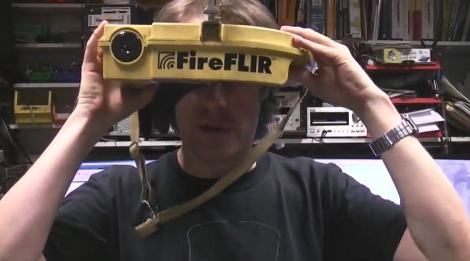
[Mike] got his hands on this thermal imaging camera which is designed for use by Firefighters. As he’s demonstrating in the image above, it clips to a helmet and has a display what will let rescuers see through heavy smoke. But this one isn’t working right so he cracked it open and repaired the damaged board.

The hour-long video (embedded after the break) is quite interesting. He starts with a disassembly of the unit, before diving head-first into trouble shooting. There is a PCB inside that fills the entire U-shaped enclosure. The thermal sensor’s habit of cutting out seems to be a symptom of this design. There is one weak point where the board is very narrow. Flexing or vibrating that section will reset the sensor, and [Mike] ends up replacing a couple of components before the thing is fixed. These include a resistor and a ferrite bead both of which are suspected of having cracks due to that board flexing. The rest of the video is spent with an EEVblog-style look that the components and the construction.

Continue reading “Repairing A Thermal Imaging Camera”