Gotta Catch ‘Em All, With An Arduino

PKMN

For every pokemon you encounter on your adventure to become the world’s greatest trainer, you have about a 1 in 8000 chance of that pokemon being ‘shiny’, or a different color than normal. Put an uncommon event in any video game, and of course a few people will take that feature to the limits of practicality: [dekuNukem] created the Poke-O-Matic, a microcontroller-powered device that breeds and captures shiny pokemon.

We’ve seen [dekuNukem]’s setup for automatically catching shiny pokemon before, but the previous version was extremely limited. It only worked with a fishing rod, so unless you want a ton of shiny Magikarp the earlier setup wasn’t extremely useful.

This version uses two microcontrollers – an Arduino Micro and a Teensy 3.0 – to greatly expand upon the previous build. Now, instead of just fishing, [dekuNukem]’s project can automatically hatch eggs, search patches of grass for shiny pokemon, and also automatically naming these new shiny pokemon and depositing them in the in-game pokemon storage system.

The new and improved version works a lot like the older fishing-only automated pokemon finder; a few wires soldered on to the button contacts control the game. The Teensy 3.0 handles the data logging of all the captured pokemon with an SD card and RTC.

What did [dekuNukem] end up with for all his effort? A lot of shiny pokemon. More than enough to build a great team made entirely out of shinies.

Video below, with all the code available through a link in the description.
Continue reading “Gotta Catch ‘Em All, With An Arduino”

Electronic Phenakistoscope!

phenakistoscope

Looking for a clever way to build a Phenakistoscope? Maybe you’re more familiar with its other names; Fantoscope, Phantasmascope, or perhaps its close cousin the Zoetrope?

If you’re still scratching your head, that’s okay — they have really weird names. What we’re referring to here is a type of optical illusion that mimics movement by showing a series of still images at an offset interval — this can be achieved by looking through slots, strobing a light (like in this case) or even by the use of mirrors.

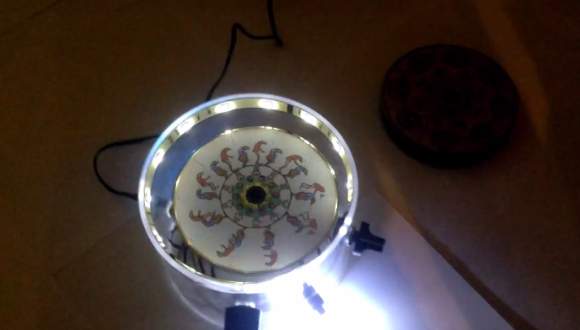
This particular Phenakistoscope is a very simple but clever design that makes use of a recycled stepper motor from a printer, a CD as the animation disk, a strip of LED lighting, a few potentiometers and an Arduino to control the strobe. It works by synchronizing the strobe frequency with the motor rotation, resulting in the image in motion effect.

Stick around after the break for a full gallery of the build and a demonstration video.

Continue reading “Electronic Phenakistoscope!”

USBPass – A Mooltipass-like Project

In our Developed on Hackaday series some readers may recall a sentence we wrote: “if one’s idea is not yet in the market, it’s either completely stupid or people are already working on it”. Well, [Josh] casually mentioned that he was also working on an offline password keeper after having recently subscribed to our google group. Similarly to the Hackaday-developed platform, the USBPass is connected to a computer via USB and is detected as an HID keyboard. As you can see in the picture shown above, it uses very few components: an ATMega32U2, a USB connector, three buttons and a few passives chips.

A total of 20 passwords can be stored in the microcontroller’s memory, which can be ‘typed’ by the platform using the push buttons. The USBPass firmware is based around the LUFA USB stack, to which [Josh] added HID report functionality to allow data transfer from his desktop application. The latter uses the Linux/Windows/OS X HID API library so bringing his software to other operating systems can be done in no time. All the project resources can be found on GitHub, while [Josh] is currently working on a B revision which will include an OLED screen.

Wireless Power Transfer For Quadrotors

quadcopter

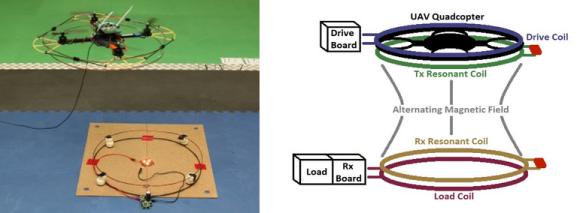
Quadrotors are great, but what kind of range can you get on them, really? What if you could charge them up just by flying over high voltage power lines, by or temporarily hovering by a charging station? That’s just what [Dr. Carrick Detweiler] wrote a paper about! (Caution: PDF)

The paper discusses the method of wireless power transfer via magnetic resonance, which, depending on the scale, can transfer power at medium distances (~1 meter). This outperforms inductive coupling which requires a much closer proximity (~1-2 centimeters) for power to transfer. It does still require a certain amount of accuracy, but as we all know, quadrotors have no problem with even the most complex aerodynamic feats!

There is an excellent demonstration video of a small scale wireless quadrotor prototype after the break.

Continue reading “Wireless Power Transfer For Quadrotors”