Bring A Hack At World Maker Faire 2014

After a hard Saturday at World Maker Faire, some of the best and brightest in the Hacker/Maker community descended on The Holiday Inn for “Bring A Hack”. Created by [Jeri Ellsworth] several years ago at the Bay Area Maker Faire, Bring A Hack (BAH) is an informal gathering. Sometimes a dinner, sometimes a group getting together at a local bar, BAH is has just one rule: You have to bring a hack!

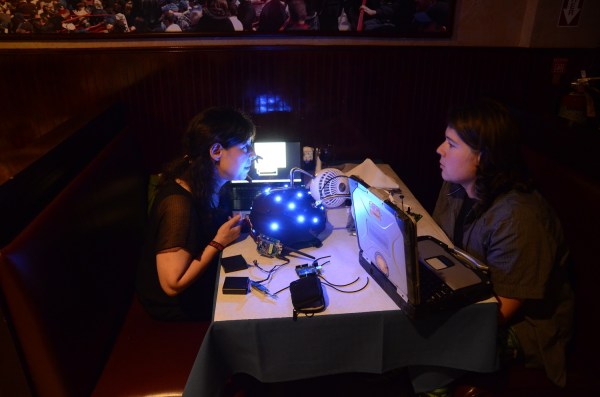
[Sophi Kravitz] has become the unofficial event organizer for BAH in New York. This year she did a bit of live hacking, as she converted her Wobble Wonder headgear from wired to wireless control.

[Chris Gammell] brought his original Bench BudEE from Contextual Electronics. He showed off a few of his board customizations, including making a TSSOP part fit on the wrong footprint.
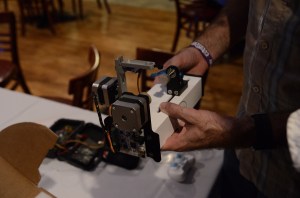
BAH-eggbotsmall[Windell and Lenore] from Evil Mad Scientist Laboratories brought a few hacks along. They picked up an old Radio Shack music player chip at the Electronics Flea Market and built it up on a breadboard. Also on display was their new EggBot Pro. The Pro is a beautifully machined version of the eggbot. Everything is built strong to withstand the sort of duty an EggBot would see at a hackerspace or public library. [Windell] was full of surprises, as he also gave everyone chunks of Sal Ammoniac, which is a great way to bring the tin back to a tired soldering iron tip. The hack was that he found his Sal Ammoniac at a local Indian grocery in the Bay Area. Check out [Windell’s] blog entry for more information.
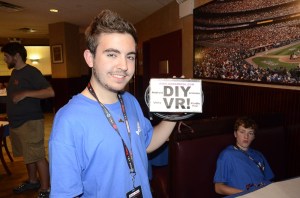
BAH-diyVRSmall[Cal Howard] brought his DIY VR goggles. [Cal] converted a Kindle Fire into an Oculus Rift style head mounted display by adding a couple of magnifying lenses, some bamboo kebab sticks to hold the lenses in place. Judicious use of cardboard and duct tape completed the project. His current hurdle is getting past the Fire’s lack of an accelerometer. [Cal] planned to spend Sunday at Maker Faire adding one of his own!

As the hour grew late, everyone started to trickle out. Tired but happy from a long day at Maker Faire, the Bring A Hacker partygoers headed back to their hotels to get some sleep before World Maker Faire’s final day.

Countdown To Finals

There can be only 5.

This Sunday Night we will snapshot the state of the final 50 entries for The Hackaday Prize. Our panel of Launch Judges will then begin the difficult task of choosing the five projects which best exemplify the virtues of the challenge: Openness, Connectedness, Innovation, Wow Factor, Reproducibility, and User Experience.

Want to help your favorite project make the finals? Get in there and take a look at their write-ups. Leave a polite comment on the project page that mentions the parts that are unclear or things you think should be added to the description.

The five who do move on are up for some huge prizes: A trip to space, Milling Machine, a 3D Printer, a trip to Akihabara, and Team Skydiving. Of course we won’t know the order of the finalists or who the Grand Prize Winner is until the final judging round happens at the end of October.

Hacklet 17 – Keyboards

This week on The Hacklet we’re featuring some of the best keyboard hacks from Hackaday.io!

Hackers are really into their keyboards. Everyone has a favorite, and those favorites vary wildly. Mechanical, soft touch, ergonomic, QWERTY, DVORAK, chorded, you name it, there is a hacker, maker, or engineer who loves it, or absolutely hates it. For some, no commercial product is perfect. All is not lost though, as a custom keyboard is just a hack away!

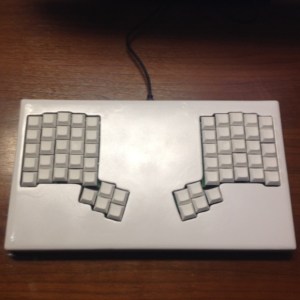
ergo60

[Warren Janssens] gets things rolling with Ergo60, his 60 key ergonomic keyboard. [Warren’s] layout is a pair of 25 key hand clusters, each with a matching 5 key thumb cluster. This layout minimizes lateral wrist movement. With the reduced key count and stacked keys, the user’s hands never move from the home row. [Warren] rolled his own PCBs for Ergo60. A Teensy 2.0 running a fork of TMK serves as Ergo60’s controller. [Warren’s] is running Cherry Black switches and his keycaps are from Signature Plastics. [Warren] is using Ergo60 as his daily driver these days, so it’s no surprise that he’s set the “Completed Project” tag.

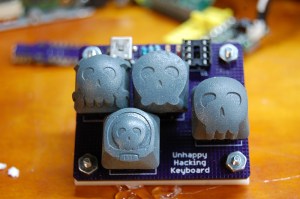
keycaps

Some say he needs no keyboard at all, and that his heartbeat sounds just like an IBM Model M. All we know is he’s called [Brian Benchoff]. [Brian’s] created a pair of minimalist keyboard projects. The Unhappy Hacking Keyboard takes us back to basics. After all, computers run on 1’s and 0’s, right? What more could a person need? Apparently just a space and return. Unhappy Hacking Keyboard uses an ATtiny85 with V-USB as the controller and the interface. Keys are cherry MX blues. The keycaps are [Brian’s] own Hackaday Cherry MX Keycaps printed by Shapeways.

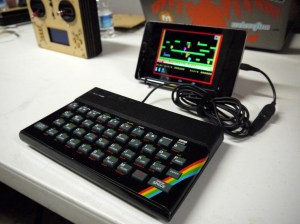
zxkeyboardAn entire generation of hackers don’t know the joy of typing on a tiny rubber keyboard. [Alistair MacDonald] aimed to fix that, so he turned an old computer into a keyboard with his ZX Keyboard. [Alistair] started with a broken ZX Spectrum. He gutted the original electronics and added an Ardunio Pro Mini running the V-USB library. [Alistair] directly wired the row and column I/O lines from the keyboard to his Arduino. The result is a keyboard which is the perfect size for cell phones, Raspberry Pi’s and the like.

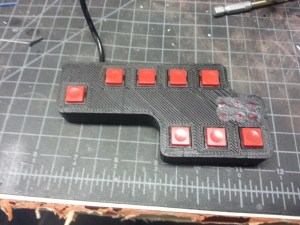
chordkey[Servo] teaches us new ways to type with Chordy KEY, his chording keyboard project. Chordy Key is meant to be used in the left hand. Five finger buttons and three thumb buttons are all that is needed to chord out 64 different letters and symbols. [Servo] utilized an ATmega32U4 powered Sparkfun pro micro to control his keyboard. Chordy Key is a proof of concept, but with [Servos’s] use of 3D printed parts, Chordy Key looks like it’s ready for your next wearable computing project!

chord2[jmptable] is also working on a chorded keyboard design. Chord Keyboard uses only 7 keys to send the entire ASCII character set and a few control combinations. [jmptable] used an ATmega328P as his processor. Chord keyboard isn’t wired though. An RN-42-HID module provides bluetooth connectivity to the world.

[jmptable] has provided an amazing amount of detail on his research, including one of his goals of adding a chorded keyboard to the Gameboy Advance. They keyboard itself would be mounted on the spine of a game cartridge. We would love to see that idea come to fruition, [Servo]!


mightyFinally we have [Gertlex], who just wanted a scroll wheel embedded in his keyboard. He got there with the help of an Apple Mighty Mouse. Keyboard with Apple Mouse Scroll Ball is one of those hacks that looks like it original equipment. [Gertlex] took a drill to a Targus slim USB keyboard, putting a small hole right between the ESC and F1 keys. He fit the scroll ball from his Apple Mighty Mouse in the hole. Electronics are as simple as plugging the mouse and keyboard into the same USB hub. The only downside to the design is that [Gertlex’s] keyboard doesn’t recognize fast enough to send key presses during the boot process.

That’s just about enough keystrokes for this episode of The Hacklet. As always, see you next week. Same hack time, same hack channel, bringing you the best of Hackaday.io!

Update – check our our keyboard list right here!

Maker Faire ATL

We’re At Maker Faire Atlanta, Oct 4-5

If you live in the southeastern US, mark your calenders for next weekend—October 4th and 5th—and head out to the fourth annual Maker Faire Atlanta in downtown Decatur, GA. You can find a complete list of participants here.

I’ll be around all weekend to talk to makers about their projects and to hand out some Hackaday stickers. As [Brian] said with the HaD crew at the NY Faire, don’t be afraid to introduce yourself if you see me walking around or lurking at the Hackyard booth. See you there!

Starting To Wrap Up Maker Faire

It’s almost a week since the NYC Maker Faire, and it’s about time for us to start wrapping up all the posts we’re doing on everything we’ve seen.

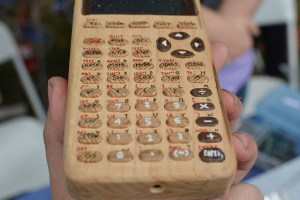
DSC_0216[Chris Mitchell], hackaday favorite from Cemetech did what he always does at Maker Faire: brought some stuff he’s doing with TI graphing calculators.
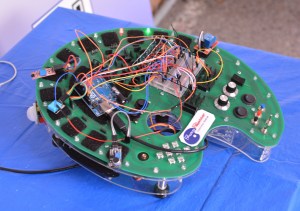
The TI-84 with GPS made a showing, as did the graphing calculator IRC client. By far the coolest looking calculator was the wooden casemod. It’s a TI-82 put into a (what feels and looks like) a maple enclosure. The buttons are painted on, and despite stuffing consumer electronics into a handmade case, it’s still reasonable portable.

DSC_0201There were more Hackaday fans at the faire, but I’m not sure if anyone can beat the guys from Protopalette. Wait. One guy could. Find me in public sometime and I’ll tell you about that.
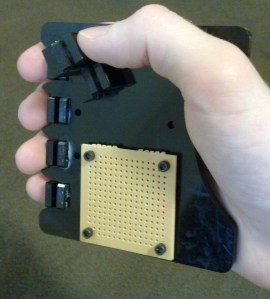
The Protopalette is a board with a bunch of lights, buttons, switches, sensors, knobs, servos, and buzzers for electronics prototyping. Think of it as a stylized version of the old ‘parts and springs and wire’ radio shack beginner electronic kits.

DSC_0160

Some of the members of the hackerspace with the craziest group narrative, LVL1 in Louisville, made it to the faire. They’re working with GE to create a ‘maker module’ for appliances. It’s called Green Bean, and GE is actually building support for this into some of their fridges, washers, stoves and dishwashers.

There are a few modules already, like a scale that will send out a message when you’re out of milk. It’s an interesting system, and there are already a lot of appliances that support the system.

Pics below.

Continue reading “Starting To Wrap Up Maker Faire”

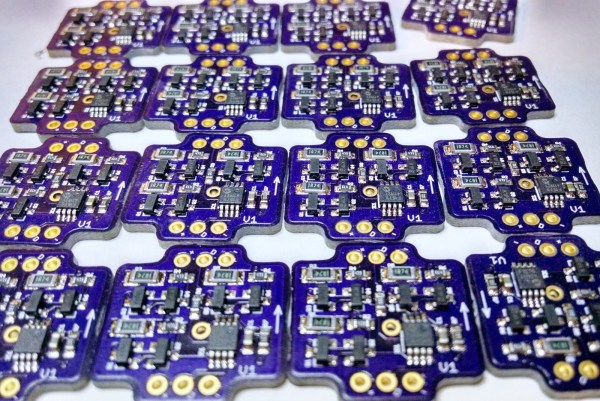
A collection of boards that make up the LED Jacket

A Very Bright LED Jacket

Last year, [Ytai] went to Burning Man for the first time. He was a bit inexperienced, and lacked the lumens to make him visible on the Playa. This year, he made up for it by building an extra bright LED Jacket.

The jacket consists of 48 LEDs, at 150 lumens each. Each RGB LED module was placed on its own PCB, and controlled by the tiny PIC12F1571 microcontroller. This microcontroller was a great fit since it has three PWM channels (one for each color) and costs 50 cents. Firmware on the PIC allows the boards to be daisy-chained together to reduce wiring. This was done by using a protocol similar to the popular WS2811 LEDs.

Assembling 50 of the boards presented a challenge. This was addressed by using surface mount components, a solder stencil from OSH Stencils, an electric skillet, and a good amount of patience. The final cost of each module was about $3.

With 50 of the boards assembled, a two layer jacket was sewn up. The electronics were sandwiched between these two fabric layers, which gave the jacket a clean look. A wrist mounted controller allows the wearer to select different patterns.

For a full rundown of the jacket, check out the video after the break.

Continue reading “A Very Bright LED Jacket”

THP Semifinalist: NSA Away

Back when we started The Hackaday Prize, security, big brother, and the NSA were making headlines every day. Since that time, there has been enough bread and circuses in the news to wipe the consequences of these leaks out of the public consciousness, but work is still being done by hackers and tinkerers the world over to give you the tools to protect your data.

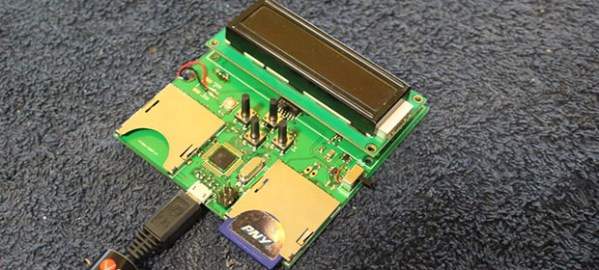
NSA Away is one of these tools. The first part of the project is a standalone key generator that writes the same random bits to a pair of SD cards simultaneously. With their random number generator, this is perfect encryption. The only way to crack the one time pad the team is using for encryption is to 1) use parts of the pad more than once, 2) have a terrible RNG, or 3) do something really stupid like sell the one time pad in a store.

The other part of the build is an Android-based encryption device with a camera, keyboard, SD card reader, and a USB port. This device reads the ‘OTP SD cards’ and reads data with the camera using OCR and decrypts it on the screen. Provided the OTP doesn’t fall into the wrong hands, this is a perfectly secure way to transmit data to anyone.

As far as progress goes, the members of the team have a fully functional pad generator, writing random data to SD cards. This device can also output random bits to a computer as a USB HID device, should you want to transmit your pad over unsecured mediums.

It’s an impressive bit of work, especially in the RNG department. The team is using eight avalanche noise generators in the circuit description. This part of the build isn’t quite working yet, but that’s really not needed for a proof of concept.


SpaceWrencherThe project featured in this post is a quarterfinalist in The Hackaday Prize.