The Atomic Gardener Of Eastbourne

Pity the video team at a large hacker camp, because they have a huge pile of interesting talks in the can but only the limited resources of volunteers to put them online. Thus we often see talks appearing from past camps, and such it is with one from Electromagnetic Field 2022. It’s from [Sarah Angliss], and as its subject it takes the extraordinary work of [Muriel Howorth], a mid-20th-century British proponent of irradiated seeds as a means to solve world hunger.

Today we are used to genetic modification in the context of plants, and while it remains a controversial subject, the science behind it is well known. In the period following the Second World War there was a different approach to improving crops by modifying their genetics: irradiating seeds in a scattergun approach to genetic modification, in the hope that among thousands of duds there might be a mutant with special properties.

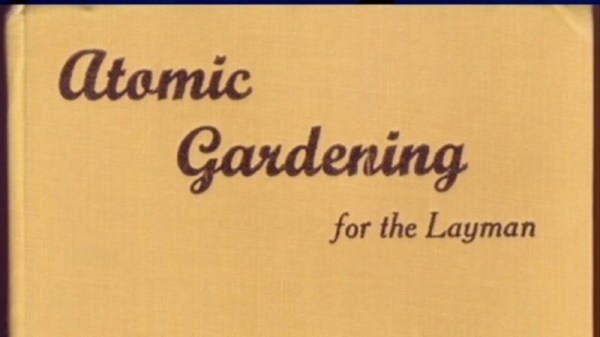
To this came Muriel Howorth, at first charged with telling the story of atomic research for the general public. She took irradiated seeds from Oak Ridge in the USA, and turned them into a citizen science program, with an atomic gardening society who would test these seeds and hopefully, find the supercrops within. It’s a wonderfully eccentric tale that might otherwise be the plot of a Wallace and Gromit movie, and but for a few interested historians of popular science it might otherwise have slipped into obscurity. We’re sorry we didn’t catch this one live back when we attended the event.

Continue reading “The Atomic Gardener Of Eastbourne”

Programming Ada: Implementing The Lock-Free Ring Buffer

In the previous article we looked at designing a lock-free ring buffer (LFRB) in Ada, contrasting and comparing it with the C++-based version which it is based on, and highlighting the Ada way of doing things. In this article we’ll cover implementing the LFRB, including the data request task that the LFRB will be using to fill the buffer with. Accompanying the LFRB is a test driver, which will allow us to not only demonstrate the usage of the LFRB, but also to verify the correctness of the code.

This test driver is uncomplicated: in the main task it sets up the LFRB with a 20 byte buffer, after which it begins to read 8 byte sections. This will trigger the LFRB to begin requesting data from the data request task, with this data request task setting an end-of-file (EoF) state after writing 100 bytes. The main task will keep reading 8-byte chunks until the LFRB is empty. It will also compare the read byte values with the expected value, being the value range of 0 to 99.

Continue reading “Programming Ada: Implementing The Lock-Free Ring Buffer”

Programming Tiny Blinkenlight Projects With Light

[mitxela] has a tiny problem, literally: some of his projects are so small as to defy easy programming. While most of us would probably solve the problem of having no physical space on a board to mount a connector with WiFi or Bluetooth, he took a different path and gave this clever light-based programming interface a go.

Part of the impetus for this approach comes from some of the LED-centric projects [mitxela] has tackled lately, particularly wearables such as his LED matrix earrings or these blinky industrial piercings. Since LEDs can serve as light sensors, albeit imperfect ones, he explored exactly how to make the scheme work.

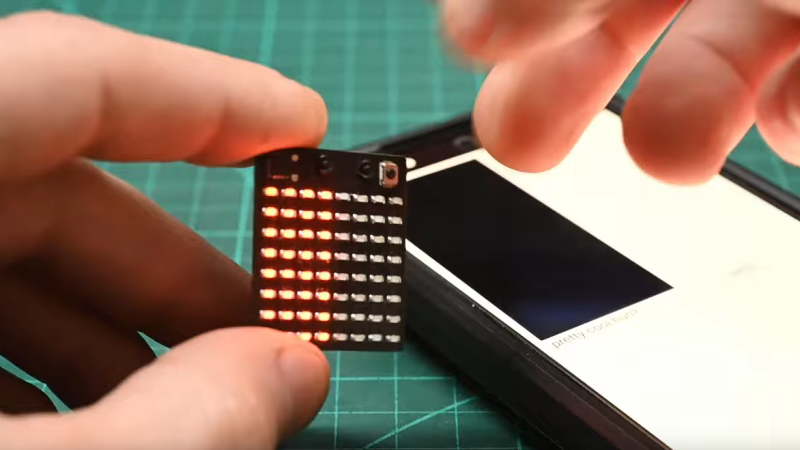
For initial experiments he wisely chose his larger but still diminutive LED matrix badge, which sports a CH32V003 microcontroller, an 8×8 array of SMD LEDs, and not much else. The video below is a brief summary of the effort, while the link above provides a much more detailed account of the proceedings, which involved a couple of false starts and a lot of prototyping that eventually led to dividing the matrix in two and ganging all the LEDs in each half into separate sensors. This allows [mitxela] to connect each side of the array to the two inputs of an op-amp built into the CH32V003, making a differential sensor that’s less prone to interference from room light. A smartphone app alternately flashes two rectangles on and off with the matrix lying directly on the screen to send data to the badge — at a low bitrate, to be sure, but it’s more than enough to program the badge in a reasonable amount of time.

We find this to be an extremely clever way to leverage what’s already available and make a project even better than it was. Here’s hoping it spurs new and even smaller LED projects in the future.

Continue reading “Programming Tiny Blinkenlight Projects With Light”

Secret Messages On Plastic, Just Add Tesla Coil

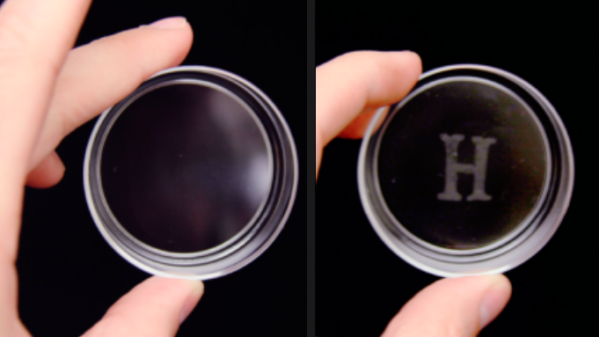
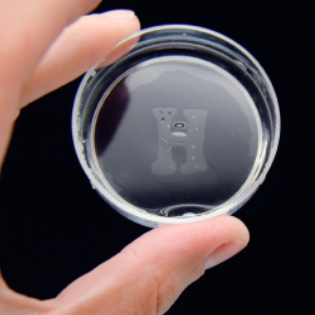
Here’s a short research paper from 2013 that explains how to create “hydroglyphics”, or writing with selecting surface wetting. In it, an apparently normal-looking petri dish is treated so as to reveal a message when wetted with water vapor. The contrast between hydrophobic and hydrophilic surfaces, which is not visible to the naked eye, becomes visible when misted with water. All it took was a mask, and a little treatment with a modified Tesla coil.

Plastics tend to be hydrophobic, meaning their surface repels water. These plastics also tend to be non-receptive to things like inks and adhesives. However, there is an industrial process called corona treatment (invented by Verner Eisby in 1951) that changes the surface energy of materials like plastics, rendering them more receptive to inks, coatings, and adhesives. Eisby’s company Vetaphone still exists today, and has a page describing the process.

What’s this got to do with the petri dishes and their secret messages? The process is essentially the same. By using a Tesla coil modified with a metal wire mesh, the surface of the petri dish is exposed to the coil’s discharge, altering its surface energy and rendering it hydrophilic. By selectively blocking the discharge with a nonconductive mask made from a foam sticker, the masked area remains hydrophobic. Mist the surface with water, and the design becomes visible.

The effects of corona treatment decay over time, but we think this is exactly the sort of thing that is worth keeping in mind just in case it ever comes in useful. Compact Tesla coils are fairly easy to get a hold of nowadays, but it’s also possible to make your own.