Optimizing Software With Zero-Copy And Other Techniques

An important aspect in software engineering is the ability to distinguish between premature, unnecessary, and necessary optimizations. A strong case can be made that the initial design benefits massively from optimizations that prevent well-known issues later on, while unnecessary optimizations are those simply do not make any significant difference either way. Meanwhile ‘premature’ optimizations are harder to define, with Knuth’s often quoted-out-of-context statement about these being ‘the root of all evil’ causing significant confusion.

We can find Donald Knuth’s full quote deep in the 1974 article Structured Programming with go to Statements, which at the time was a contentious optimization topic. On page 268, along with the cited quote, we see that it’s a reference to making presumed optimizations without understanding their effect, and without a clear picture of which parts of the program really take up most processing time. Definitely sound advice.

And unlike back in the 1970s we have today many easy ways to analyze application performance and to quantize bottlenecks. This makes it rather inexcusable to spend more time today vilifying the goto statement than to optimize one’s code with simple techniques like zero-copy and binary message formats.

Continue reading “Optimizing Software With Zero-Copy And Other Techniques”
WCH CH32M030: Another Microcontroller To Watch Out For

One of the joys of writing for Hackaday comes in following the world of new semiconductor devices, spotting interesting ones while they are still just entries on manufacturer websites, and then waiting for commonly-available dev boards. With Chinese parts there’s always a period in which Chinese manufacturers and nobody else has them, and then they quietly appear on AliExpress.

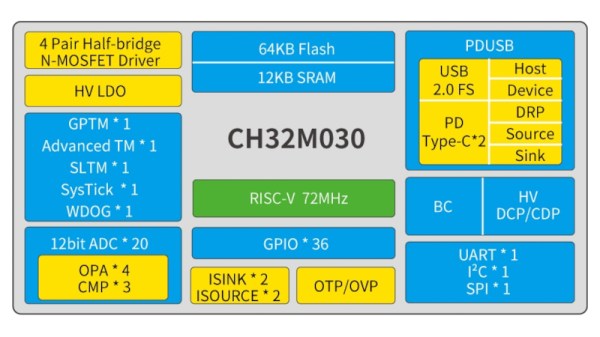
All of which brings us to the WCH CH32M030, a chip that’s been on the radar for a while and has finally broken cover. It’s the CH32 RISC-V microcontroller you may be familiar with, but with a set of four half-bridge drivers on board for running motors. A handy, cheap, and very smart motor controller, if you will.

There’s been at  least one Chinese CH32M030 dev board (Chinese language) online for a while now, but the one listed on AliExpress appears to be a different design. At the time of writing the most popular one is still showing fewer than 20 sales, so we’re getting in at the ground floor here.

We think this chip is of interest because it has the potential to be used in low price robotic projects, replacing as it does a couple of parts or modules in one go. If you use it, we’d like to hear from you!

A PSOne In The Palm Of Your Hand

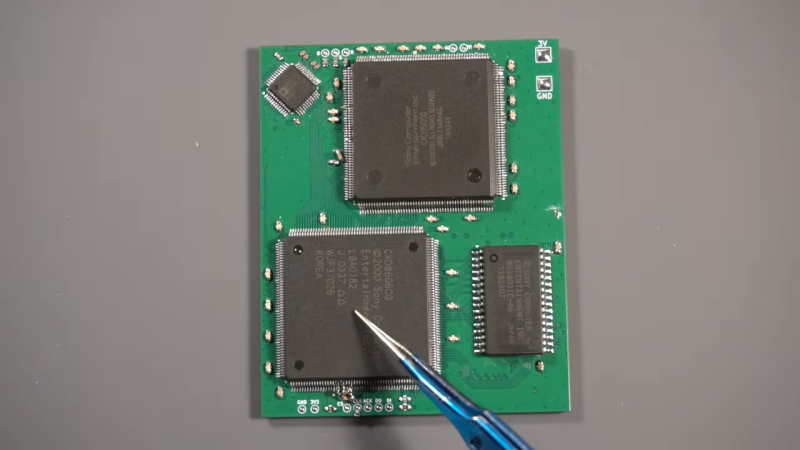
Sony’s original Playstation wasn’t huge, and they did shrink it for re-release later as the PSOne, but even that wasn’t small enough for [Secret Hobbyist]. You may have seen the teaser video a while back where his palm-size Playstation went viral, but now he’s begun a series of videos on how he redesigned the vintage console.

Luckily for [Secret Hobbyist], the late-revision PSOne he started with is only a two-layer PCB, which made reverse engineering the traces a lot easier. Between probing everything under the microscope and cleaning the board off to follow all the traces in copper, [Hobbyist] was able to reproduce the circuit in KiCAD. (Reverse engineering starts at about 1:18 in the vid.)

With a schematic in hand, drafting a smaller PCB than Sony built is made easier by the availability of multi-layer PCBs. In this case [Hobbyist] was able to get away with a four-layer board. He was also able to ditch one of the ICs from the donor mainboard, which he called a “sub-CPU” as its functionality was recreated on the “PSIO” board that’s replacing the original optical drive. The PSIO is a commercial product that has been around for years now, allowing Playstations to run from SD cards– but it’s not meant for the PSOne so just getting it working here is something of a hack. He’s also added on a new DAC for VGA output, but otherwise the silicon is all original SONY.

This is the first of a series about this build, so if you’re into retro consoles you might want to keep an eye on [Secret Hobbyist] on YouTube to learn all the details as they are released.

Continue reading “A PSOne In The Palm Of Your Hand”