A Radio Power Amplifier For Not A Lot

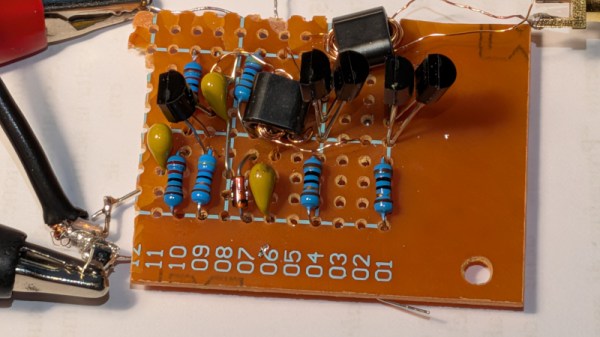
When building a radio transmitter, unless it’s a very small one indeed, there’s a need for an amplifier before the antenna. This is usually referred to as the power amplifier, or PA. How big your PA is depends on your idea of power, but at the lower end of the power scale a PA can be quite modest. QRP, as lowe power radio is referred to, has a transmit power in the miliwatts or single figure watts. [Guido] is here with a QRP PA that delivers about a watt from 1 to 30 MHz, is made from readily available parts, and costs very little.

Inspired by a circuit from [Harry Lythall], the prototype is built on a piece of stripboard. It’s getting away with using those cheap transistors without heatsinking because it’s a class C design. In other words, it’s in no way linear; instead it’s efficient, but creates harmonics and can’t be used for all modes of transmission. This PA will need a low-pass filter to avoid spraying the airwaves with spurious emissions, and on the bands it’s designed for, is for CW, or Morse, only.

We like it though, as it’s proof that building radios can still be done without a large bank balance. Meanwhile if the world of QRP interests you, it’s something we have explored in the past.
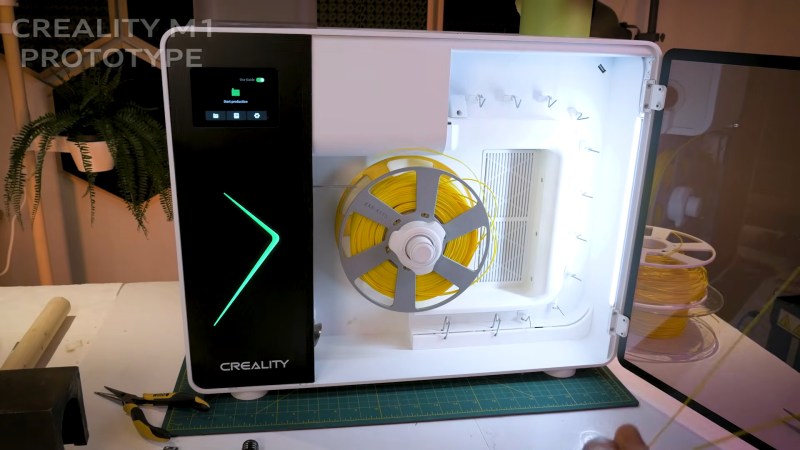

Hands On With Creality’s New M1 Filament Maker

Ever since 3D printing has become a popular tool, the question of waste has been looming in the background. The sad reality of rapid prototyping is that you’re going to generate a lot of prints that just aren’t fit for purpose, even if your printer runs them off perfectly every time. Creality has some products on the way aimed at solving that problem, and [Embrace Making] on YouTube has got his hands on a pre-production prototype of the Creality M1 Filament Maker to give the community a first look.

The M1 is actually only half of the system; Creality is also working on an R1 shredder to reduce your prints into re-usable shreds. [Embrace Making] hasn’t gotten his hands on that, but shredding prints isn’t the hard part. We’ve featured plenty of DIY shredders in the past. Extruding filament reliably at home has traditionally proven much more difficult, which is why we mostly outsource it to professionals.

Lacking the matching shredder, and wanting to give the M1 the fairest possible shake, [Embrace] tests the machine out first using Creality-supplied PLA pellets. The filament diameter isn’t as stable as we’ve gotten used to, and the spool rolling setup needs a bit more work.

Again, this is an early prototype. Creality says they’re working on it and claims they’ll get to ±0.05 mm precision in the production models. Doubtless they’ll also fix the errors that led to [Embrace]’s messy spool. That’s probably just software given that the winding mechanism did a pretty good job on the Creality-supplied spool.

Most importantly, the M1-produced filament does print. The prints aren’t perfect due to the variation in diameter, but they turn out surprisingly well for home-made filament. [Embrace] also shows off the ability to mix custom colors and gradients, but, again, using raw PLA rather than shredded material. Hopefully Creality lets him test drive the R1 shredder once its design is further along.

This is hardly the first time we’ve seen a filament extruder. The goal of this product is to pair with a shredder and use it for recycling, but if you’re going to stick with raw plastic pellets, you may as well print them directly.

Continue reading “Hands On With Creality’s New M1 Filament Maker”

Printing An Underwater Diving Helmet With Floating Air Supply

Old-school diving helmets are deceivingly simple, even if they are – as [Hyperspace Pirate] puts it in a recent video – essentially the equivalent of an upside-down bucket with an air hose supplying air into it. While working on a 3D-printed diving helmet, he therefore made sure to run through all the requisite calculations prior to testing out said diving helmet in his pool.

The 3D model for the diving helmet can be found over at Thingiverse if you too feel like getting wet, just make sure that you size it to fit your own head. In the video CAD (cardboard-aided design) was used to determine the rough bounding box for the head, but everyone’s head is of course different. The helmet was printed in ABS, with the sections glued together before being covered in fiberglass and epoxy resin. Note that polyester resin dissolves ABS, so don’t use that.

On the helmet is a 1/4″ SAE fitting for the air hose, with the air provided from an oil-less compressor that in the final iteration is strapped to a floatation device along with an inverter and batteries. Of note is that you do not want to use a gas-powered compressor, as it’ll happily use any CO2 and CO it exhausts to send down the air hose to your lungs. This would be bad, much as having vaporized oil ending up in your lungs would be bad.

Although in the video the system is only tested in a backyard pool, it should be able to handle depths of up to ten meters, assuming the compressor can supply at least 41 L/minute. With some compressor-side miniaturization and waterproofing, [Hyperspace Pirate] reckons it would work fine for some actual ocean exploration, which while we’re sure everyone is dying to see. Perhaps don’t try this one at home, kids.

Continue reading “Printing An Underwater Diving Helmet With Floating Air Supply”

3D Printing A Harmonic Pin-Ring Gearing Drive

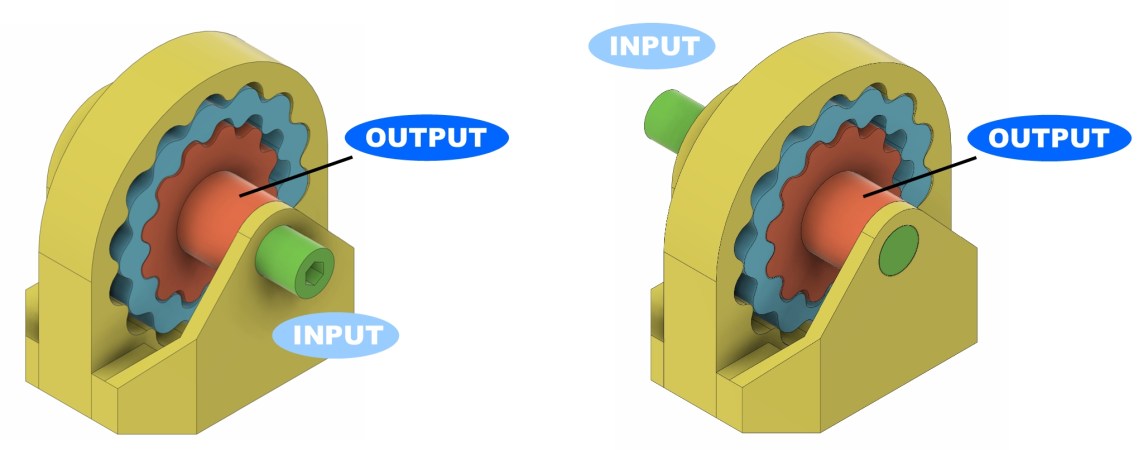
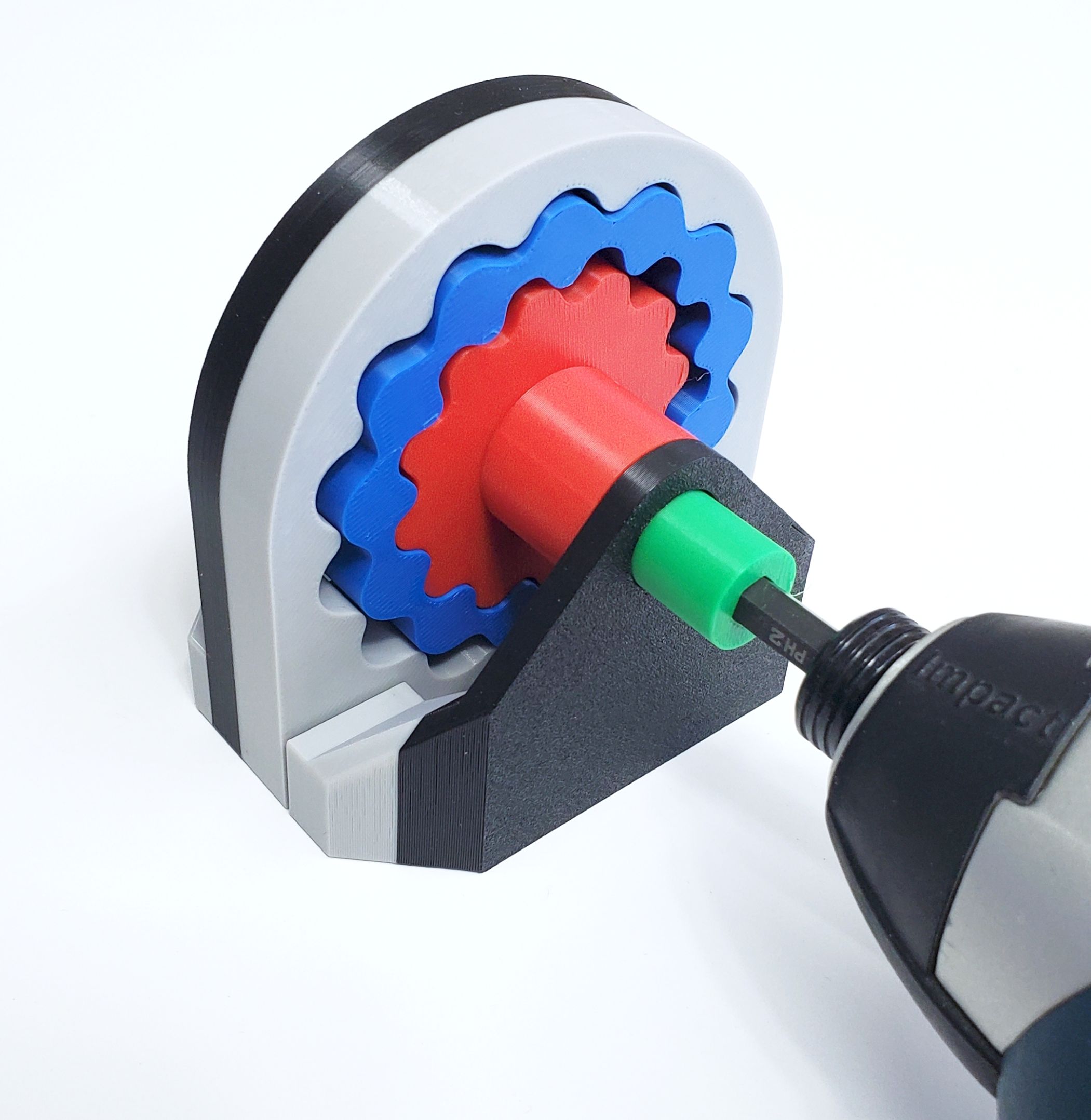
Cycloidal drives are a type of speed reducer that are significantly more compact than gearboxes, but they still come with a fair number of components. In comparison, the harmonic pin-ring drive that [Raph] recently came across as used in some TQ electric bicycles manages to significantly reduce the number of parts to just two discs. Naturally he had to 3D model his own version for printing a physical model to play with.

How exactly this pin-ring cycloidal drive works is explained well in the referenced [Pinkbike] article. Traditional cycloidal drives use load pins that help deal with the rather wobbly rotation from the eccentric input, but this makes for bulkier package that’s harder to shrink down. The change here is that the input force is transferred via two teethed discs that are 180° out of sync, thus not only cancelling out the wobble, but also being much more compact.

It appears to be a kind of strain wave gearing, which was first patented in 1957 by C.W. Musser and became famous under the Harmonic Drive name, seeing use by NASA in the Lunar Rover and beyond. Although not new technology by any means, having it get some more well-deserved attention is always worth it. If you want to play with the 3D model yourself, files are available both on GitHub and on MakerWorld.

Are We Finally At The Point Where Phones Can Replace Computers?

There was an ideal of convergence, a long time ago, when one device would be all you need, digitally speaking. [ETA Prime] on YouTube seems to think we’ve reached that point, and his recent video about the Samsung S26 Ultra makes a good case for it. Part of that is software: Samsung’s DeX is a huge enabler for this use case. Part of that his hardware: the S26 Ultra, as the upcoming latest-and-greatest flagship phone, has absurd stats and a price tag to match.

First, it’s got 12 GB of that unobtanium once called “RAM”. It’s got an 8-core ARM processor in its Snapdragon Elite SOC, with the two performance cores clocked at 4.74 GHz — which isn’t a world record, but it’s pretty snappy. The other six cores aren’t just doddling along at 3.62 GHz. Except for the very youngest of our readers, you probably remember a time when the world’s greatest supercomputers had as much computing power as this phone.

Continue reading “Are We Finally At The Point Where Phones Can Replace Computers?”

A Rotary Dial The 3D Printed Way

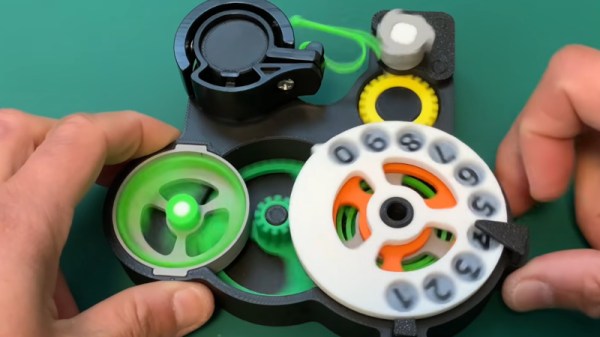
There’s a meme which may have a basis in truth, of a teenager left clueless when presented with a rotary telephone. The dial, in reality a mechanical pulse chain generator, was once ubiquitous enough that having one in your parts bin was anything but unusual. If you’re curious about their inner workings in 2026 though, you may be out of luck. Never fear though, because [Moeya 3D Designs] is here with a fully 3D printed version. It’s not as compact as the original, but it’s all there.

If you’re not put off by the anime-style Japanese voice over on the video below the break and you can enable subtitles for your language, you get the full explanation. There’s a ratchet and spring on the dial, which when released drives a gear train that ends in a cam that would operate a switch for the pulses. Another set of gears drives a very neatly designed centrifugal speed governor, and we see the effect immediately when it is removed. We’re not sure who will go for this project, but we surely like it.

There are two videos below the break, with the dial shown off in the first and the design process in the second. Meanwhile we’ve talked in the past about the networks behind the dials. Continue reading “A Rotary Dial The 3D Printed Way”

German Fireball’s 15 Minutes Of Fame

Sunday night, around 7:00 PM local time, a bright fireball streaked across the western German sky, exploded, and rained chunks of space rock down on the region around Koblenz. One of the largest known chunks put a soccer-ball-sized hole in someone’s roof, landing in their bedroom. Fortunately, nobody was hurt. But given the apparent size of the explosion, there must be many more pieces out there for the finding, and a wave of hopeful meteorite hunters has descended upon the region.

But if you wanted a piece of the action, where exactly would you start looking? How do scientists find meteorites anyway? And what should you do if you happen to see a similar fireball in the night sky?

Citizen Science

Meteorite video-bombs a boring parking lot in Heerlen, NL.

In the age of always-on dashboard cameras, ubiquitous smartphones, and other video recording devices, it’s hard for a shy meteorite to find a quiet spot out of the public eye. That makes them a lot easier to find than they were in the past. Indeed, the International Meteor Organization, which aggregates amateur meteor observations, received more than 3,200 reports of this one, including several with video documentation. Some are stunning, and others may not even be of the event at all.

By collecting reports from many locations, they can hope to piece together the meteorite’s trajectory. However, if you look at the individual reports, it’s clear that this is a difficult task. Nobody is expecting a bright fireball to streak across the night sky, so many of the reports are reasonably vague on the details and heavy on the awe.

This report from [Sophie Z], for instance, is typical. She records where she was and roughly the location in the night sky where the meteorite passed, along with the comment “I’ve never seen anything so amazing and large before in my life.” Other amateur observers are more precise. [David C] (“I have a Ph.D in physics”) managed to record the start and the end heading of the meteorite to a couple of decimal places. He must have had a camera.

Continue reading “German Fireball’s 15 Minutes Of Fame”