
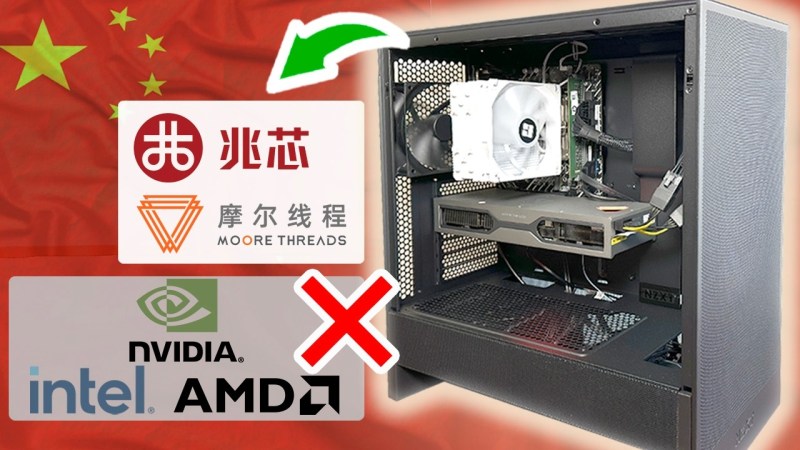
This is an interesting challenge from the “why not?” files — [GPUSpecs] over on YouTube built a gaming PC without using a single component from NVIDIA, Intel, or AMD. That immediately makes us think of the high-power ARM workstations or perhaps even perhaps the new “AI workstations” coming available with RISC V architecture, but the challenge here was specifically “gaming PC,” not workstation. A gaming PC, without a GPU by one of those three? To make it even more interesting, the x86 CPU isn’t Intel or AMD either.
If you’re of a certain vintage, you may remember Cyrix. Cyrix reverse-engineered the x86 ISA and made their own compatible chips in the 90s, before being bought out by National Semiconductor, and then VIA Technologies. VIA partnered with the Government of Shanghai to found Zhaoxin, and it is from Zhaoxin that the KaiXian KX 7000 CPU hails — an x86-64 device, that isn’t Intel or AMD. We’ve actually covered the company before. This particular chip benchmarks like an old i5, so not spectacular, but usable.
The GPU is also Chinese: a Moore Threads MTT S80, with 16 GB of DDR6 vRAM, 4096 shading units, 256 texture mapping units, and 256 ROPs. On paper, that looks like a very respectable graphics card, but it’s not clear how well the games [GPUSpecs] tested were actually using it. Based on the numbers he was getting in his testing, there are some serious driver issues with this card. Even Black Myth: Wukong, which is supposed to be a game the card targets, was sitting at 13.6 FPS on low settings and 1080p. That almost feels like integrated graphics numbers, not something a beefy GPU would give you — but it matches what other reviewers were saying when the card first came out.
So if you’re looking for a sanction-proof gaming rig, we’re sorry to say it’s not quite ready for triple-A. On the other hand, it’s a neat hack and we didn’t know this box could even get built. Right now, it looks like you will need at least one of the big three names to game on–you can game on ARM with NVIDIA graphics, or even with Intel graphics, and of course AMD, which has been in the works the longest.












Yeah. I had a Biostar mainboard with a VIA C7D processor by late 2000s.
The PC ran Windows XP on max. memory expansion (4GB installed ca. 3,5 GB usable).
The PC later got an SATA SSD, but a small one (64GB)..
Boot prompts that contain the Gold Star logo and programs that output an audio sample of an American lady saying, shareware. Nostalgia.
VIA’s C7D isn’t Cyrix, it’s Centaur (but as I mentioned below Zhaoxin is Centaur derived anyway). Cyrix’s last products were the Geode designs.
Hi! It came to my mind because of the predecessor VIA C3,
which was also named “VIA Cyrix III” at one point..
https://en.wikipedia.org/wiki/VIA_C3#Cores
https://en.wikipedia.org/wiki/Cyrix_III
https://en.wikipedia.org/wiki/VIA_C7
The VIA C3 in turn was popular because of the VIA EPIA motherboard series.
There was an embedded and car PC scene that used the EPIA boards..
The Cyrix III is one of those things that’s basically more a name than a product – it started out as an actual Cyrix product (using the Joshua core) but it was so trash compared to the Centaur product (the Samuel core) that it never actually went to production and there are only a few models out there. And when I say “trash”, I really mean it – lower performance, 4x the power, and bigger die (so higher price).
But VIA just swapped in the Centaur product and kept the exact same name for a while, before switching to C3. And so if you actually had a Cyrix III, it was almost certainly still a Centaur product – VIA never actually produced a Cyrix product at scale, they basically drove all of the engineers out of the company.
And of course, the Centaur core wasn’t actually great performance-wise, either, so it spawned a whole “VIA killed Cyrix!” mindset from people who didn’t understand how bad the Joshua core was – which of course was expected, because it was just an iterative improvement over the old, basic MII while Intel and AMD both had advanced to superscalar highly pipelined processors that could both scale and maintain IPC.
In defense to the critics VIA did kill off Cyrix’s Jalapeno core which would have been a more modern design, but given how far behind Intel/AMD they were, a shift to focus on low-power made sense.
What also comes to my mind:
Cyrix/TI 486DLC and 486SLC/486SXL processors for 386DX and 386SX motherboards.
https://en.wikipedia.org/wiki/Cyrix_Cx486DLC
https://en.wikipedia.org/wiki/Cyrix_Cx486SLC
Yeah…my first 486 was a 486DLC upgrade on my 386DX motherboard. However, I didn’t use it for long, as older DOS games were basically unplayable…the combo wreaked havoc with CPU timings.
It was however a fun time for IT…with the Cyrix and AMD CPU’s of the 90’s. With the exception of memory (still it seems), you could put together a PC for small-change if you knew “where” to buy the Asian imports from, directly.
I had a 486DLC-40. I remember that I was a bit disappointed by its speed. It wasn’t much faster than my 386DX-33 before. But then found out that the issue was that my motherboard’s BIOS didn’t have support for it, and that it didn’t enable the CPU’s L1 cache. The cache could simply be enabled by programming one or two registers (or so I remember, maybe I just had to execute a few special instructions, I don’t remember anymore), so I hacked a quick .com program together in debug.exe. And it worked! Now it was faster than my friend’s 386DX-40, while being a cheaper upgrade. :)
I already had a 387 coprocessor in that motherboard. But the 386/387 combo is not 486-compatible, and a few programs I wanted to use needed a 486. I didn’t have the money for a real 486 (I was a student), and the 486DLC/387 combo was recognized as being a 486DX. So it was a great success.
In the end I never had a real 486DX computer. I could use that 486DLC for such a long time that I could save enough money to skip the rest of the 486 generation, buy a Pentium 90 with corresponding mobo and memory, and still sell the 486DLC for a nice price too.
Moral of the story is that those cheap CPUs may not have the power of the ‘real thing’, but that their value for money is always super. And they are great for bridging gaps when you temporarily don’t have the money for the ‘real thing’. And if you are a bit lucky and save your money, you can skip a whole generation of CPUs and get the ‘next real thing’ instead of that old ‘real thing’. :)
Of course, now I have a job, make money, and can just buy ten ‘real things’ if I want. But to be honest, I like to spend my money wisely, and would still rather buy just the power that I can get by with for the lowest price I can. It’s a matter of principle. ;)
The only 486 thing about them was their name. They were firmly 386 architecture (and bus). Most of the speed boost came from embedded cache. Now they were brilliant CPUs and I love them.
Running Cx486drx2 in my GRiDCase 1530 now. it is a blast!
I believe they did support the extra instructions that the 486 had over the 386.
China is getting closer and closer to being the only self-sufficient country on Earth.
What about Korea? They’ve been using Juche system for decades and despite socialist governments collapsing during 1989 their still around.
To fill in the gap for people who don’t follow North Korea, Juche is their official name for their economic philosophy (not socialism). It translates to something like “self-reliance” (in the sense of not being dependent on foreign imports).
That mafe it extra ironic when they were intermittently dependent on foreign food aid and stolen Volvos.
Maybe things have improved for them since Russia became a client for artillery shells.
It does makes me miss the days when you had other GPU chip MFGRs to choose from: Matrox, 3DLabs, 3dfx (before acquisition), S3, Number Nine, etc.
Better get lisuan g100
At this point in time, triple-A is a inverse efficiency rating, right?
And this build also comes with at least 10 backdoor in various components.
The history isn’t correct here. Cyrix was bought by NatSemi but while the name was sold to VIA the actual company (the engineering and team) went to AMD and became their Geode product.
VIA’s Cyrix products are actually derived from another company called Centaur, which made the WinChip products. That’s the team that worked with Zhaoxin.
Except a few years ago, Intel bought out the actual engineering team from VIA and so at this point, while there’s history tracing to Centaur (not Cyrix, other than tangentially through name) the engineering for Zhaoxin isn’t.
It’s funny because if you trace the engineering from the major 90s x86 processors, they’re basically all Intel and AMD owned now. I don’t actually know what happened to the Transmeta engineering team – they’re one of the very few that weren’t bought up.
Thank you very much, I’ve learned something new here! 😎👍
Zhaoxin’s relation to Centaur is one of those murky bits distorted by Chinese marketing thing. The early Zhaoxin CPUs were just Chinese-produced VIA/Centaur chips, specifically the Isaiah architecture (which is a 2008 architecture). Zhaoxin also had access to the CNS architecture from right before Intel bought up Centaur’s talent.
The newer architectures from Zhaoxin are ‘different’ than the Centaur architectures but they pretty clearly are derivatives and a lot of the architectural changes don’t work well with each other. Chips and Cheese posted a breakdown of this chip last year. It’s really weird – lots of cores, big execution units, no memory bandwidth to supply them.
So, kinda weirdly, while it doesn’t have an Intel chip in it, it very likely has technology that was developed by someone who now works for Intel.
Related story, I was fixing up a friend’s PC back in the 90s with a Centaur winchip (another socket 7 compatible chip from a company absorbed into VIA ) and needed jumper setting or bios documentation right after they were also acquired by via but their website had been stripped of everything useful. As a last resort I emailed their job application address expressing disappointment after reading an article about their CEO and his excellent reputation for doing good things. (I essentially whined something like ‘i thought you guys cared’ )
I was astounded when I got a reply back from the CEO, Glenn Henry, himself CCed to various others along with the documentation I wanted. (I think the subject line was “I do care” )
Sometimes the people at the top really are there for the right reasons.
Very related: Glenn Henry stayed president of Centaur Technology inside VIA until 2019 and was involved with the Zhaoxin joint project (since it was really Centaur, not Cyrix). He still posts on LinkedIn frequently and has a technical memoir available online.
Entirely unrelated to the topic, but. Is there ANY WAY to get Youtube embeds to just display a plain clickable (or copy-pastable) link that goes directly to the regular video watch page, instead of having to copy the embed URL, paste into a text editor, and replace the embed-specific URL with the normal watch?v=[videoID] URL, then paste into the browser?
HaD is better than most all the rest of the internet in that there’s usually a direct link somewhere in the article but I do not want embedded videos at all ever on any site and I am sick and tired of seeing the NoScript placeholders and being presented only with an embed URL. Enough! This sucks! WHY isn’t there just a simple checkbox somewhere I can tick to make this the default behavior?!
Right click on the “watch on Youtube” graphic in the bottom right and select “copy link” ?
In the bottom right of the embedded youtube video above you can move your cursor over the hyperlink that is labelled “watch on youtube” . then middle click your mouse and it will open a long form URL in another tab, in firefox at least.
So, not possible then. Weird especially coming from this crowd.
I have youtube.com marked as ‘untrusted’ on every site that isn’t youtube.com (because why wouldn’t I? Why does that make me the odd one out here?). Marking it as ‘untrusted’ means I do not get a preview thumbnail (because I don’t want a preview of anything because why would I want a preview of an embedded video that shouldn’t be there in the first place), all it gives is a NoScript placeholder that takes up 2/3rds of the container, and with only a placeholder there are none of youtubes overlays or the ‘watch on youtube’ button. When it could just replace the embeds with a link to the video. If I want to watch a youtube video I will go to youtube.
EVERY WEB SEARCH I have tried, all imaginable variations, just gives endless hits for ‘how to embed youtube’. Searching is broken. Trying to search for exact phrase with double quotes, no matter how short or how common, gives the “No results found for [string]” middle-finger. I can search DuckDuckGo for [“DuckDuckGo”] and it’s like the double-quotes are some alien technology that causes it to choke. I do not understand.
I know this reeks of ‘old man yells at cloud’ but I’m not that old, tech these days is just becoming increasing stupid and broken for no good reason other than ‘well if we made it Just Work, we would make less money’.
Make me think of https://www.youtube.com/watch?v=nEAyJ939KFY
Was x86 ISA a secret that had to be reverse engineered? Because I just learned it from a random x86 assembly programming book.
Perhaps this is similar to the difference between knowing what to order from a menu, and exactly how to cook and plate each item on the menu?
Well at the end, it seems the drivers are just bad is why you get low fps? Perhaps there can be improvements here with the drivers or test it out on a LINUX system. Thanks for the review, showing alternatives to the high prices AMD/NVIDIA gpu solutions. OHALALUYA!