Sheety Turns Spreadsheets Into Binaries, For Some Reason

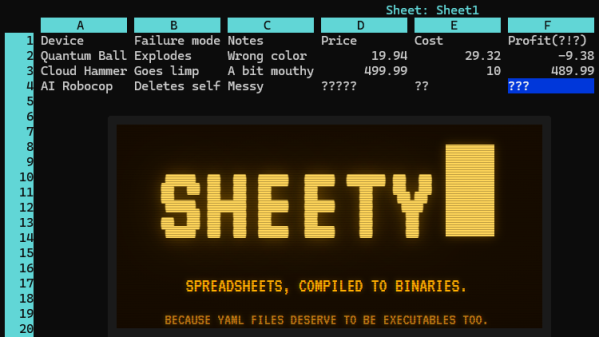
Ever wanted a spreadsheet as an executable with a built-in terminal interface? No? Well, that’s a pity because [Roberto Alsina]’s Sheety project does exactly that.

Sheety compiles spreadsheet definitions into a self-contained, executable binary with zero runtime dependencies. It presents a simple terminal application (with mouse support) in which one can browse and edit data and formulas with a simple interface. As far as formats go it can import and export Excel files, or a human-readable .yaml file.

When Sheety runs, the data and formulas defined are compiled into a self-contained executable with the formulas baked in, and that’s actually what one sees and uses. If a formula gets changed in the UI, a new and updated version is created on the fly to reflect the changes.

Sheety is perfectly functional, though it does have some limitations. Can the display width of cells be resized? They cannot. Does anyone actually need this? Probably not, as [Roberto] happily admits. Is it a fun project? Absolutely.

Be warned that while Sheety supports the Excel format, it understandably doesn’t support every single function Excel has added in the over forty years it has been around.

Sheety is written in Crystal and the GitHub repository has everything you need if you’d like to give it a try for yourself.
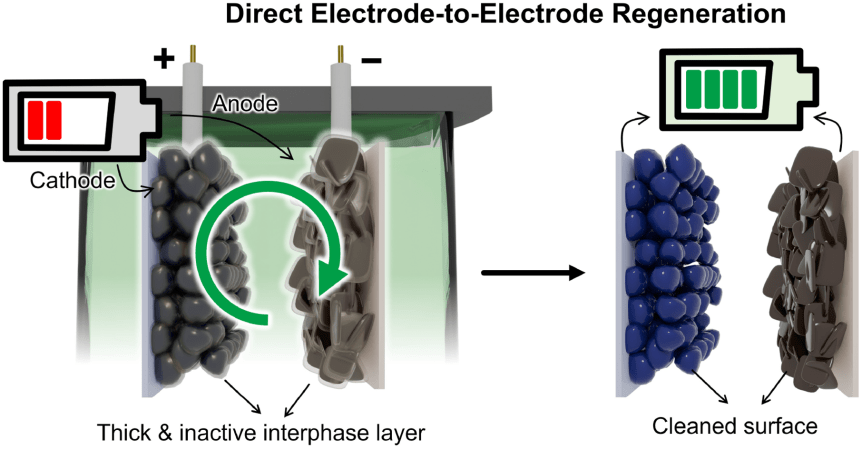

A drawing of a battery cell with gunk on the labeled anode and cathode called the "thick and inactive interphase layer." An icon of a dead battery with two red bars within a pictograph of a battery is superimposed. An arrow points to the right to a cleaner looking cell with a full battery icon with green bars inside showing the cell after regeneration.

A Simple Solution For Streamlining Battery Recycling

Lithium batteries have become the backbone of many modern devices ranging from toothbrushes to semi trucks, so what are we going to do with them when these rechargeable cells finally die? Researchers at Cornell have identified a way to streamline the recycling process.

Most current lithium battery recycling involves grinding up the batteries and separating active material from other components like the casing, current collectors, etc. These materials are then processed and turned back into fresh material for a new batch of batteries. Taking everything all the way down to rebuild it is time and labor consuming, and therefore expensive, especially in light of increasingly lower prices for lithium.

The researchers found that by electrochemically dissolving the inactive electrode–electrolyte interphase layers that built up over time, they could rejuvenate the electrode without completely taking it apart. This direct electrode-to-electrode regeneration (DEER) uses 1,3-dimethyl-2-imidazolidinone (DMI) as a solvent for the process. Once reassembled, these regenerated cells have up to 95% of their original capacity while cutting the cost of recycling by over half.

If you’re looking to reuse a pack before sending it to the recycler, may we suggest a whole house battery from an old EV pack and how to integrate them safely.