This Week In Security: Broken Embargoes, UEFI Overflow, Wormable Tailscale, Starlink Ad Snooping, And A DHS Directory Dump

Last week brought us at least two broken embargoes: php2shell leaked onto Hacker News a day early, and a batch of Linux kernel bugs landed on the public kernel mailing list instead of the private security list. This week has been slightly less exciting overall, fortunately, but Akamai’s security team published a pointed essay titled “TLP Is Not a Suggestion”, and it’s hard to argue with the timing.

When a researcher finds a serious bug, the usual process is “coordinated disclosure”. The developers get time to build a fix, and downstream vendors get advance notice under embargo so patches and protections are ready the moment details go public. The Traffic Light Protocol (TLP) is the vocabulary everyone uses to say who may know what: TLP:RED for named recipients only, TLP:AMBER for an organization and its clients on a need-to-know basis, TLP:GREEN for a trusted community, and TLP:CLEAR for anyone. It has no legal teeth whatsoever. It’s not classified data in a legal sense. It works because everyone involved agrees to make it work.

Akamai’s complaint isn’t really about the original php2shell leak, but about what came after: vendors and researchers racing to confirm, reproduce, and publish first. According to Akamai, a researcher published a reconstruction of the bug before the patch existed, and exploitation attempts started before most admins knew there was anything to patch. They draw parallels to Heartbleed in 2014, where a handful of companies got early notice and then advertised that they were already safe while Linux distributions were caught flat-footed, and to Meltdown and Spectre in 2018, where a six-month embargo collapsed six days early.

In the rush to publish, it’s also become less clear what the actual severity of the bug is in the real world. It clearly exists, and is of concern, but groups are still struggling to prove a complete exploit path, with several challenges showing results but nothing definitive so far.

Their advice boils down to “protect first, publish second”: push the detection rules and virtual patches, tell your customers privately, and save the blog post for after the official advisory. With AI tooling shrinking the time between “details exist” and “working exploit” to hours, the cost of a broken embargo is going up, not down.
Continue reading “This Week In Security: Broken Embargoes, UEFI Overflow, Wormable Tailscale, Starlink Ad Snooping, And A DHS Directory Dump” →

The Sounds Of The World, One Random Album At A Time

In the streaming era it’s easy to forget that there’s still a lot of stuff being broadcast over the radio for anyone who cares enough to dial in their receiver. Give me an antenna big enough and a tower on which to place it, and I shall listen to the world.

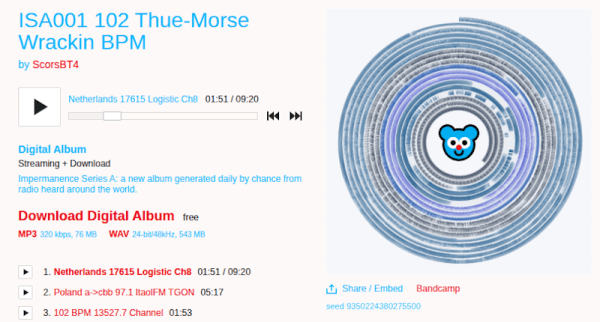
Of course, so you can’t actually listen to everything being blasted out all over the planet yourself. But if you’d like to at least have a little taste, check out Impermanence Series A — a project by [Sam Scorsby] that randomly combines bits and pieces of audio pulled down from shortwave and FM broadcasts with some web streams, live microphones, and even a bit of the Internet Archive each day into a one of a kind album. We’re not sure we’d call it music, exactly. But it’s certainly fascinating to listen to, a bit like randomly spinning the dial on a planet-wide radio receiver.

[Sam] has shared the Python scripts that pull together each day’s album, and he’s not shy about the fact that the project was created with the help of artificial intelligence tools. In fact, that’s sort of the point. [Sam] puts himself somewhere in the middle when it comes to the current debate over AI, and acknowledges that while computers are good at processing raw data, it still takes a human touch to put it all into context.

So each day [Sam] will listen to the latest computer-generated album and pick his favorite tracks, and once the project has run its course, he’ll put together a human-curated “Best Of” collection. Man and machine working together, each doing what they do best.

We know something of opinionated folks on the Internet, and our experience tells us that Impermanence Series A is unlikely to change anyone’s minds when it comes to AI. But we do appreciate the thoughtful approach [Sam] has taken with the project, and look forward to hearing what he comes up with in the end.

Snake On A Seven-Segment Display Is Gloriously Bad

You’ve no doubt heard the saying, “If something is worth doing, it’s worth doing well.” But there’s actually a counter-perspective to this particular philosophy that says it’s also worth doing things badly, with the general idea being that even a semi-successful attempt at something is better than no attempt at all.

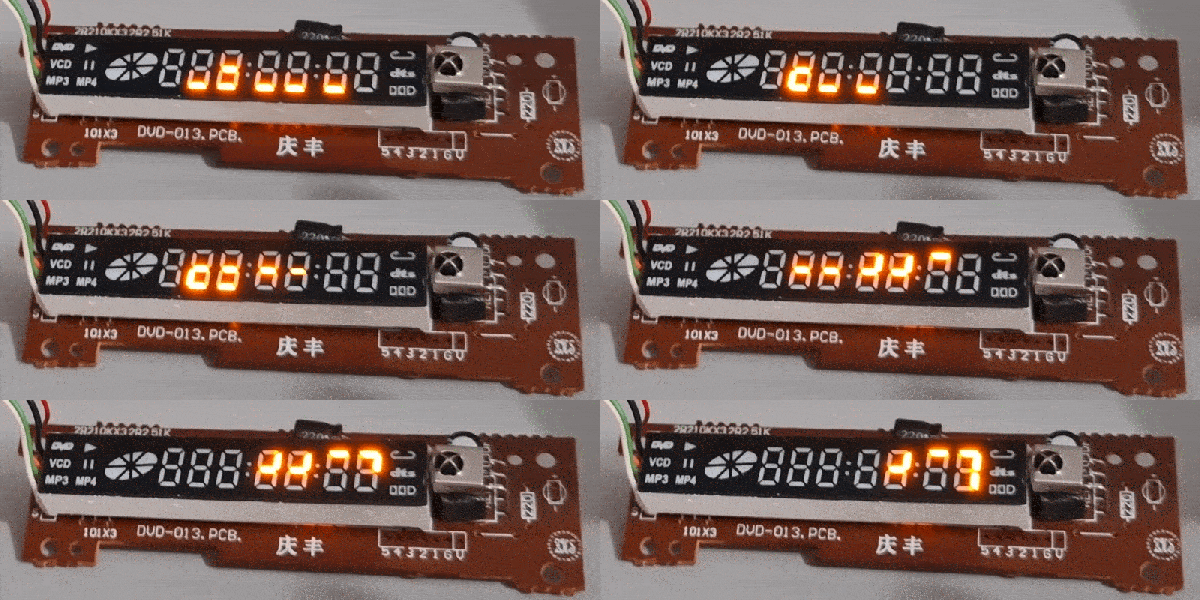
We’re not sure if that’s the principle [José Luis Monteiro] and his father had in mind while working on a way to play the classic Snake on a seven-segment LED display salvaged from an old DVD player, but surely the end result is the same. It’s not so much that the display isn’t a good fit for the eponymous snake, in fact, it actually makes a strange amount of sense. Each of the segments can stand in for a piece of the ever-growing serpent, and they’re already arranged in a roughly rectangular grid that makes moving around straightforward enough.

The issue is that the resolution — such as it is — of the display it pretty unforgiving for anything else. Namely, the “food” that your sake is after is naturally identical to one of its own segments, so it doesn’t take long before it’s all rather confusing visually. But in those brief opening moments, it actually works pretty well.

Even if you’re not interested in Snake, between the documentation, source code, and the video below, this project is a great primer on reverse engineering these types of displays. With a microcontroller, a datasheet, and a bit of patience, you could put together an unattractive and frustrating gameplay experience of your very own! If that’s not the dream, what is?

Continue reading “Snake On A Seven-Segment Display Is Gloriously Bad” →