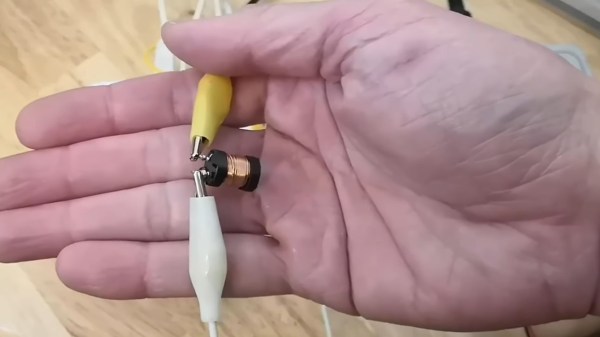
A photo of the air-wired circuit, with one LED on and the other off.

The Magic Of The Hall Effect Sensor

Recently, [Solder Hub] put together a brief video that demonstrates the basics of a Hall Effect sensor — in this case, one salvaged from an old CPU fan. Two LEDs, a 100 ohm resistor, and a 3.7 volt battery are soldered onto a four pin Hall effect sensor which can toggle one of two lights in response to the polarity of a nearby magnet.

If you’re interested in the physics, the once sentence version goes something like this: the Hall Effect is the production of a potential difference, across an electrical conductor, that is transverse to an electric current in the conductor and to an applied magnetic field perpendicular to the current. Get your head around that!

Of course we’ve covered the Hall effect here on Hackaday before, indeed, our search returned more than 1,000 results! You can stick your toe in with posts such as A Simple 6DOF Hall Effect ‘Space’ Mouse and Tracing In 2D And 3D With Hall Effect Sensors.

Continue reading “The Magic Of The Hall Effect Sensor”

Electronic Wizard in his lab wearing his wizards hat

How To Use The AT24C32 EEPROM For 4KB External Memory For Microcontrollers

Over on YouTube [Electronic Wizard] explains how to use the AT24C32 EEPROM for external memory for microcontrollers.

He begins by explaining that you don’t want to try modifying your microcontroller flash memory for storing settings, you want to use a separate EEPROM for that. Sometimes your microcontroller will have EEPROM memory attached, but you might still find yourself needing to attach more. The AT24C32 EEPROM is a 4KB non-volatile memory chip. It’s available in various 8-pin packages and two voltage levels, either 2.7 to 5.5 volts or 1.8 to 5.5 volts, and it’s programmed using the I2C protocol.

Continue reading “How To Use The AT24C32 EEPROM For 4KB External Memory For Microcontrollers”

A photo of the PCB from the charging case

Anker Soundcore Space A40 Earbuds Teardown

Wireless earbuds are notoriously tiny. Want to see inside? [MCH170] did and published a Soundcore Space A40 Teardown.

In this teardown, you’ll see inside the charging case and one of the earbuds. Starting with the case, removing the back cover revealed the charging coil and a few screws holding the PCB in place. Removing the screws allows for removing the coil. The main PCB and the magnets that hold the earbuds in place are then visible. The microcontroller is an SS881Q from Sinhmicro. The back side of the main circuit board has a handful of SMD components, including some status LEDs. The battery is a 13450 with a nominal voltage of 3.72V and a capacity of 800mAh or 2.967Wh.

Continue reading “Anker Soundcore Space A40 Earbuds Teardown”

A photo of two magnetic bubble memories installed in a circuit board

Scott Baker’s Magnetic Bubble Memory Mega-Post

Over on his blog our hacker [Scott Baker] has a Magnetic Bubble Memory Mega-Post.

If you haven’t heard of magnetic bubble memory before it’s basically obsolete nonvolatile memory. Since the 1970s when it was introduced this type of memory has been outperformed in every dimension including durability, reliability, price, density, performance, and so on. For any given application of bubble memory you will be able to find an alternative technology which is better in many ways. Except if you want some old tech to geek out over, in that case magnetic bubble memory is for you!

Continue reading “Scott Baker’s Magnetic Bubble Memory Mega-Post”

Looking in the back of the Tektronix 577

Repairing A Tektronix 577 Curve Tracer

Over on his YouTube channel our hacker [Jerry Walker] repairs a Tektronix 577 curve tracer.

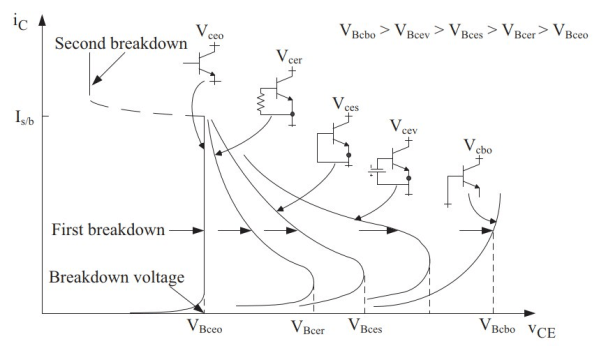
A curve tracer is a piece of equipment which plots I-V (current vs voltage) curves, among other things. This old bit of Tektronix kit is rocking a CRT, which dates it. According to TekWiki the Tektronix 577 was introduced in 1972.

In this repair video [Jerry] goes to use his Tektronix 577 only to discover that it is nonfunctional. He begins his investigation by popping off the back cover and checking out the voltages across the voltage rails. His investigations suggest a short circuit. He pushes on that which means he has to remove the side panel to follow a lead into the guts of the machine.

Continue reading “Repairing A Tektronix 577 Curve Tracer”

Scott and his Prompt 80

Restoring A Vintage Intel Prompt 80 8080 Microcomputer Trainer

Over on his blog our hacker [Scott Baker] restores a Prompt 80, which was a development system for the 8-bit Intel 8080 CPU.

[Scott] acquired this broken trainer on eBay and then set about restoring it. The trainer provides I/O for programming, probing, and debugging an attached CPU. The first problem discovered when opening the case is that the CPU board is missing. The original board was an 80/10 but [Scott] ended up installing a newer 80/10A board he scored for fifty bucks. Later he upgraded to an 80/10B which increased the RAM and added a multimodule slot.

[Scott] has some luck fixing the failed power supply by recapping some of the smaller electrolytic capacitors which were showing high ESR. Once he had the board installed and the power supply functional he was able to input his first assembly program: a Cylon LED program! Making artistic use of the LEDs attached to the parallel port. You can see the results in the video embedded below.

Continue reading “Restoring A Vintage Intel Prompt 80 8080 Microcomputer Trainer”

A hand holding a One ROM with a Commodore 64 in the background

One ROM: The Latest Incarnation Of The Software Defined ROM

Retrocomputers need ROMs, but they’re just so read only. Enter the latest incarnation of [Piers]’s One ROM to rule them all, now built with a RP2350, because the newest version is 5V capable. This can replace the failing ROMs in your old Commodore gear with this sweet design on a two-layer PCB, using a cheap microcontroller.

[Piers] wanted to use the RP2350 from the beginning but there simply wasn’t space on the board for the 23 level shifters which would have been required. But now that the A4 stepping adds 5 V tolerance [Piers] has been able to reformulate his design.

The C64 in the demo has three different ROMs: the basic ROM, kernel ROM, and character ROM. A single One ROM can emulate all three. The firmware is performance critical, it needs to convert requests on the address pins to results on the data bus just as fast as it can and [Piers] employs a number of tricks to meet these requirements.

The PCB layout for the RP2350 required extensive changes from the larger STM32 in the previous version. Because the RP2350 uses large power and ground pads underneath the IC this area, which was originally used to drop vias to the other side of the board, was no longer available for signal routing. And of course [Piers] is constrained by the size of the board needing to fit in the original form factor used by the C64.

The One ROM code is available over on GitHub, and the accompanying video from [Piers] is an interesting look into the design process and how tradeoffs and compromises and hacks are made in order to meet functional requirements.

Continue reading “One ROM: The Latest Incarnation Of The Software Defined ROM”