808 Drum Machine In An ATTiny 14-Pin Chip

You may not know the 808 drum machine, but you have definitely heard it: the original Roland TR-808 was the first programmable drum machine and has been a mainstay of electronic music ever since. Hackers have been building their own versions of this vintage device for years, but this version from do-it-yourself synth builder [Jan Ostman] is quite remarkable.

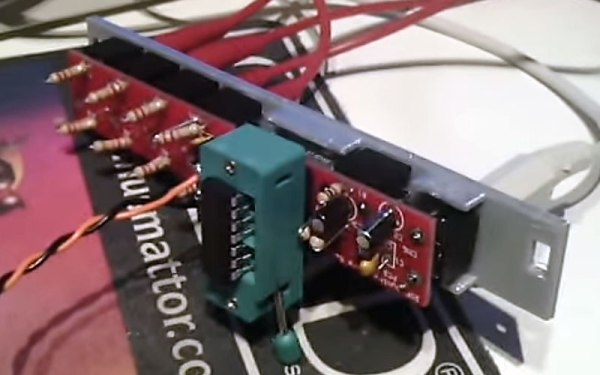
He’s packed the entire device (called the Drum8 Vintage) into a single ATtiny84 14-pin DIP package, including the samples and eight polyphonic voices, plus old-school analog CV triggers, a global tune and an analog global accent input. That won’t mean a lot to non-musicians, but suffice to say that these are the same inputs that the original TR-808 had that allowed you to do all sorts of interesting stuff to trigger and modify the drum sounds. Plus some extras.

[Jan] is offering the chip itself for $20, and has made a limited edition version that is built into a patch bay panel for that genuine hard-wired look for $99. If you want to go the home-made route and make your own, he’s released the source code and schematics for making your own. You can check out more of [Jan’s] work in this post on making your own open-source instruments from Elliot. Thanks, Jan!
Raspberry Pi Adds A Digital Dash To Your Car

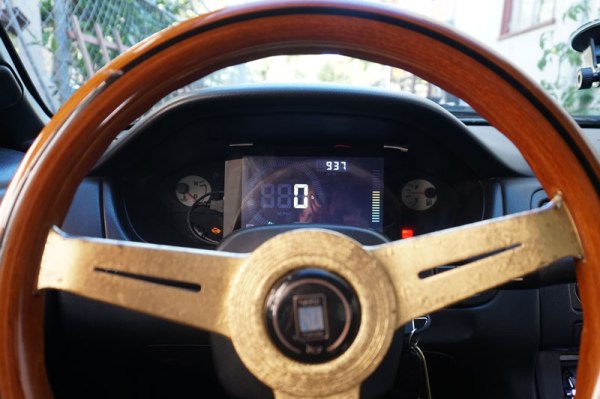
Looking for a way to make your older car more hi-tech? Why not add a fancy digital display? This hack from [Greg Matthews] does just that, using a Raspberry Pi, a OBD-II Consult reader and an LCD screen to create a digital dash that can run alongside (or in front of ) your old-school analog dials.

[Greg’s] hack uses a Raspberry Pi Foundation display, which includes a touch screen, so you don’t need a mouse or other controls. Node.js displays the speed, RPM, and engine temperature (check engine lights and other warnings are planned additions) through a webpage displayed using Chromium. The Node page is pulling info from another program on the Pi which monitors the CAN Consult bus. It would be interesting to adapt this to use with more futuristic displays, maybe something like a pico projector and a 1-way mirror for a heads-up display.

To power the system [Greg] is using a Mausberry power supply which draws power from your car battery, but which also cleanly shuts down the Pi when the ignition is turned off so it won’t drain your battery. When you throw in an eBay sourced OBD-II Consult reader and the Consult Dash software that [Greg] wrote to interpret and display the data from the OBD-II Consult bus, you get a decent digital dash display. Sure, it isn’t a Tesla touchscreen, but at $170, it’s a lot cheaper. Spend more and you can easily move that 60″ from your livingroom out to your hoopty and still use a Raspberry Pi.

What kind of extras would you build into this system? Gamification of your speed? Long-term fuel averaging? Let us know in the comments.

UPDATE – This post originally listed this hack as working from the OBD-II bus. However, this car does not have OBD-II, but instead uses Consult, an older data bus used by Nissan. Apologies for any confusion!

Continue reading “Raspberry Pi Adds A Digital Dash To Your Car”

Simple RFID Door Lock System

Group entry hacks are a favorite for hacker social groups. Why use old fashioned keys when you can use newfangled electronic keys? If you are looking to build a simple RFID-based security system to secure your important stuff, this project from Resin.io is a good place to start. In it, [Joe Roberts] outlines the process of building a simple RFID-triggered mechanism for their office door.

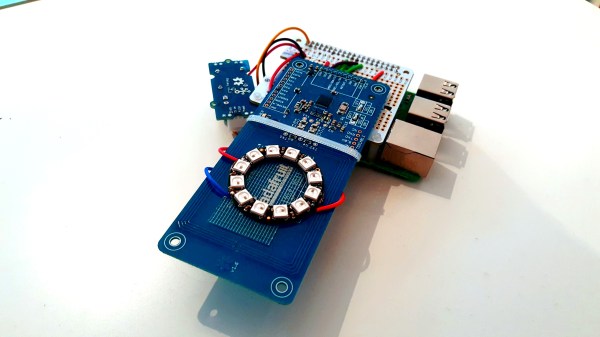
It’s a pretty simple setup that is composed of an RFID reader, a Rasperry Pi and a Neopixel ring. When someone places an RFID card against the reader hidden behind a poster by their front door, the reader grabs the code and the Pi compares it with a list of authorized users. If the card is on the list, the Pi triggers the door lock using a signal line originally designed to work with an intercom system. If the user isn’t on the list, a laser is triggered that vaporizes the interloper… well, that’s perhaps in the next version, along with an API that will allow someone to open the door from the company chat application.

At the moment, this is a clean, simple build that uses only a few cheap components, but which could be the basis for a more sophisticated security system in the future.

Home-made Adjustable Knife Jig

When sharpening a knife, it is critical to have the knife at the right angle. A knife jig handles this for you, letting you focus on getting the edge right. You could just buy one, but where’s the fun in that? [origamimavin] decided to make his own adjustable knife jig using bits he bought from the hardware store for $27, and which you might have in your junk pile. Fortunately for us, he’s written up the process in excellent detail, explaining the how and why of each step.

He used a couple of tools that you might not have lying around (a bandsaw and a belt sander), but these could be easily replaced with their manual cousins, or your local hackerspace will doubtless provide you access to them. Either way, it’s a simple build which could help your knives keep their clean, sharp edge for years to come.

Tracking Airplanes From An Autonomous Boat

Airplane tracking systems like FlightRadar24 rely on people running radios that receive the ADS-B signal and forward the data on to them. That doesn’t work so well in the middle of the ocean, though: in spots like the mid-Atlantic, there are no islands to speak of.

So, the service is now experimenting with a new approach: putting an ADS-B radio onto an autonomous boat. The boat is a Wave Glider from Liquid Robotics, an autonomous boat that harvests the power of the waves to run propulsion, guidance, and its payload. In this case, that payload includes an ADS-B receiver and a satellite transmitter that uploads the plane data to the service, where it is added to their mix of data sources. The boat is planned to spend the next six to eight weeks cruising about 200 miles off the coast of Norway, listening to the broadcasts of planes flying overhead and relaying them back to HQ. They will then be plotted on the live map in blue.

If you’re interested in building your own plane-trackers, we’ve got you covered, at least on land.

Raspberry Pi Walkie Talkie Mumbles To Friends

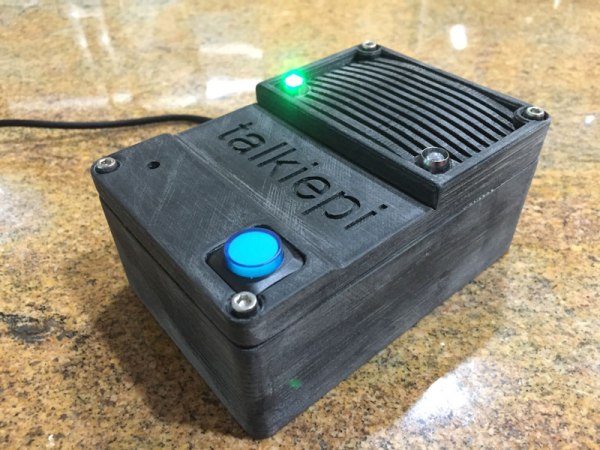
His kids wanted walkie talkies, so [Daniel Chote] built one. The TalkiePi is a neat project built around a Raspberry Pi running Mumble, the open-source voice chat system that his kids can share with their siblings and friends.

It’s easy enough to choose the Raspberry Pi, and Mumble is pretty well known. But what’s the easiest way you can think of to add microphone and speakers to the RPi? We applaud [Daniel’s] choice to equip it with the guts of a USB speakerphone. Mumble lets you choose voice activation or keyboard input — in this case an added button makes it push-to-talk, as you would expect in a traditional walkie talkie.

He put all of this into a nicely designed 3D case with a few LEDs, so it is easy to tell that it is ready to transmit. [Daniel] isn’t quite finished yet, though: he’s now working on a new version that is portable, battery powered and uses a Raspberry Pi Zero for the ultimate walkie talkie. We can’t wait to see someone take this to the extreme and include a cellular-modem. But then again, anywhere you can get on WiFi this rig should work, it’s not relegated to a single LAN, and that already far outperforms walkie talkies of yore.

10,000 Lumen Sunrise Lamp Curses The Darkness

Some of us need a bit of help to get up in the mornings. This can come in the form of a sunrise lamp, which simulates the light of the sunrise to fool our poor sleep-deprived brains into waking up in the depths of winter. [Lincoln Johnson] found the ones he tried were not bright enough to wake him, so he decided to build his own: a 10,000-lumen monster that can wake him up from across the room.

It uses a lot of LEDS: 5 meters of 5630 LED strip, which pulls a circuit bending 72 watts when running at full blast. This monstrosity is powered by an Arduino Pro, which is programmed to slowly increase the brightness over a period of 30 minutes, thus simulating the sunrise. It uses PWM control to fade the LEDs, and also includes a dot matrix display to show the time. Honestly, if you are able to sleep through this thing blasting your eyes, you are probably dead.