We Didn’t Know The Sun Could Do Digital

You don’t get much more old school than a sundial, and more new school than 3D printing. So, it is nice to see these two combined in this impressive project: the 3D printed digital sundial. We have seen a few sundial projects before, ranging from LED variants to 3D printed ones, but this one from [Julldozer] takes it to a new level.

In the video, he carefully explains how he designed the sundial. Rather than simply create it as a static 3D model, he used OpenSCAD to build it algorithmically, using the program to create the matrix for each of the numbers he wanted the sundial to show, then to combine these at the appropriate angle into a single, 3D printable model. He has open-sourced the project, releasing the OpenSCAD script for anyone who wants to tinker or build their own. It is an extremely impressive project, and there is more to come: this is the first in a new podcast series called Mojoptix from [Julldozer] that will cover similar projects. We will definitely be keeping an eye on this series.

Continue reading “We Didn’t Know The Sun Could Do Digital”

Dragon Doors Round Off Hobbit Themed Restaurant

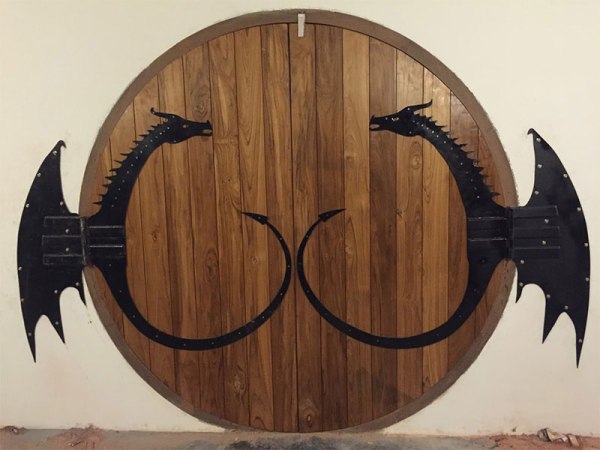
[Abhimanyu Kumar] is renovating a hotel in Nainital, near the India-Nepal border, and like any self-respecting Lord of the Rings fan, he wanted to give the restaurant a Hobbit theme. He built circular windows and to top it off a gorgeous round door complete with dragon hinges.

I asked him how well the doors work, as the 50kg (over 110lbs) weight of each of the doors must put a lot of strain on the hinges. [Abhimanyu] told me, “The door opens quite smoothly.While building the hinges even I was concerned about needing support as all other commercially available hinges we tried broke down or got bent.”

However, once the dragon hinge was installed it worked better that we expected and the door stays about 0.5″ over the ground at all times. The dragon hinges (made from 1/4-inch iron) integrate the hinge pins to the wings of the dragon, making it look like they are taking off when the doors open.

He has posted plenty of pictures of the build and the final product looks incredible.  The tail of the dragon is quite long and provides a lot of support for the entire door. Each hinge itself weighs about 30kg, so it should be strong enough to hold up a door for a long time without any sagging. Kudos to him for some serious engineering!

Teach An ATTiny 85 To Swear

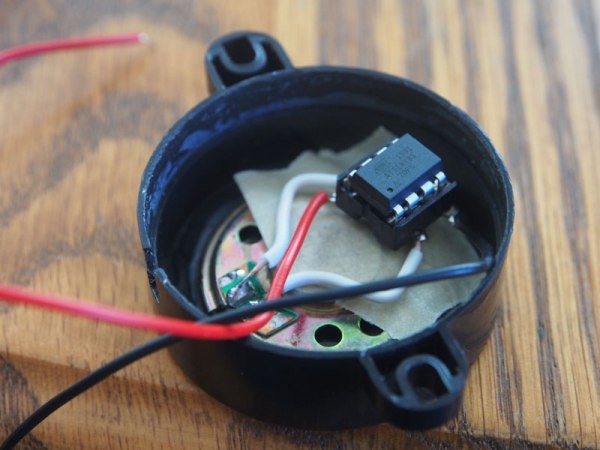
Let’s be honest here: one of the first things we all did when we came across speech synthesizers like the Speak-n-spell was to try swear words. [Alec Smecher] has taken this to heart, building a simple buzzer mechanism driven by an ATTiny 85 that swears repeatedly when you connect it. It is a rather simple project (or, as [Alec] himself says, it is “a satisfyingly minimalist build”), but it is quite nicely done.

The 8kHz speech sample (taken from Google Translate) is stored in the code, and written out to one of the PWM outputs of the ATTiny85 from a timing loop to directly drive the small speaker. So, all that is needed is the buzzer case, a small speaker, the ATTiny85, a power source and a few bits of wire. It’s a great example of a minimalist design: the ATTiny85 can just about drive the speaker directly, and can be run directly from batteries without requiring a power controller. Sometimes it pays to keep things simple, especially when it comes to swearing. 

Continue reading “Teach An ATTiny 85 To Swear”

Powered Skateboards Are Passe; Skelecs The New Hotness

[Harris] has an interesting answer to the inevitable question about what he did on his summer vacation: he built a pair of electric roller blades.  [Harris] is an Electrical Engineering student at the University of Nottingham, and he completed the first version of what he calls Skelecs just before he went back to college. He has documented the process from the initial concept and building his own controller board, through his failures at correctly drilling the steel base, to his first drive down the road.

His build uses a pair of small 120W hub motors attached to a steel chassis, which is attached to a pair of cannibalized rollerblade boots.

It’s a bit of a Frankenstein build (he currently has the batteries and controller stuffed into a pants pocket, which isn’t really a practical long-term solution), but it works. A bit too well, in fact: [Harris] says that a combination of speed and a bumpy road detached one of the batteries and sent him flying. He’s not letting a minor injury and a bit of blood put him off, though: he’s already started work on version 2, which will use lighter aluminum construction and a pair of omniwheels for easier steering and more control. We’ll believe that claim when we see it.

Remember, powered skateboards are over — non hackers got their hands on them so they’re commonplace. Hipster hackers need to drop that build and start on your own pair of Skelecs.

Continue reading “Powered Skateboards Are Passe; Skelecs The New Hotness”

Make A Cheap (And Dangerous) Automated Flamethrower

Nothing lights up the night like a quick blast from a flamethrower, but there is a reason why you can’t buy them in the Halloween decoration aisle at Target. They are dangerous, for fairly obvious reasons. [Erco] seems to have no particular fear of death, though, and he shows how you can build a simple flamethrower with a small candle, a servo, Arduino and a can of hairspray. Tresemme Extra Strong Hold, in particular, although we don’t think the exact type matters that much. All he did was to mount the candle in front of the hairspray, then mount the servo so the arm presses the spray head down. The candle does the rest, lighting the highly flammable propellant in the hairspray to produce the flamethrower effect. [Erco] is using four of these, which are co-ordinated to fire in time with music.

This one seems a bit risky. Servos have a habit of locking, and there is nothing stopping these from locking in the open position, or sticking there if the Arduino crashes. A relay or other switch that reverts to an off position when the power is removed would have been more suitable here. Secondly, there is no emergency off switch. [Erco] has wired the Arduino up next to the flamethrower itself, so you are going to have to reach in to disconnect it. That is risky enough, but he also tried a 4-way configuration that would have been impossible to disable in the event of a problem (shown in the accompanying images). Thirdly, there is no fire protection between the can of hairspray and the open flame, so if the spray head melts or fails from the heat, it’s game over. Finally (and most importantly), where are the fire extinguishers? We’d like to hear how you’d build this with safety in mind. Let us know in the comments below.

We’re big fans of flames and explosions: we’ve have seen a couple of Survival Research Laboratory shows and were blown away by their destructive pyrotechnics. But, as SRL head Mark Pauline said in a recent talk, “when things blow up at an SRL show, it’s on purpose”.

Continue reading “Make A Cheap (And Dangerous) Automated Flamethrower”

Hackaday Dictionary: Near Field Communications (NFC)

You are at the corner store, buying gum. The cashier rings up the purchase, showing you the amount. You casually pull out your cell phone and wave it near the credit card machine, which beeps appreciatively. The cashier nods, and you walk out, stuffing gum into your face. What just happened? You used Near Field Communications (NFC) to send data between your phone and the credit card terminal.

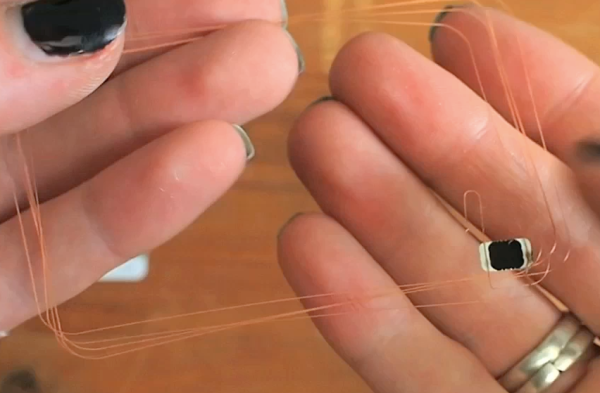
NFC is a standard that allows two devices to exchange information over a short distance without being in physical contact. The two devices communicate using a weak magnetic field that, in theory, only has a range of a few centimeters, so both devices have to be physically close, and someone standing nearby can’t intercept or alter the signal.

Continue reading “Hackaday Dictionary: Near Field Communications (NFC)”

DARE To Fly: Live Coverage Of A 50KM Rocket Launch

We wrote about the Delft Aerospace Rocket Engineering (DARE) project recently: a group of students at Delft Technical University who are trying to launch a rocket to 50kM, breaking the European amateur rocketry record. Now, the group is close to their latest launch attempt, which is scheduled to take place from their launch base in Spain between the 14th and the 20th of October.

Launch preparations are underway, with the team working through a 10,000 point pre-launch checklist. Last year, their launch failed because of a leaking valve, but the amateur engineers have just successfully completed a pressure test using inert gas, so they are confident that this problem won’t happen again. They are offering a live video feed of the launch (embedded below), and will be regularly updating their twitter feed as they prepare. We wish them the best of luck.

Continue reading “DARE To Fly: Live Coverage Of A 50KM Rocket Launch”