VCF East X: The Quarternet Steering Committee

Today was the first day of the Vintage Computer Festival East X. As is the tradition, the first day was packed with talks and classes about various retrocomputing ephemera, with this year featuring a great talk from [David Riley] about 8-bit computer music, a class on system architecture from our own [Bil Herd] (video coming soon), and a talk about vintage teletypes. One of these talks was about creating new hardware: [Jim Brain]’s steering committee on a networking solution for vintage microcontrollers. It’s called Quarternet: a two-bit solution for an eight bit world.

While minicomputers are easily networkable, designed around multi-user operating systems, and have the hardware for a lot of networking hardware, 8-bit micros are the exact opposite. That doesn’t mean 8-bitters don’t have networking; you can get an Ethernet cart for a C64, and just about everything can connect to a BBS. [Jim]’s talk was about whittling down the use cases for the Quarternet to something that could be implemented easily, but still give the most capability.

During the talk, the audience settled on using a serial connection from the micro to the outside world; this makes sense, as everything has a serial port. A ‘lightweight API’ was suggested to take up the software side of the problem, but there wasn’t much agreement over what that API would actually do.

[Jim]’s idea is for a box that plugs into the serial port of any old microcomputer and would connect to the Internet somehow. Ethernet, WiFi, or even a modem isn’t out of the question here. That takes care of connecting to the Internet, but there’s also the question of the cooler side of networking – network drives, file sharing, and the like.

For this, [Jim] is imagining a box with a serial port on one end, and a network port on the other. In the middle would be a cartridge slot for any hardware imaginable. If you want to plug in an Apple II disk drive, just insert the right cartridge and you’re good to go. If you need network access to a Commodore 1541 drive, just insert another cartridge, and it’ll just work.

It’s an interesting idea, but [Jim] is really interested in getting even more feedback for a networking system for old microcomputers. If you have any ideas, leave a note for him in the comments.
Review: Printrbot Assembled Simple Metal

Hackaday is getting back into the swing of doing reviews, and with that comes reviews of the tool du jour, 3D printers. I have some reservations about reviewing a 3D printer; they’re a new technology, and what may be standard today could be hopelessly outdated in a few months time. Remember geared extruders? The new hotness is, apparently, direct drive extruders.

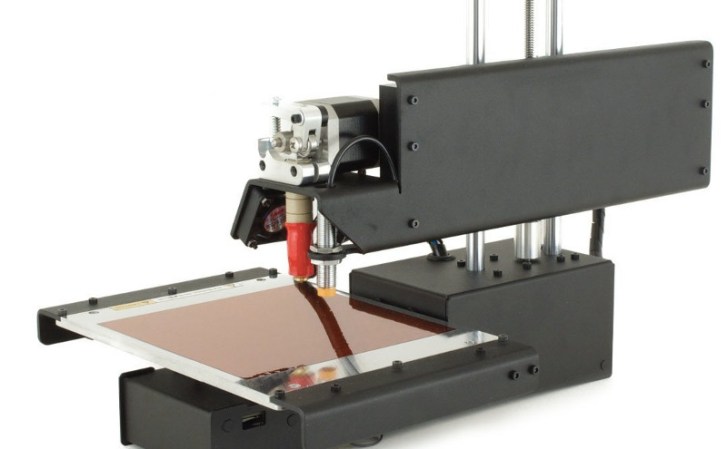
This is a review of the Printrbot Assembled Simple Metal. If you need any evidence that reviews of 3D printers have a shelf life, you only need to look at the Getting Started guides for this printer. When I bought my Simple Metal, the Printrbot recommended software stack was Slic3r and Repetier-Host. Barely three months later, Cura is now the Printrbot recommended software stack. If you think a simple change in software is inconsequential, check out these prints:

prusa parts
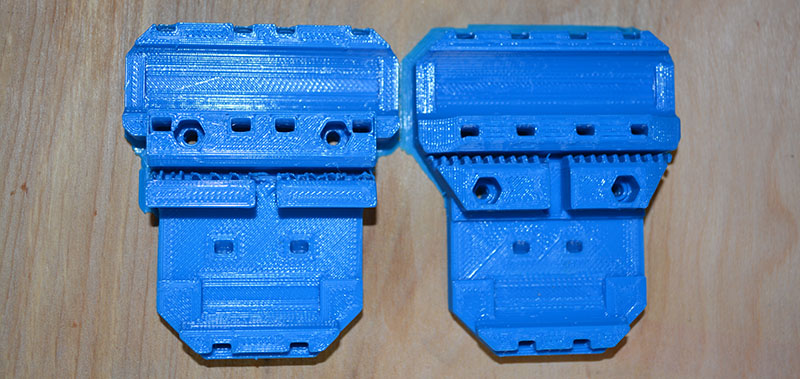
Prusa i3 X-carriages. Left sliced by Slic3r, right sliced by Cura

The print on the left was sliced with Slic3r. The print on the right was sliced with Cura. Notice the small teeth that grip the timing belt on each of these prints. With the Cura-sliced print, everything is fine. The Slic3r-sliced print is a complete failure, not of the machine, but the recommended software for the machine.

Therefore, if the goal of writing a review is to have a definitive opinion of a piece of equipment, a number of questions must be addressed. Since most 3D printing software is open source, should software be included in the review? Is the value proposition of a 3D printer simply a function of price to build volume (this seems to be the standard metric now), or are there intangibles? Should the review cover the quality of prints out of the box, or should the review only focus on print quality after dozens of hours of tweaking? I simply don’t know the answers to these questions, and I suspect you couldn’t get any two people to agree on the answers to these questions.

With that said, I feel I have used this printer enough to make a judgment call as to if this printer was a good buy.

Continue reading “Review: Printrbot Assembled Simple Metal”

Making Funhouse Mirror Lenses

[Robb] has had a little experience making lenses from scratch. His first attempt was for a DIY projector, and while the lens was a little blurry, it did work rather well for something carved out of a block of acrylic. Now he’s taking his experiments with lenses even further with DIY optics that turn everything into a funhouse mirror.

There were two techniques tested while making these lenses. The first was the old standby, CNC milling. A piece of acrylic was put in a CNC and carved with a 1/2″ ball mill. The second technique was 3D printing on a very fancy and very expensive Objet Connex 500. Neither of these methods produce a ready to use lens; to get a finished lens out of the machined or printed objects, [Robb] had to wet sand with 240, 320, 400, 600, 1000, 1500, and 2000 grit sandpaper. After a few hours worth of sanding, the parts were polished with a scratch remover.

Making a lens like this isn’t really that novel – it’s basically the same way lenses have been made for 500 years. The real trick here is making funhouse mirror style lenses. These lenses were created by raytracing in Rhino and Neon. It’s tricky; the index of refraction for acrylic is a little lower than glass, and the refraction for 3D photoresin is a bit higher than glass.

With those models in hand, it’s a relatively simple matter of making some very cool and very strange lenses.

The Possibility Of Driving 16,000 RGB LEDs

Like just about everyone we know, [Luis] decided a gigantic RGB LED matrix would be a cool thing to build. Gigantic LED matrices are very hard to build, though: not only do you have to deal with large power requirements and the inevitable problems of overheating, you also need to drive a boat load of LEDs. This is not easy.

[Luis] found a solution to the problem of driving these LEDs with a new, fancy ARM Cortex M4 microcontroller. All Cortex M4 ARMs have DMA, making automatic memory transfers to peripherals and LED strips a breeze.

The microcontroler [Luis] is using only supports 1024 transfers per transfer set, equating to a maximum of 14 LEDs per transfer. This problem can be fixed by using the ping-pong mode in the DMA controller by switching between data structures for every DMA request. Basically, he’s extending the number of LEDs is just switching between two regions of memory and setting up the DMA transfer.

The result is much better than [Luis]’ original circuit that was just a bunch of SPI lines. It also looks really good, judging by the video below. It’s not quite a gigantic LED matrix yet, but if you want to see what that would look like, check out the huge 6 by 4 foot matrix hanging in the Hackaday overlord office.

Continue reading “The Possibility Of Driving 16,000 RGB LEDs”

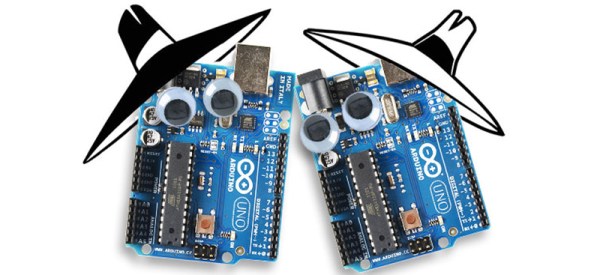
Arduino Vs. Arduino: The Reseller’s Conundrum

Over the last few months, the internal struggles between the various founders of Arduino have come to a head. This began last November when Arduino SRL (the Italian version of an LLC) sued Arduino LLC for trademark infringement in Massachusetts District court. To assuage the hearts and minds of the maker community, Arduino SRL said they were the real Arduino by virtue of being the first ones to manufacture Arduino boards. A fork of the Arduino IDE by Arduino SRL – simply an update to the version number – was a ploy to further cement their position as the true developers of Arduino.

This is a mess, but not just for two organizations fighting over a trademark. If you’re selling Arduinos in your web store, which Arduino do you side with?

[Nate] from Sparkfun is answering that question with a non-answer.

Currently, Arduino SRL is the only source of Arduino Unos. Sparkfun will continue to buy Unos from SRL, but they’re not necessarily siding with Arduino SRL; people demand blue Arduinos with Italy silkscreened on the board, and Sparkfun is more than happy to supply these.

There are, however, questions about the future of Arduino hardware. The Arduino software stack will surely be around in a year, but anyone that will be purchasing thousands of little blue boards over the next year is understandably nervous.

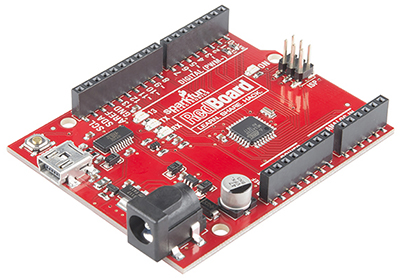
redboardThis isn’t the first time Sparkfun has faced a challenge in Arduino supply. In 2012, when the Arduino Uno R3 was released, all the documentation for their very popular Inventor’s Kit was obsoleted overnight. In response to these supply chain problems, Sparkfun created the RedBoard.
Sparkfun has always offered to pay royalties on the RedBoard to Arduino LLC, just as they do with the Arduino Pro and Pro Mini. Effectively, Sparkfun is on the fence, with offers to manufacture the Arduino Zero, Uno, Mega, and Due coming from the LLC.

The reason for this is consumers. If someone wants an Arduino SRL-manufactured board, they’ll buy it. If, however, a customer wants to support Arduino LLC, that option is on the table as well.

It’s not a pretty position to be in, but it does show how someone can support one Arduino over another. In a year or two, there will only be one Arduino, but until then, if you have a preference, at least Sparkfun is giving you a choice.

Credit to Sparkfun for the great Spy vs. Spy image. Why don’t you sell googly eyes?

An Improved Table Saw Fence With Threaded Rod

Back in the bad old days, table saw fences were terrible. You would have to measure the top and bottom of the fence before each cut, just to make sure the fence was square to the blade. In the 1970s, [Bill Biesemeyer] invented a better table saw fence, one that was always square, and included a measuring tape, right on the table saw.

[Jer] wanted an upgrade for his table saw and came up with what might be the next evolution of the table saw fence. It will always produce a square cut, but unlike the 1970s version, this fence has repeatability. If you rip a board to 1″, move the fence, come back to it after a month, and try to rip another board to 1″, those two boards will be exactly the same width.

The secret to this repeatability is a threaded rod. On the front of the fence is a big, beefy piece of threaded rod with 16 threads per inch. On the fence itself is two nuts, cut in half, welded to the guide, with a lever and cam to lock them in place.

When the lever is up and the nuts are disengaged from the threaded rod, the fence easily moves from one side of the table to the other. When the fence is locked down, it locks to the nearest 16th of an inch, and only the nearest 16th of an inch. While that may seem a little large for a relatively expensive tool, this is wood we’re talking about here. There’s not much reason to make the resolution of this fence any smaller; wait until the humidity changes and you’ll have a piece of wood that’s the desired dimension.

Continue reading “An Improved Table Saw Fence With Threaded Rod”

Retro Edition: VCF East X This Weekend

It’s mid-April and time once again for the Vintage Computer Festival East X. The X means 10. It’s a three-day weekend full of interesting people, cool tech, and computers you’ve only heard about. We’ll be there all three days, and if you’re in New York or are unable to pump your own gas (Oregon excluded), it’s a great way to spend the weekend.

The sessions for this Friday will include everything from chiptunes to retr0bright to emulating vintage computers on FPGAs. Sessions of note include our own [Bil Herd] giving a talk on system architecture. Think of this as a bunch of engineers in a room with a whiteboard. How could you not have fun with that. There will also be the first meeting of the Quarternet committee, headed up by [Jim Brain]. This session will be a discussion of implementing a vintage networking protocol across different models and different brands of vintage computers. Confused? It’s a, “two-bit solution for an eight-bit world.” That’s all we know, and I’m pretty sure that’s all anyone knows. It will be interesting.

Saturday and Sunday will feature an incredible number of exhibits that includes everything from Atari 8-bits, Hollerith cards, mainframes, an amateur radio station (KC1CKV) and somehow a Fairlight CMI. Since this is the 50th anniversary of the PDP-8, there will be a few of these ancient machines on display. A freshly restored Straight-8 will be up and working, as will an incredible emulation from hackaday.io.

Just because there are exhibits doesn’t mean the talks end on Friday. On Saturday the guest speaker will be [Brian Kernighan], the guy who literally wrote the book on C. Sunday will feature [Bob Frankston], co-developer of VisiCalc. There will be very important people here all weekend.

Even if vintage computers aren’t your thing, there’s still plenty of stuff to see at the venue. The InfoAge science center has technological curiosities stretching back a century, and recently they’ve rehabbed an old satellite dish and turned it into a radio telescope. Registration happens here, and if the last few paragraphs haven’t sold you on the event, you can check out [The Guru Meditation]’s VCF preview video below. We will, of course, be posting a lot of stuff from the event.

Continue reading “Retro Edition: VCF East X This Weekend”