Breaking Open The Quirky Nimbus

Nimbus

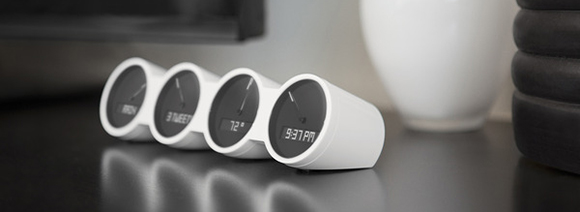
The Nimbus is a little Internet-connected device put out by a company called Quirky. It features four analog dials, each with graphic LCDs, with WiFi connectivity to show you how many tweets you’ve made in the past day. You know, in case you forgot, or something.

[Edu] didn’t find the social media-oriented Nimbus very useful, but Internet connected analog gauges are just so cool, so out came the screwdriver and the writing of new firmware commenced.

Inside the Nimbus there’s an SPI Flash, PIC micro, and an Electric Imp, a tiny ARM microcontroller and WiFi adapter stuffed inside an SD card. The Imp is always tied to a cloud service, in this case, a Quirky-lined cloud, but the folks at Quirky were keen to help [Edu] in his quest for better firmware.

After figuring out all the traces, [Edu] wrote a simple firmware that can control everything there is to control – the dials, displays, two buttons, and a speaker. So far he’s put some graphics on the display and PWM’d the theme from Monkey Island. This is just scratching the surface of what the device can do – [Edu] can still make use of the WiFi connectivity, and those dials can do much more than spin around in circles.

Monkey Island video below.

Continue reading “Breaking Open The Quirky Nimbus”

ISEE-3: Ready To Come Home

ISEE

The team working to reboot the ISEE-3 satellite hurtling towards an August encounter with Earth is hard at work. They’ve put up a crowdfunding page, and now that they’re completely funded (don’t stop donating, btw), they’re starting to go deeper into the waters that will allow them to capture a forgotten satellite.

The project put up a status report going over what they’ve accomplished so far, and what work has yet to be done. For a few months now, they knew both transmitters aboard the craft were operational, but they were not sending telemetry. The team has gone through the documentation, came up with a set of commands, and are currently en route to Arecibo to transmit those commands.

Two ground station transmitters are being constructed, one specifically built to be installed at Arecibo for this application. The other is a portable, self-contained 700 watt transmitter that will be used at the official ISEE-3 ground station in Morehead State University in Kentucky.

With transmitters taken care of and receiving handled by an SDR from Ettus Research, a lot of work has focused on the command and telemetry systems.  In 1978, the user interface for commands and telemetry was primitive to say the least. The team is now working on a system built-in Labview that’s much easier on the eyes than the vintage text terminal screens.

So far, signals from ISEE-3 are planned to be received at Arecibo, Morehead State, and Bochum observatory in Germany. This will give the team extremely good coverage for most of a day, and there are other ground stations in California that will extend the time the team is able to communicate with ISSE-3 each day by a few hours.

There’s still a lot of work to be done; the team really doesn’t know what systems are still operating, although most of them did make it 20 years with only one fault. In the next few days, we’ll all get to see if this satellite will be up to the task of coming back home to Earth. If everything goes to plan, ISEE-3 will be on track towards a 17 hour burn to put it on the correct trajectory some time in mid June.

A WiFi Home Power Meter

acFor his masters at Cornell, [Christopher McNally] designed a simple, non intrusive home power meter capable of doing everything a ‘smart meter’ can do – log power consumption throughout a home, and display a log of a home’s power consumption over WiFi. He’s even testing out some interesting ideas, like automatically detecting when specific devices turn on by reading the current data.
From [Chris]'[Jeramy] developed his system around the Arduino and a Ethernet shield, taking care of networking and choosing a micro, leaving him more time to develop the more interesting part of the project: sensing current. For this he used a small, clip-on current transducer. This sensor generates up to 10 VAC across a resistor, but the Arduino doesn’t play well with AC, requiring a small rectifier built around an op amp.

While the project works as a homebrew smart meter, [Jeramy] wasn’t able to automatically detect when certain devices were powered on. This is partly due to the fact that changes in current were only seen in magnitude and not waveform. Also, if two devices were powered on at the same time, the software would see that as a larger device that draws the sum of the current of two smaller devices. Still, [Jeramy] came up with a cheap way of metering power in any home, and the cost of his solution is cheaper than a lot of professional systems out there.

All the code, files, and design report are available on [Jeramy]’ git.

MicroModem, For Data Transmission Explorations

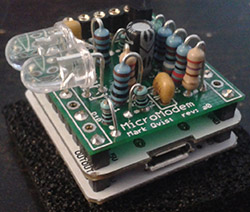
modemThem kids with those Arduinos don’t know what they’re missing. A serial connection is just too easy, and there’s so much fun to be had with low bandwidth modems. [Mark] made the MicroModem with this in mind. It’s a 1200 baud AFSK modem, capable of APRS, TCP/IP over SLIP, mesh network experimentations, and even long-range radio communication.
As the MicroModem is designed to be an introduction to digital wireless communication, it’s an extremely simple build using only 17 components on a board compatible with the Microduino. The software is built around something called MinimalProtocol1, a protocol that will be received by all other listening stations, features error correction, and automatic data compression. There’s also the ability to send TCP/IP over the link, which allowed [Mark] to load up our retro site at a blistering 1200 bps.

The code is extremely well documented, as seen on the Github for this project, with board files and even breadboard layouts included. [Mark] has three PCBs of his prototype left over, and he’s willing to give those out to other Hackaday readers who would like to give his modem a shot.

Introducing The Arduino Zero

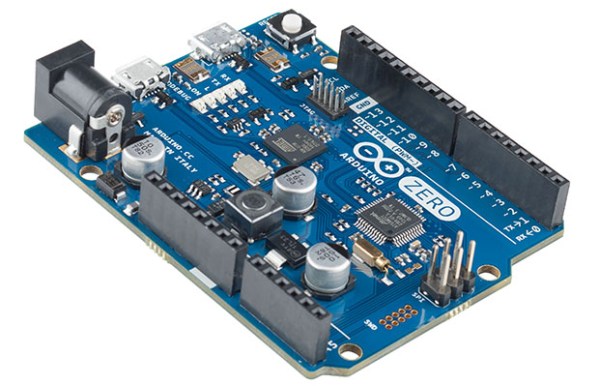
The Arduino Uno is the old standby of the Arduino world, with the Arduino Due picking up where the Mega left off. The Arduino Tre is a pretty cool piece of kit combining a Linux system with the Arduino pinout. Care to take a guess at what the next Arduino board will be called? The Arduino Zero, obviously.

The Arduino Zero uses an Atmel ARM Cortex-M0+ for 256kB of Flash and 32k of RAM. The board supports Atmel’s Embedded Debugger, finally giving the smaller Arduino boards debugging support.

The chip powering the Zero features six communications modules, configurable as a UART, I2C, or SPI. USB device and host are also implemented on the chip, but there’s no word in the official word if USB host will be available. There are two USB connectors on the board, though.

The Arduino folk will be demoing the Zero at the Bay Area Maker Faire this weekend. Hackaday will have boots on the ground there, so we’ll try to get a more detailed report including pricing and availability then.

Bumpy, The Beautiful DIY MP3 Player

OLYMPUS DIGITAL CAMERA

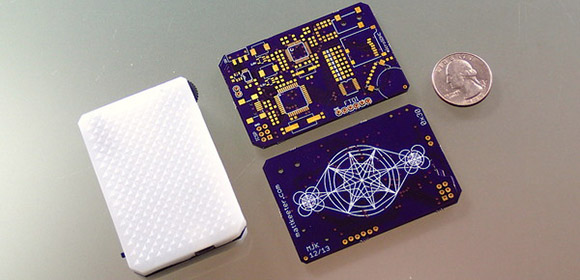
[Matt]’s been working on a small hombrew MP3 player, and although it’s not much more useful than an iPod Shuffle, sometimes that’s all you need. Besides, it turned out to be a beautiful project, completely custom, and a great example of what a high resolution 3D printer can do with an enclosure design.

Inside Bumpy is an ATMega32u4 with a VS1003 MP3 codec IC. The device is powered by a 1000mAh lithium battery, and the user interface is an exercise in simplicity; a single click/scroll wheel changes the volume, toggles play and pause, and selects the next or previous track. Eight LEDs mounted in the center of the board glow through the case for status, volume, and interface feedback.

By far the most impressive part of Bumpy is the case. It was printed at [Matt]’s place of employment – Formlabs – in white UV curing resin. The pictures show a surface finish that would be difficult to replicated on a squirting plastic style 3D printer, with a textured, bumpy surface that inspired the name.

Programming Micros With Impossibly Cheap Bluetooth Adapters

tooth

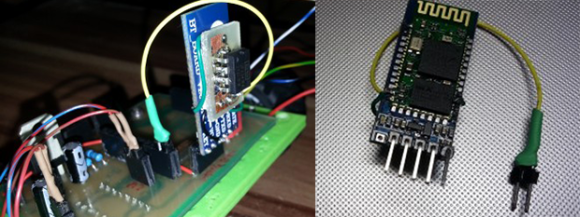
[Zenios] and [Raivis] are building a small balancing robot, and for communications to the outside world, they’re using a small, extremely cheap Bluetooth adapter. They figured uploading code to the microcontroller over Bluetooth would be a good idea, but their adapter, a cheap HC-06 module, had no way of resetting the microcontroller; it just provided Tx and Rx the serial port. They did notice a LED blinked when a device wasn’t connected to the adapter, so with a simple circuit they kludged a reset circuit where it wasn’t intended.

The small LED on the HC-06 module blinks when nothing is connected, and remains on when a connection is established. Figuring a new connection would be a good time to upload new code, the guys needed to design a circuit that would stay low when the LED was blinking, and switch to high when the LED was on.

A simple RC filter took care of the blinking LED, keeping the line low until a device connected. Bringing the logic level high when the LED stayed solid required digging through a part drawer, eventually finding an LM741 p differential amplifier.

After a few small changes to the bootloader, the guys had a reliable means of flashing new firmware without the need of programming adapters or wires draped over their workspace, all with a Bluetooth adapter that shouldn’t have this capability. Video below.

Continue reading “Programming Micros With Impossibly Cheap Bluetooth Adapters”