A Light Painting Infrared Ray Gun

gun

[Noe] over at Adafruit has a really great build that combines the Internet’s love of blinkey LEDs and rayguns with the awesome technology behind extraordinarily expensive thermal imaging cameras. It’s a light painting infrared heat gun, used for taking long exposure photographs and ‘painting’ a scene red or blue, depending on the temperature of an object.

While this isn’t a proper FLIR camera, with a DSLR and a wide open shutter, it is possible to take pseudo-thermal images by simply ‘painting’ a scene with the light gun. This is an absurdly clever technique we’ve seen before and has the potential to be a useful tool if you’re looking for leaks around your windows, or just want to have a useful cosplay prop.

The circuit inside this raygun is based on a contactless infrared sensor connected to an Adafruit Gemma, with the LEDs provided by a NeoPixel ring. There are two 3D printable cases – your traditional raygun/blaster, and a more pragmatic wand enclosure. With either enclosure, it’s possible to take some pretty heat map pictures, as seen in the video below.

Continue reading “A Light Painting Infrared Ray Gun”

Sci-Fi Contest Roundup: The Voight-Kampff Machine

Voight-Kampff

You’re watching a stage play – a banquet is in progress. The guests are enjoying an appetizer of raw oysters. The entrée consists of boiled dog stuffed with rice. The raw oysters are less acceptable to you than a dish of boiled dog.

The Voight-Kampff Machine, or VK, from Blade Runner is an extremely advanced form of lie detector that functions on blush response, pupil dilation, respiration, heart rate, and other physiological factors in response to emotionally charged questions to determine if the interrogation subject does or does not dream of electric sheep. It’s also an awesome prop, making it a great subject for our Sci-Fi contest.

You’ve got a little boy. He shows you his butterfly collection plus the killing jar. What do you do?

[Aven] is building a Voight-Kampff Machine built around a Raspberry Pi with a few small LCDs to display simulated vital signs. There will, of course, be a small webcam showing the subjects face or eye, and a few LEDs that will flash with the same pattern the original had.

You’re reading a magazine. You come across a full-page nude photo of a girl.

[Aven] still has a little bit of work to complete the VK, but there’s still a week and a half left in the contest. More than enough time for you to come up with your own Sci-Fi project and get your grubby mitts on some really awesome prizes.

BeagleBone Black + RAMPS

CRAMPS

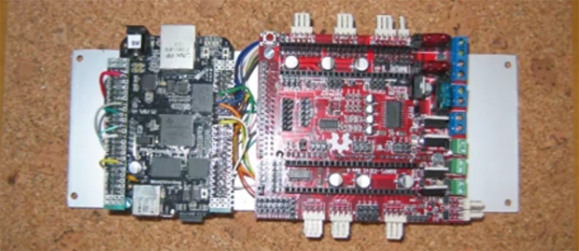
The BeagleBone Black, with an impressive amount of computing power and a whole bunch of I/O, would make an impressive CNC controller, save for two shortcomings: The BBB isn’t in stock anywhere, and CNC capes are a little on the pricey side. [Marc Peltier] can’t do anything about finding a distributor that doesn’t have the BeagleBone on backorder for you, but he did come up with an adapter for the very popular RAMPS-FD 3D printer controller board (Forum, French, Here’s the Google translation matrix).

The RAMPS-FD is an extension of the RAMPS board and a shield for the Arduino Due. Both the Due and BBB work on 3.3 V, meaning controlling the RAMPS-FD is simply a matter of finding the correct wiring diagram and pin assignments on the BeagleBone. [Marc] solved this problem by using the settings from the BeBoPr cape and using the existing BeBoPr LinuxCNC configuration.

The end result of [Marc]’s tinkering is something a lot like [Charles Steinkueler]’s CNC capes for the BeagleBone Black we saw at the Midwest RepRap Fest. [Charles] isn’t selling his capes, but no one else seems to be selling BeagleBone Blacks, either.

Continue reading “BeagleBone Black + RAMPS”

Sci-Fi Contest Roundup: No Tea

thumb2

In case you haven’t heard, we’re running a contest on Hackaday Projects for the best Sci-Fi build. We’re a little under two weeks until the deadline for the contest and so far there are a lot of great entries (and lots of great prizes still up for grabs).

If there’s one thing this contest has taught us, it’s that Hackaday readers have impeccable taste in their choices of books, movies, TV shows, and video games. We were surprised at how many entries there are for Hitchhiker’s Guide to the Galaxy, a series not generally known for having cool gadgets such as giant mechs, lightsabers, and other impressively awesome stuff. Here’s a roundup of the current HHGTTG submissions for the Sci-Fi contest:

Doors That Sass
roundup-robot-doorThe doors in Hitchhiker’s Guide are insufferable self-contented sentient portals programmed by the Sirius Cybernetics Corporation to love their simple lives. Upon everyone opening or closing one of these doors, they thank the person for validating their existence.

The door in [Jarrett]’s hackerspace wouldn’t stay closed, so what better way to fix the door than with a robotic door greeter? Actually, it’s just a weight tied to a pulley that keeps the door closed with a little bit of circuitry that plays an .mp3 file when the door moves. Still, self-contented doors. [Goug] is also making one of these self-satisfied doors, but there’s not much in the way of progress.

Going Up?

sentient-elevatorThe Happy Vertical People Transporter is HHGTTG’s answer to the common elevator. Like doors, they’re also sentient, but also have ‘defocused temporal perception’ to arrive at a floor before a passenger even realizes they need a lift. [DigiGram] and [Lolla] are working on one of these sentient elevators using a webcam, OpenCV, and some AVR-based electronics.

Look Out!
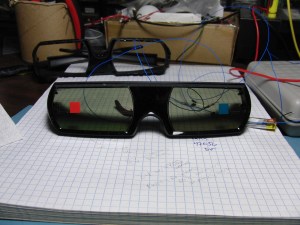
peril-sensitive-glassesThe Joo Janta 200 Super-Chromatic Peril Sensitive Sunglasses allow the user to adapt to danger by blacking out a the first signs of peril. [colabot] and [minimum effective dose] realized you can just buy glasses that can be blacked out electronically in the form of active shutter glasses for a 3D TV. With a few peril sensors, they’re working on finishing up their peril sensitive sunglasses.

Remember, the Hackaday Projects Sci-Fi contest doesn’t end until April 29th. That leaves you plenty of time to enter your own build. May we suggest a Brownian motion simulation beverage?


 

Using Non-Crappy Software With The Da Vinci Printer

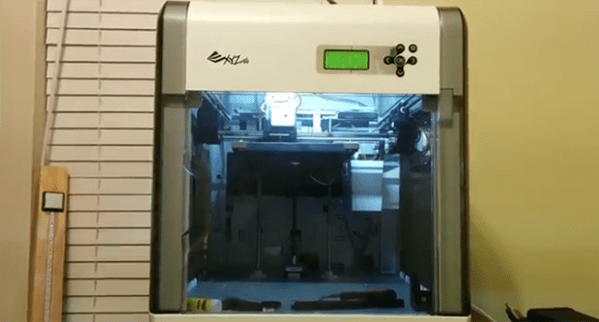
The Da Vinci printer from XYZprinting is turning out to be one of the best buys in the world of cheap, consumer printers. Sure, it uses chipped filament, but that’s an easy fix for anyone who knows what a .hex file is. And yes, the Da Vinci host software is a mess of proprietary garbage with limited functionality, but [Mark] has figured out a way around that.

When [Mark] received his Da Vinci, he immediately started snooping around inside the printer’s guts, like any good tinkerer should. He found an SD card holding all the sample prints that ship with the printer, all in a convenient Gcode format. Inside these sample .STL files were all the calls you would expect – setting the temperature, changing the layer height, and all the other good stuff you’d find in any other RepRap.

With a little bit of modification to .STL files generated by any slicing program, [Mark] isn’t limited any more by the terrible host software that ships with the Da Vinci. Combine this with the ability to reset the chip inside the filament cartridge, and [Mark] has a printer at least as functional as any open hardware model.

Continue reading “Using Non-Crappy Software With The Da Vinci Printer”

Hackaday Retro Edition: Parallel Port Ethernet

It’s time once again for a roundup of ancient hardware that has successfully loaded our retro edition. Up this time is a completely random and totally not planned roundup of parallel port to Ethernet adapters.


First up is [Tom Moss] with his IBM 5150 – the first ‘IBM Compatible’ home computer, progenitor of the i7 boxxen warming your ankles as you read this. This machine comes standard with a 4.77 MHz 8088 CPU, 8087 FPU, 512k RAM, two 360k 5.25″ floppy drives, and a few very cool additions: an ISA to CompactFlash card adapter, giving [Tom]’s box 4GB of storage.

How is [Tom] connecting to the Internet? A Xircom PE3-10BT Network Adapter. This neat device turns any parallel port into an Ethernet. With a Telnet program, [Tom] was able to connect to a Unix system and use Lynx to browse over to the retro site. He’s yet to get a DOS browser working, but FTP is go, allowing him to download ancient software directly onto his huge CF card.

The next one isn’t exactly vintage, but it does carry the spirit of antiquated hardware onto the web. [Valentin] is using a FleaFPGA and a 186 over at OpenCores. The FPGA board gives him VGA output, an SD card, A PS/2 keyboard, but no options for networking. That’s no problem for [Valentin], as he wired up a Xircom PE3 parallel port to Ethernet adapter. Yes, the same adapter as the 5150 above. [Valentin] says his parallel port hack is a bit of a mess with non-bidirectional and no dedicated IRQ hardware support. It works, though, so we can’t fault him for that.

We’re always looking for people who have loaded our retro edition on old hardware. If you have some outdated hardware sitting in the attic, get it out, load up Hackaday Retro, and send it in.

Pics from [Tom] and [Valentin] below.

Continue reading “Hackaday Retro Edition: Parallel Port Ethernet”

The HellZXchreiber

HellZXschreiber

Hellschreiber – German for ‘light pen’ – was developed in the 20s as a way to transmit text in a way that was much more robust than the teletypes of the time. These devices were used to great effect by the Germans in WWII, and later became popular with wire services and was used until the 80s. The fax machine then happened, and no one really cared about Hellschreiber, save for a few plucky amateur radio enthusiasts.

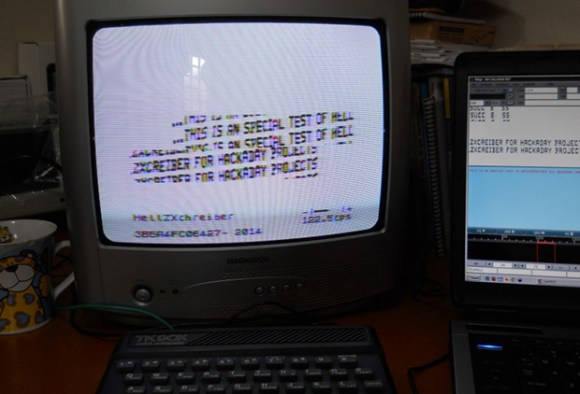
In the early 90s, a few of these amateur radio enthusiasts realized they could use their personal computers to communicate with this extremely simple protocol that’s also very resilient against interference and weak radio links. [Danjovic] is following in their footsteps by decoding Hellschreiber on an old ZX Spectrum clone.

[Danjovic] tested his code with the sound sample found in the Hallschreiber wiki article and some text generated by Fldigi. Everything works beautifully, an [Dan] can even change the intensity of the text with the volume control – a very useful feature should the HellZXchreiber ever make it out into the field.

Source and image files available for all you strange Speccy fans. Everyone else can check out the videos below.

Continue reading “The HellZXchreiber”