Using Bitcoin To Detect Malware

vigil

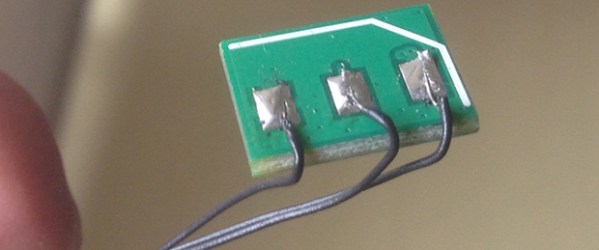
Now that you can actually buy things with bitcoins, it’s become a playground for modern malware authors. [Eric] recently lost about 5 BTC because of some malware he installed and decided to do something about it. He came up with BitcoinVigil, a web service that constantly looks at bitcoin honeypots and alerts you when bitcoins are surreptitiously removed.

The idea behind BitcoinVigil is to set up a Bitcoin wallet with a small amount of coins in it – only about $10 USD worth. When modern, Bitcoin-seeking malware is run on a computer, it looks for this ‘moneypot’ and sends an email out notifying the owner of the coins to stolen money.

[Eric] was at a LAN party a few weeks ago and ‘borrowed’ a friend’s copy of Starcraft 1. Just a few seconds after installing it, he received an alert notifying him about a few stolen bitcoins. This time [Eric] only lost a few microBTC, but better than the thousands of USD he lost before.
Fake Audiophile Opamps Revealed

chip

The OPA627 is an old, popular, and very high-end opamp found in gear cherished by the most discerning audiophiles. This chip usually sells for at least $15, but when [Zeptobars] found a few of these expensive chips on ebay going for $2, his curiosity was piqued. Something just isn’t right here.

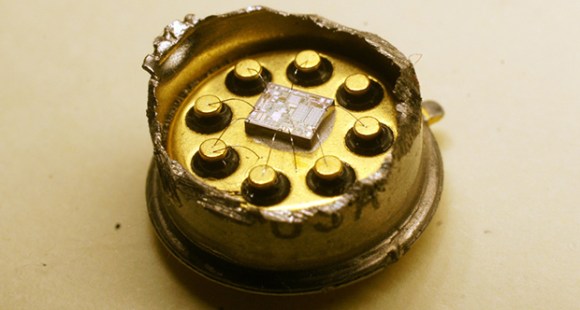
[Zeptobars] is well known for his decapsulating and high-resolution photography skills, so he cut the can off a real OPA627, and dissolved one of the improbably cheap ebay chips to reveal the die. Under the microscope, he found an amazing piece of engineering in the real chip – laser trimmed resistors, and even a nice bit of die art.

The ebay chip, if it were real, would look the same. It did not. The ebay chip only contained one laser trimmed resistor and looks to be a much simpler circuit. After a bit of research, [Zeptobars] found it was actually an AD774 opamp. The difference is small, but the AD774 still has much higher noise – something audiophiles could easily differentiate with their $300 oxygen-free volume knobs.

This isn’t the first instance of component counterfeiting [Zeptobars] has come across. He’s found fake FTDI chips before, and we’re counting the days until he gets around to putting a few obviously fake ebay 6581 SID chips under the microscope.

An Exceptional BASIC Computer

BASIC

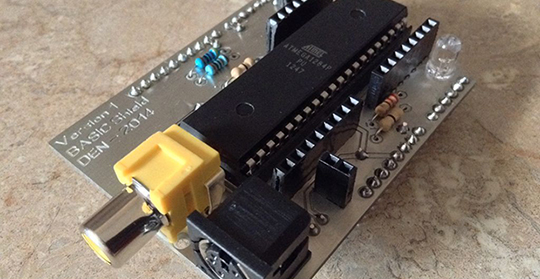
Since [Dan] has started using microcontrollers, he’s been absolutely fascinated by the fact these chips are essentially low performance computers. Once he caught wind of TinyBASIC, he decided he would have a go at creating a simple, tiny computer that’s very simple to the old, tiny, 8-bit computers of yore.

The computer is built on an Arduino shield, using TinyBASIC, the TVout library, and the PS/2 keyboard library. After piecing together a little bit of code, the Arduino IDE alerted [Dan] to the fact the TVout and PS/2 libraries were incompatible with each other. This inspired [Dan] to use the ATMega328P as a coprocessor running the TVout library, and using the capacious ATMega1284P as the home of TinyBASIC and the PS/2 library.

A circuit was put together in Fritzing using minimal components, and a PCB milled out of copper board. After the board was tinned, [Dan] had a beautiful minimalist retro computer with nearly 14kB of RAM free and an RCA display.

Future versions of the build will probably be based around the Arduino Mega, allowing for a TV resolution of 720×480. Also on tap are an SD card slot, LEDs, pots, and possibly even headers for I2C and SPI.

Resetting DRM On 3D Printer Filament

The Da Vinci 3D printer is, without a doubt, the future of printing plastic objects at home. It’s small, looks good on a desk, is fairly cheap, and most importantly for printer manufacturers, uses chipped filament cartridges that can’t be refilled.

[Oliver] over at Voltivo was trying to test their new printer filament with a Da Vinci and ran head-on into this problem of chipped filament. Digging around inside the filament cartridge, he found a measly 300 grams of filament and a small PCB with a Microchip 11LC010 EEPROM. This one kilobyte EEPROM contains all the data about what’s in the filament cartridge, including the length of filament remaining.

After dumping the EEPROM with an Arduino and looking at the hex file, [Oliver] discovered the amount of filament remaining was held in a single two-byte value. Resetting this value to 0xFFFF restores the filament counter to its virgin state, allowing him to refill the filament. A good thing, too; the cartridge filament is about twice as expensive as what we would normally buy.


Turning An Analog Scope Into A Logic Analyzer

scope

When [Marco] was planning on a storage oscilloscope build, he realized having a small device to display eight digital signals on an analog scope would be extremely useful. This just happens to be the exact description of a simple logic analyzer and managed to turn his idea into a neat little project (German, Google translation).

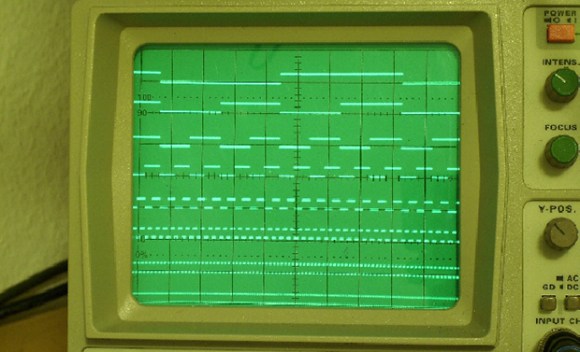
The theory of operation for this surprisingly simple, and something that could be completed in a few hours with a reasonably well stocked hackerspace or parts drawer in a few hours. A clock generator and binary counter are fed into the lower three bits of a simple R2R DAC, while the 8 inputs are fed into an 8-input multiplexer and sent to the last bit of the DAC. With nothing connected to the logic analyzer inputs, the output to the scope would just be an 8-step ramp that would appear as eight horizontal lines on the screen. With something connected to the logic analyzer input, an extremely primitive but still very useful logic analyzer appears on the screen.

While it’s not the greatest analyzer, it is something that can be cobbled together in an hour or two, and the capabilities are more than sufficient to debug a few simple circuits or figure out some timings in a project.

VCF East Wrapup MegaPost

VCF East, the fabulous retrocomputing festival held in Wall, NJ this last weekend was a blast. We had a great time, dropped t-shirts and stickers to just about anyone who wanted one, took a lot of pictures, and shot a lot of video. Now that it’s over it’s time for the post-mortem, with one insanely long post.

We saw some very cool stuff that merited its own post, and much more that we simply didn’t have time to video. The previous posts from VCF East:

There’s still tons more, including a tour of the retrocomputer museum that hosted VCF East. The biggest talk was from [Dave Haynie], lord of the Amiga giving part three of a multi-year talk on the soap opera that was Commodore International.

Click that ‘Read more…’ to see all this.

Continue reading “VCF East Wrapup MegaPost”

VCF East: PR1ME And AT&T Unix Boxes

unix

At the Vintage Computer Festival last weekend, there was a wonderful representation of small 8 and 16-bit home computers from the 80s, an awful lot of PDP and VAX-based minicomputers, and even some very big iron in the form of a UNIVAC and a Cray. You might think this is a good representation of computing history, but there was actually a huge gap in the historical reality. Namely, workstations and minicomputers that weren’t made by DEC.

[Ian Primus] was one of the very few people to recognize this shortcoming and brought his PRIME minicomputer. This was a huge, “two half racks, side by side” computer running PRIMOS, an operating system written in FORTRAN. Of course this made it extremely popular with engineering teams, but that doesn’t mean [Ian] can’t have fun with it. He had two terminals set up, one running Dungeon (i.e. Zork pre-Infocom) and a text-based lunar lander game.

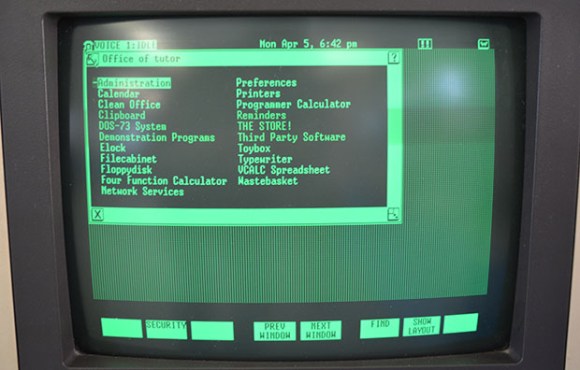
Because the VCF East is held in New Jersey, it’s probably no surprise a few vintage AT&T Unix boxes showed up. [Anthony Stramaglia] brought in a few very cool vintage Unix workstations, dating from the early to mid 80s. In the video, he shows off two AT&T boxes. The first is a UNIX PC, containing a 68010 clocked at a blistering 10 MHz. Next up is the UNIX PC’s bigger brother, the 3B2 400. This is the workstation found on just about every desk at Bell Labs in the 80s, meaning this is the same computer [Ken Thompson] and [Dennis Ritchie] used for their work on UNIX.


Continue reading “VCF East: PR1ME And AT&T Unix Boxes”