An Open Source IPad Display Adapter

Those fancy 2048×1536 pixel resolution displays found in the iPad 3 and 4 can be used for much more than high def Candy Crush and Netflix viewing. [Freddie] over in Southampton, UK built his own adapter to connect these high-resolution LCD panels to anything with a DisplayPort connection. It’s called OSCAR, and it’s the open source way to add a whole lot of pixels in a second (or third, or fourth….) monitor.

The LCD panels found in the iPad 3 and 4 don’t use the usual LVDS connection found in just about every other LCD panel ever made. It uses an extension of the DisplayPort protocol, meaning any graphics card with one of these ports already does the heavy lifting for this panel. The only other thing that’s needed is an adapter to control the power and backlight, which is easily handled by an ATMega32U4. This makes OSCAR Arduino compatible, making it easy to add sensors and USB playthings.

OSCAR is available on Kickstarter for £65 (~$100 USD) for the board itself. Adding to that, you’ll need to grab an iPad retina display through the usual channels for about $65. Not exactly cheap, but try finding another better-than-1080p display for that price.

Custom Mechanical Keyboards

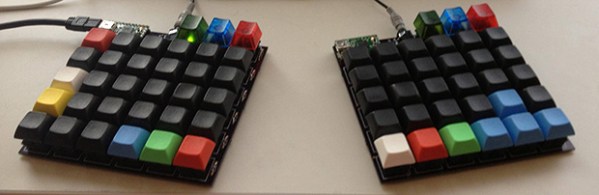
[Wyager] was shopping around for a mechanical keyboard, and after noticing custom PCB manufacturing had come down in price so much, he decided to build his own. The end result is a keyboard that’s so elegant in its design, that it could, with a little work, become a very interesting Kickstarter project.

The design had three requirements: cheap, mechanical switches, and extremely customizable. The cheap requirement was solved by splitting the keyboard into two parts with a master/slave arrangement. The boards are connected by a 1/8″ TRRS jack conveying an I2C bus. Since both boards are identical except for the code running on the Teensy dev boards, [Wyager] saved a bit of cash by using two of the three PCBs that came with his OSHPark order.

The mechanical switches – Cherry MX Blues – are rather expensive parts for a failed project. For fear of failure, [Wyager] first ordered a PCB containing the footprint of only one key. With the footprint correct, he graduated to a 2×2 matrix. Once that was verified, the 6×5 matrix was ordered. Everything worked perfectly the first time, something we can’t say about many of our projects.

The code, board files, and schematics are available over on the github

SOAP Drama: An Interview With The SOAP Creators

A few days ago, we caught wind of SOAP, a Kickstarter project for an Android-based home automation router. With a quad-core ARM, quad gigabit Ethernet ports, 802.11ac, SATA, and every radio under the sun – all for $100 (sans display, $170 with display), it seemed too good to be true. At the time, it probably was: the images from the PCB prototype were taken from [Bunnie Huang]’s open source laptop, there weren’t enough Ethernet ports for a router, and the hardware just seemed all wrong.

The guys behind SOAP have decided to respond to these accusations by posting a huge update on their Kickstarter page and answering a few questions from me. Interview follows below.


HaD: There’s a BOM/cost analysis breakdown for the Essentials package (the SOAP sans display) that puts the total cost at about $130. This is the reward for pledging at the $100 level. How accurate is this cost analysis, and how do you plan on meeting that reward level?

SOAP: This cost analysis that you mention is very accurate. We will not profit on the early release pricing of $60.00 we have taken the loss leader pricing to attract backers and press (and we think we have done a good job). We are working with a large router manufacturer and this is really the link that makes the pricing possible without them we couldn’t do this.

HaD: You’re using a Quad Core Freescale i.MX processor for SOAP, and putting a four port Gigabit router in there. The Quad core i.MX chips only have one Gigabit port, and that’s limited to 470 Mbps. How are you solving this problem, and what are you using as a MAC/PHY?

SOAP: First off let me state that we are very aware of the CPU limitations and we have done a lot of work on finding a solution and we do have a unique solution. We have support from a big player in the router industry that has offered us a unique solution that we have been working on to bypass this issue. We will post more on this after our trip to San Jose. This is our fallback method and yes its benchmarks are not as pretty as we want them but they are getting there and we feel with enough tweaks we can get this to decent level.

This is from our layout guy: We are planning I.mx processor’s gigabit port will be connected to external IC working as a switch. 1Gb ethernet -> 1 to 4 switch -> 4x Gb Ethernet ports. Possible  http://www.ti.com/lit/ds/symlink/tnetx4090.pdf. Use 4 ports from there plus put RGMII Ethernet transceiver from Marvell  for each ETH port and we will have on board Ethernet switch.

HaD: What WiFi chipset/chipsets are you using? Will that/they be able to do 802.11ac at full speed, and how are you doing this with (I think) only one antenna on the updated board images?

SOAP: The speeds have varied greatly on the chipset and how buggy the software was for the day but we have clocked speeds over 1 gigabyte per second and we will continue to develop this further to achieve maximize speeds this is where our new Union with the guys over at Droidifi will help.

In our prototype we tested Avastar 88W8864, Broadcom 4360 , and a couple more that failed to actually work.  We didn’t get those all functioning like we would have wanted as there is little support for android and router chipsets to date. We demo with a Broadcom chipset.

We want to use Quantenna QAC2300 but at current funding we will be using the Broadcom we have received a lot of suggestions from our backers and a new big player behind us that thinks they have the right match we are waiting to announce this after our meeting in San Jose.

We have one antenna on the most current design but we are planning on adding two more for the final design. We didn’t place them on the most recent design because we are waiting to see how much funding we get to finalize the wifi chipset. We didn’t want antenna design that worked best with a Broadcom when we switch to Marvel or Quantenna.

HaD: What is the status of the software? Do you have a repo somewhere that people could look over?

SOAP: We have been working with a new player from the older kickstarter project called Droidifi. We will be working with them on the software. This is a something we haven’t been able to announce till we lock it down but you are the first to know about this union. Check out our update later today.

HaD: Finally, do you have a functional prototype with the quad-core i.MX, four Ethernet ports, and WiFi? Can we see a video?

SOAP:  If you mean a mass production ready device that can be used by an end user then no. We have a solid functioning proof of concept prototype. We have a lot of Demo videos of our POC that show  what we have developed so far.  We  have to have the current PCB design manufactured to get down to the more rigorous testing and qualifying. All the specs listed on our kickstarter are what we currently are planning and we hope to fulfill the tech specs.

HaD: There are some other questions in the Kickstarter comments section, but honestly I don’t care about how many Twitter followers you have.

SOAP: Twitter was our marketing company. We thought people actually were following us but we have  since found out that half of them are not real. Check this out though.

All in all we understand how ambitious this project looks and we also know that it technology development can run into roadblocks and things but we want to be clear we are not a scam and we are quite aware where these attacks have originated. We will continue to work hard on this project, we will not be running off to Costa Rica and we plan on seeing everyone at CES next year.


The TL;DR for everyone without an attention span:

Yes, the $100/$170 price is too good to be true. It’s called a loss leader to generate interest. This part was a success. The SOAP guys are partnering with the DroidFi guys for the operating system. The Gigabit Ethernet will probably work, and the WiFi is limited by *nix chipset support. No complete functional prototypes yet.

So there you go. It’s not the ideal update with the SOAP crew showing off a shipping container of units ready to be shipped, but the project isn’t in as bad a shape as I originally thought.


ISEE-3: We Get Signal

ISSE-3

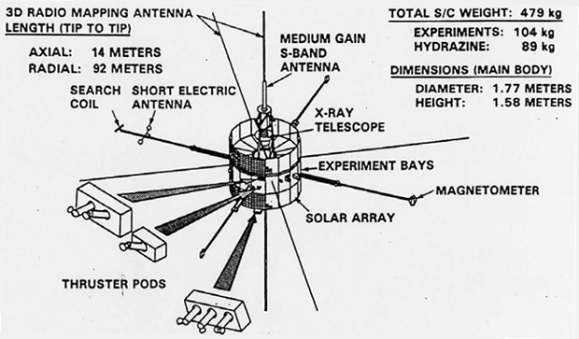
Out in the depths of space, more than 100 times the distance from the Earth to the moon, there’s a lonely spacecraft gracefully spinning towards an August encounter with our planet. It’s ICE/ISEE-3, a probe long-forgotten by official space agencies. Now, the team dedicated to repurposing this satellite has made contact with this probe using a 20-meter satellite dish in Germany.

When we first heard about the planned communication by volunteers, no one was certain the probe was still alive. It shouldn’t be a surprise this satellite was still functioning; it was launched in 1978, and most of the instruments were still functioning in 2008. Still, this is the first time amateurs – not NASA – had received a signal from the probe

ICEteam, the group of volunteers dedicated to reviving this spacecraft used the huge dish at Boshum observatory to detect the 5 Watt carrier signal coming from the spacecraft. That’s all the probe is sending out right now – no data was received – but this is a huge accomplishment and the first step towards directing ICE/ISEE-3 into an orbit around one of the Earth-Sun Lagrange points.

Side note: Looking at the ephemeris data (target -111) I *think* ICE/ISEE-3 will be above the night side of Earth at closest approach. Can anyone confirm that, and does that mean a future mission at L2?

Video from the ICEteam below.

Continue reading “ISEE-3: We Get Signal”

Hackaday Links: March 9, 2014

hackaday-links-chain

Thinking about starting a CNC machine, 3D printer, or laser cutter project? Misumi has you covered. They’re offering up $150 worth of free stuff with a coupon code. [CharlieX] is putting together a BuildLog laser cutter, a whole bunch of people on reddit are building 3D printers, and I have most of the rods for an i3 build. Just use the promotion code First150 on your order. Actually, read the terms and conditions, but rest assured – this is legit.

A few months ago, we saw this Enigma cypher machine that combines the classic late-30s aesthetic of the original with modern hardware – including a few 16-segment displays. Now there’s a Kickstarter for the Open Source Enigma replica, and it looks like it’s going to end up being pretty popular. Here’s the site with all the deets. Check out that QWERTZ keyboard.

[Jason] has a love of LEGO and a terrible keyboard. Combine the two and he came up with a functional LEGO keyboard. The electronics are, sadly, an old PS/2 membrane keyboard, but the mechanicals are a work of art – all the keys are mounted on a grid of Technic parts that can be positioned over each of the membrane buttons.

Want a really cool look for your next enclosure? How about LED pipes? They’re those clear plastic bits that direct the light from LEDs around corners and can make any enclosure looks like a Star Trek set piece. You can cut these things with a laser cutter like the Alima team did with their indoor air quality meter. Looks pretty cool.

Building The Mountainbeest

mounainbeest-pic

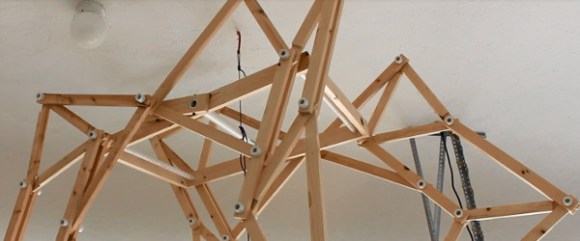
Builder extraordinaire and Hackaday alum [Jeremy] was asked by a friend about “doing something really crazy” for his local Makerfaire this year. That Makerfaire clock is ticking down, and not wanting to build awesome from scratch, referred his friend to a few of the temporarily shelved projects from the last year. The winning incomplete build was the Mountainbeest, a four-legged mechanical walker inspired by [Theo Jansen]’s Strandbeest.

We’ve seen the beginnings of the Mountainbeest before, starting with [Jeremy] building the linkages for one leg. This build turned into two legs and now it’s a full-on quadruped, theoretically capable of rambling over the lush mountains in [Jeremy]’s backyard.

The plan now is for [Jeremy] to get is Beest walking with the help of windshield wiper motors left over from a failed hexapod build. He’s not ging all the details yet, but it looks like the power train will be made out of bike parts. Video of the current state of the project below.

Continue reading “Building The Mountainbeest”

Next Weekend: The Midwest Reprap Festival

midwest

Guess what next weekend is? It’s the Midwest Reprap Festival, in Goshen, Indiana. We’ll also be there keeping tabs on an absurd amount of new RepRaps and other 3D printers, new filaments, and distributing a ludicrous amount of Hackaday swag.

The highlights of the fest include the folks from Lulzbot and UltiMachine, [Prusa] showing off his i3, [Nick Seward] and the WallySimpson, and Lisa RepRaps, and hundreds of other RepRappers showing off their latest projects and printers.

Here’s the best part: it’s all free! It would be cool if you register before making the trip out, but any way you look at it, it’ll be an awesome weekend. It’s also the largest US gathering of 3D printer aficionados that isn’t on the east or west coast.