3D Printering: Making A Thing In Autodesk 123D

printering

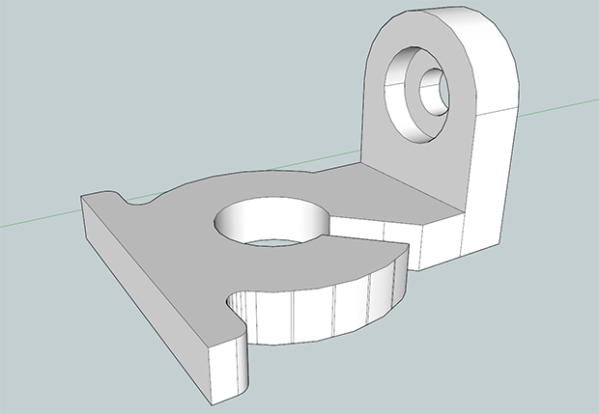
In the continuing battle against 3D printers used exclusively for fabricating plastic octopodes and useless trinkets, here’s yet another installment of a Making A Thing tutorial. If you’ve ever wanted to make one single object in multiple 3D design softwares, this is for you.

Previously, we’ve built a ‘thing’ in a few different 3D modeling programs, including:

See that ‘Read more…’ link below? You might want to click that.

Continue reading “3D Printering: Making A Thing In Autodesk 123D”

Apex Electronics, Your Souce For Oscilloscopes And Drop Tanks

While some of the Hackaday crew is in LA for The Gathering, we decided to make a trip out to Apex Electronics, easily the oldest and largest electronics surplus store on the west coast.

Inside Apex, everything is stacked to the 20-foot ceiling with any electronic component you can imagine. Want a shopping cart full of huge capacitors? Awesome. Tube sockets? Done. Any kind of wire imaginable? That takes up two aisles. Test equipment abounds as well with oscilloscopes, signal analyzers and function generators, multimeters, and even a pair of cockpit voice recorders.

There’s also an outside yard at Apex containing at least two airplanes (one is a Cessna 150 that’s crying out to be made into a flight simulator), yet more test equipment, tons of video equipment, a few aircraft drop tanks, and enough aluminum extrusion to build anything.

If you’re wondering how fair the prices are at Apex, I picked up a grab bag assortment of wire wrap sockets (including a few 64-pin DIPs) that would cost $100 through the usual eBay/Chinese retailers for only $5. [Mike] picked up some stepper motors, proto boards, a pound of standoffs, and a dozen some vintage 7-segment displays for $20. No clue how much the test equipment costs, but from what we’ve seen the prices are low.

We’re not the first EE/Hacker Blog/Vlog to visit Apex. [Dave Jones] made the trek a few years ago and posted an awesome video. Below you’ll find a ton of pictures from our trip.

Continue reading “Apex Electronics, Your Souce For Oscilloscopes And Drop Tanks”

Touring Null Space Labs, Another LA Hackerspace

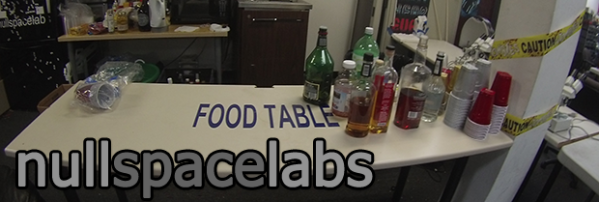
Null Space Labs prides itself on being the only hackerspace that’s not saving the world. Instead, they focus on more important matters such as repairing an industrial pick and place machine, hoisting laser cutters through third story windows, and generally being extremely awesome. Since some of the Hackaday crew is in LA, we decided to check in on the folks at Null Space, and they graciously granted us a tour.

It’s not an overstatement that Null Space is better stocked than any university EE lab. They have at least four million electronic components, and they honestly have no idea how many different types of components they have. As for tools, a 22 GHz spectrum analyzer and 2 GHz scope are tucked away behind a direct to garment printer. A gigantic laser printer, pro 3D printer, PCB milling and through-hole plating stations, and pick and place machine are just a few more of the fun toys available to Null Space members.

In the video below, [M] walks us through the main electronics work area, filled to the brim with tools and storage cabinets. After that, [arko] shows off the PCB mill and the back room with reels of parts strewn asunder.

Continue reading “Touring Null Space Labs, Another LA Hackerspace”

Touring Crashspace, The LA Hackerspace

Starsong

In case you’re not up to speed with the most recent happenings at Hackaday, we’re partying in LA tomorrow. This means visiting all the local hackerspaces and begging for a tour. First up is Crash Space, an awesome hackerspace that uses Starsong, the soldering iron alicorn shown above as a mascot.

Inside Crash Space are the usual Hackerspace compliment of tables, projectors, whiteboards, and more recycled computers than you can shake several IDE cables at. When we rolled up to Crash Space, they were just finishing up their weekly 3D printing workshop, replete with a Mendel Max, The Printer Which Shall Not Be Named, and a pair of printers from Deezmaker, a company started by one of Crash Space’s members.

For anyone wanting to roll their sleeves up and get dirty, all the action starts in the back of the building. There, they have a laser cutter, an ancient lathe and mill, drill press, and even a project that will become a vacuum former.

The folks at Crash Space were kind enough to show off their workshop for a video, viewable below along with a few pics of the space buzzing with activity.

Continue reading “Touring Crashspace, The LA Hackerspace”

The Tiniest SD Card Locker

sdlocker-tiny

In case you weren’t aware, that little ‘write protect’ switch on your SD cards probably doesn’t do anything. It’s only a switch, really, and if an SD card reader doesn’t bother to send that signal to your computer, it’s completely ineffective. Then there’s the question of your OS actually doing something with that write protect signal.

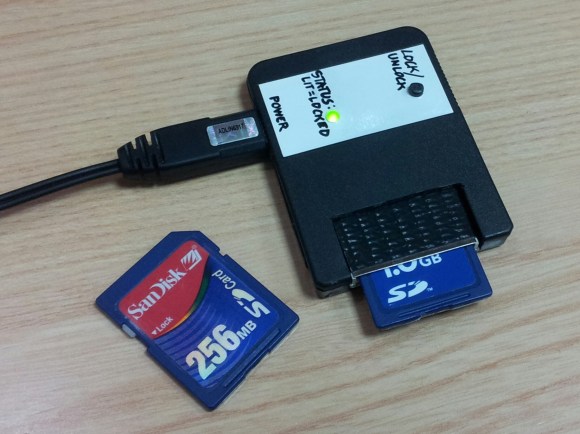
The better way to go about write protecting an SD card is using the TMP_WRITE_PROTECT bit on the SD card’s controller. [Nephiel] came up with an amazingly small device to set that bit, with the entire circuit fitting inside an old Playstation memory card.

[Nephiel] based his project on [Karl Lunt]’s SD Card Locker we saw late last year. [Karl]’s SD Locker uses an ATMega328 microcontroller, a pair of AA batteries, and an SD card socket to perform the bit toggling. This is still a very small device that fits inside an Altoids tin, but [Nephiel] thought he could make it smaller.

The new and improved version uses an ATTiny85 for SPI access to the SD card. A single button and LED serves as the user interface: with the LED off, the SD card is writable. Press the button, the card is locked, and the LED lights up.

0.19 Leagues Under The Sea

ROV

[Doug] and [Kay] have been building a steel 70-foot sailboat for the last few years, and since it’s a little too cold to work outside their home/shop in Oklahoma, they’re bringing their projects inside for the winter. Until it warms up a bit, they’re working on an underwater ROV capable of diving to 3000 feet below the waves, maneuvering on the ocean floor, and sending video and side-scan sonar back to their homebuilt ship.

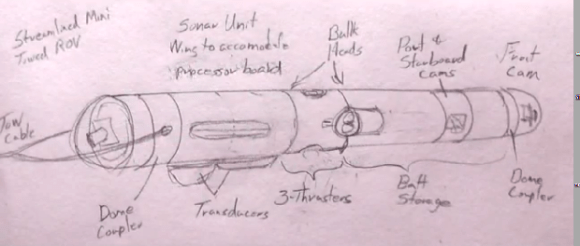
Like [Doug] and [Kay]’s adventures in shipbuilding, they’re documenting the entire build process of ROV construction via YouTube videos. The first video covers the construction of a pressure vessel out of a huge piece of 10″ ID, half inch wall steel pipe. The design of the ROV will look somewhat like a torpedo, towed by the ship with cameras pointing in all directions.

For communication with the surface everything is passing over a single Cat5 cable. They’re using an Ethernet extender that uses a twisted wire pair to bring Ethernet to the ocean bottom. With that, a few IP webcams relay video up to the ship and a simple Arduino setup allows for control of the ships thrusters.

The thrusters? Instead of an expensive custom solution they’re using off the shelf brushless motors for RC cars and planes. By potting the coils of a brushless outrunner motor, [Doug] and [Kay] found this solution makes an awful lot of sense; it’s cheap, fairly reliable, doesn’t require a whole lot of engineering, and most importantly cheap.

Bunch of videos below, or just check out [Doug] and [Kay]’s progress on their slightly out-of-date blog.

Continue reading “0.19 Leagues Under The Sea”

$20 GPS/GLONASS/Beidou Receiver

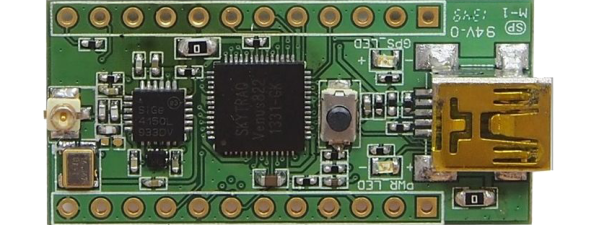
Sticking a GPS module in a project has been a common occurrence for a while now, whether it be for a reverse geocache or for a drone telemetry system. These GPS modules are expensive, though, and they only listen in on GPS satellites – not the Russian GLONASS satellites or the Chinese Beidou satellites. NavSpark has the capability to listen to all these positioning systems, all while being an Arduino-compatible board that costs about $20.

Inside the NavSpark is a 32-bit microcontroller core (no, not ARM. LEON) with 1 MB of Flash 212kB of RAM, and a whole lot of horsepower. Tacked onto this core is a GPS unit that’s capable of listening in on GPS, GPS and GLONASS, or GPS and Beidou signals.

On paper, it’s an extremely impressive board for any application that needs any sort of global positioning and a powerful microcontroller. There’s also the option of using two of these boards and active antennas to capture carrier phase information, bringing the accuracy of this setup down to a few centimeters. Very cool, indeed.

Thanks [Steve] for sending this in.