What’s Inside A 555?

555

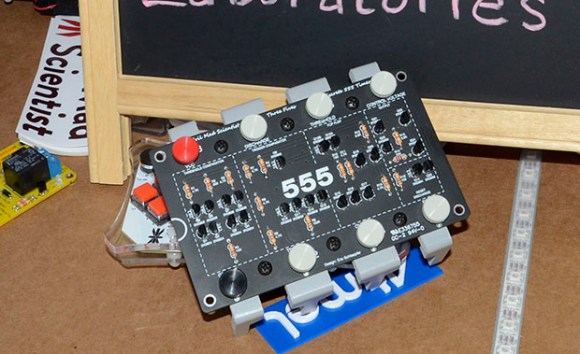
The 555 timer chip is a ubiquitous piece of technology that is oft-considered the hardcore way of doing things. Of course, the old timers out there will remind us that discrete transistors are the badass way of doing things, and tubes even more so. It’s not quite at the level of triodes and transformers, but Evil Mad Scientist’s discrete 555 kit is still an amazing piece of kit.

Instead of transistors and resistors etched into silicon as in the OG 555, [Windell] over at EMS turned the basic circuit inside a 555 into a mega-sized version using discrete components. Your parts bins need new scale if you’re going to work with this and other up-scaled hobby electronic components.

Although the integrated stand that makes the whole package look like an overgrown DIP doesn’t break out the signals on the board, it does include some neat screw terminals for alligator clips and bits of wire so this kit can be used in a circuit. Because it uses discrete components, you can also take a meter or scope to check out how a 555 chip works from the inside.

World Maker Faire 2013: The Sub-$500 Deltaprintr

There are a few delta bot 3D printers out there such as the Rostock which, while being a very nice printer, is still a little expensive. When [Shai] from SUNY wanted to use a 3D printer for his artistic and academic pursuits, he decided to build his own printer. Thus the Deltaprintr was born.

Instead of printed parts, the Deltaprintr uses laser cut and machined parts for just about all of its bill of materials. The three motors mounted in the base are connected to the delta arms with Spectra fishing line, thus getting rid of the ludicrous cost of belts of the requisite length.

Everything is Open Source, and the guys behind the project should be putting their printr up on Kickstarter sometime next month. Word is the entire thing should be sub-$500, and a little bit of guessing tells me that doesn’t mean $499.

A $100 Stereolithography 3D Printer

The Hackaday tip line has been blowing up with a new Kickstarter for a 3D printer. Although this is a pretty common occurrence around here, this printer is actually very interesting: it’s quite possibly the simplest and cheapest laser resin printer ever.

Most of the 3D resin printers we’ve seen, like the Form1 use mechanical means to raise a print up to the next slice. At $100, the Peachy printer doesn’t have the budget for such luxuries as servos or motors, so the layer height is increased by dripping salt water over the liquid resin. The X and Y axes are controlled with mirrors and voice coils, allowing this printer’s electronics to be controlled by a computer’s sound card. It’s really amazing in its simplicity, and from the looks of it the Peachy can produce some fairly good prints.

For a great explanation of how the Peachy printer works, you can check out the video below.

Continue reading “A $100 Stereolithography 3D Printer”

Pocket Sized Sattelites For Asteroid Detection

satellite

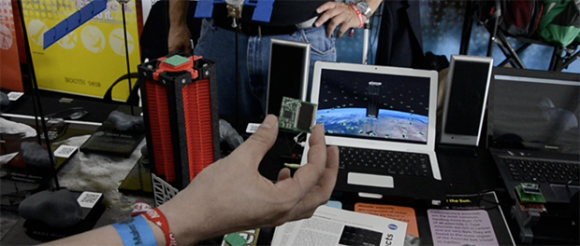
We’ve seen kicksats before, small pocketable single board satellites designed to orbit Earth. At this year’s Maker Faire, the team behind these kicksats has a new plan: using them to determine the orbits of earth-passing asteroids and hopefully not giving us any forewarning of our imminent extinction.

Instead of simply orbiting Earth, the new plan for these kicksats is to deploy them into the path of an oncoming asteroid such as Apophis so the radio transmissions from each satellite can pinpoint where exactly the asteroid is, something Earthbound optical and radio telescopes struggle with.

Despite the small size, the hardware on each kicksat is pretty impressive; each mini satellite has a solar cell on each side, a low-power MSP430 microcontroller with a radio module, and a few sensors. The system is designed so anyone can pick up the telemetry from these satellites with a small Yagi antenna and an RTL SDR TV tuner dongle.

An impressive bit of kit, but if holding a satellite or asteroid in your hand is more your thing, the same team behind the kicksat put up a whole bunch of 3D models of asteroids and space probes. They’re actually quite impressive when they’re printed out.

World Maker Faire: The New Ultimaker

Ult

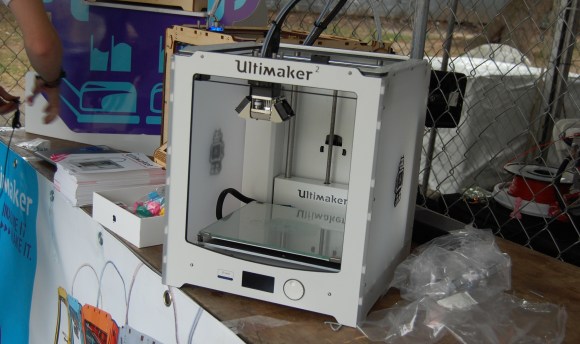
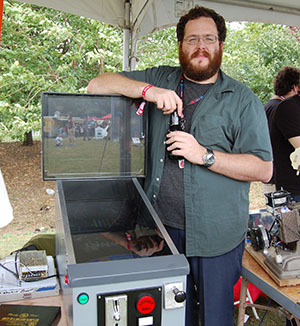
Just as the the gates opened at the World Maker Faire in New York City the skies opened, sending everyone underneath the tents and pavilians on the faire grounds. Luckily, I was able to check out the new Ultimaker before that happened, and only a day after it was officially announced.

Compared to the older laser-cut Ultimaker, the Ultimaker 2 is much, much cleaner that’s made more for designers and architects instead of students, hackerspaces and tinkerers. There are a few new additions to the Ultimaker 2 – OLED display, heated bed, and a larger build volume. Basically, if you want Ultimaker quality without a lot of futzing around, go with the Ultimaker 2.

Ultimaker will be shipping a pre-assembled version for €1.895,00, with a kit version to follow shortly. As always, the Ultimaker 2 is open source, and no, this doesn’t mean an end to the classic Ultimaker.

Polyurethane Protecting PCBs

PCB

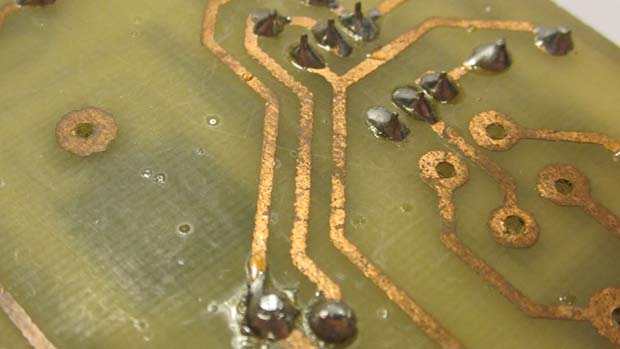
What you see above is a home-made PCB. No, this isn’t an example of a terrible toner transfer job, but rather evidence of the ravages of time. This board is seven years old, and the corrosion and broken traces show it. Luckily, [George] already has seven years of environmental data for a cheap DIY soldermask.

Seven years ago, [George] took a piece of copper clad board, masked half of it off, and sprayed it with fast drying polyurethane. After drying, he put it on a shelf in his garage. The results were fairly surprising – the uncovered portion is covered in verdigris, while the coated half is still shiny and new.

[George] took this a bit further and experimented with other spray can coverings. He found Testors spray enable worked just like the polyurethane, burning off when the heat of a soldering iron was applied, and also passed for a professional PCB.