The Arduino YUN. YUN Means Cloud.

For the longest time, the creators of the Arduino have been looking at how to bring the Arduino platform into the cloud. Ethernet and WiFi shields technically work, but if you’re processing data scraped from a web page, a lowly microcontroller really isn’t the best option. Enter the Arduino YUN. At its core, it’s a regular old Arduino Leonardo. Underneath that metal plate on the board? That’s an SoC running Linux.

Basically, the Linux side of the Yun is pretty similar to a WiFi router running OpenWRT. There’s a USB port for plugging in peripherals, native WiFi support (802.11n, even!), an Ethernet connector, and enough RAM to do all the interesting stuff a small computer connected to the Internet can do.

To make all this web programming easier for Arduino neophytes, the YUN also includes a ‘bridge’ library that automates HTTP transactions between the Linux and microcontroller sides of the YUN. There’s also support for Temboo, an SDK for dozens of APIs that interact with Facebook, Dropbox, FedEx, and hundreds of other web services.

Below you can check out [Massimo] and [David] showing off their wares and going over how the YUN connects to the Internet and interacts with the microcontroller over the ‘bridge’. It’s an interesting device, and something we’ll surely check out at the World Maker Faire.


Continue reading “The Arduino YUN. YUN Means Cloud.”

Four Meter Light Paintings

HaD

We’ve seen some light painting before – waving a microcontroller and LED strip in front of a camera is a very interesting project after all. [Saulius]’ light painting stick is unlike anything we’ve seen before, though. It’s huge – four meters high, and is also very flexible in the field, drawing images served up from a smart phone.

To get his pictures onto his light painting stick, [Saulius] used the very cool Carambola, an exceedingly small board that also runs Python. The images were converted to a 128xWhatever .BMP file served to the Carambola over WiFi with a smart phone, Since the Carambola runs Linux, sometimes a kernel interrupt would mistakenly restart the drawing process. [Saulius] found a way around that by writing the drawing code in C and wrapping that in a Python module. The speed of C and the flexibility of Python, who could ask for more.

On the project page, you can see [Saulius] pulling off some very cool light paintings. Even though the Hackaday logo is the best way to get on the front page here, this pic is probably the most impressive

3D Printering: Key Patents

Here’s a little tip about tech blogs, and journalism in general: absolutely everything you read is one hundred percent true, except in the cases where you – the reader – know anything about the story being discussed. Those stores on Wired and CNet where a device using an ARM Cortex-M3 is described as having, “the same CPU as a modern-day smart phone?” Totally legit, unless you know that running Android on such a chip is a virtual impossibility.

Such is the case with ‘key 3D printing patents set to expire in 2014’ – a phrase bandied about tech blogs with the fervency of news the seventh seal has been broken. If you believe everything you read on the Internet, we’re looking at a world of 3D printed lollipops, unicorns, and rainbows in just a few short months. Following the logic of journalistic veracity above, this obviously isn’t the case. What does the expiration of these patents actually mean, then?

Continue reading “3D Printering: Key Patents”

The Melloman, Mk. II

mello

Way back in the 60s, strange electronic instruments were all the rage. The most famous of these made before the era of the synthesizer was the embodiment of musique concrète, the Mellotron. This instrument had an incredibly complex arrangement of magnetic tape that allowed a performer to play a keyboard and have the sound of any instrument come out of a speaker. This system was prone to failure, and there has been a lot of technological improvements in tape over the last fifty years, leading [Mike Walters] to build a new version of his famous Walkman-based Mellotron, the Melloman.

This build is an upgrade over the previous Melloman made in 2009. Like the original, this build uses 14 portable tape players, each loaded up with a continuous tape for each note. The tapes contain two octaves of the same note, one each on each channel, which are routed to the output whenever a key is pressed.

There are a few improvements over the old Melloman. Instead of transistors, [Mike] is using optocouplers to send the recorded sounds to the output. This build is also a whole lot cleaner, with the wiring looking very professional. As for a sound demo, you can check out the video below.

Continue reading “The Melloman, Mk. II”

E-cigarettes, Powered By An NES Controller

Electronic cigarettes are all the rage these days, and as with any new electronic bauble, someone is eventually going to stuff it in some old NES hardware. The NES controller e-cig has been done before, but [mastblast09]’s controller mod is one of the best ones around.

A bit of background before we dig into this: e-cigarettes are just any other *cough cough cough* vaporizer you might find, but instead of turning a solid into a vapor, these guys turn a nicotine-infused liquid into a vapor. As e-cigarettes are a bit more legal than some other magic boxes, there is, of course, an amazing amount of options out there for those that partake.

[Mastblast09] is using an off-the-shelf e-cig controller and charger board carefully placed them in a hollowed out NES controller. With the help of a few tact switches he made the B button on the controller light up the coil and the up and down switches change the wattage.

The real treat in this build is the addition of a very small LED voltmeter. With this, [mastblast09] can check out the voltage of his NES e-cigarette under load, a big help if you’re trying to perfect the perfect vape while the battery is under load.

Stripping Kindle DRM With Lego

DRM

Consider a book sitting on a shelf. You can lend it out to a friend, you don’t need a special device to read it, and if you are so inclined, you can photocopy it. This isn’t true with Kindle eBooks that place severe restrictions on what you can do with a book via DRM. Although it is possible to strip eBook DRM with a few programs on your computer, [Peter] came up with a fool-proof way that’s an amateur engineering marvel. He’s turning Kindle eBooks into plain text using Lego.

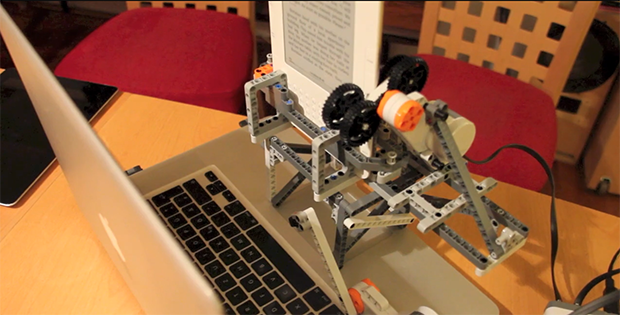
[Peter] is using a few bits of a Lego NTX system to press the, ‘next page’ button on his Kindle, then smash the space bar on his Mac to take a picture. These pictures are then sent to a cloud-based text recognition service. After a few hours of listening to plastic gears grinding, [Peter] has a copy of his eBook in plain text format sitting in his computer.

As impractical as it looks, using a robot, camera, and OCR is actually a really, really good way to turn eBooks plagued with DRM into a text file. Even if Amazon updates their DRM to make the current software cracking methods break, [Peter] will always have his Lego robot ready to scan a few hundred pages of text at a time.

Continue reading “Stripping Kindle DRM With Lego”

An RTL-SDR Spectrum Analyzer

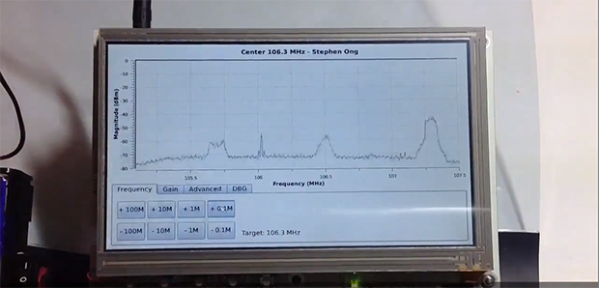
With the combination of small, powerful, and pocketable computers and cheap, off-the-shelf software defined radio receivers, it was only a matter of time before someone built a homebrew spectrum analyzer with these ingredients. This great build is the project of [Stephen Ong] and he’s even released all the softwares for you to build this on your own.

The two main components of this build are a BeagleBone Black and its 7″ Touchscreen cape. The BeagleBone is running Angstrom Linux, a blazingly fast Linux distro for small embedded devices. The radio hardware consists of only a USB TV tuner supported by RTL-SDR. In his demo video, [Stephen] shows off his project and by all accounts it is remarkable, with a UI better than most desktop-oriented SDR software suites.

You can grab the BeagleBone image [Stephen] is using over on his blog, but for more enterprising reader, he’s also put up the source of his ViewRF software up on GitHub.