Custom Handmade Boxes, Made With Steam

box factoryFrom tea sets to CD box sets, you’ll see the work of the Phillips Brothers mill on shelves all across the country. They make wooden boxes for just about any product imaginable. Interestingly, they do it the old-school way, with the entire factory powered by steam.

The wood for the boxes comes from the on-site mill, resawn and planed to the proper dimensions. These thin boards are then cut to size for each of the sides.

Most of the clients like to put their logo on their boxes, and the Phillips Brothers mill is more than happy to oblige. They brand one side of the box with a custom-made iron, permanently marking the box for the client.

The boxes are assembled with either staples or nails, enough to last for many, many years. No, there aren’t finger joints on these boxes, but with generations worth of experience in this factory, we’ll assume they know what they’re doing.

Bullet Time With A Ceiling Fan

freaking awesome

Bullet time has been around since at least the first Matrix movie (actually there was a Gap ad before that), and despite it being an oft-used cinematic technique, it still hasn’t gotten old. [Jeremiah] wanted to tap into the awesomeness of bullet time, and managed to come up with a great camera rig using only a GoPro and a ceiling fan.

The build really relies on only two components: a GoPro camera and a ceiling fan. In [Jeremiah]’s videos, a ceiling fan is mounted between two trees on a sturdy piece of lumber. The GoPro is suspended from one of the fan blades with the help of a piece of wood, a hinge, and a short bit of cable. After [Jeremiah] wired up the fan to a dimmer switch he could control the speed of the fan and Bob’s your uncle.

This isn’t the first time a GoPro has been used for a bullet time rig. In fact, our buddy [Caleb] did a similar build by spinning the camera around on a lazy suzan. Gotta love the high frame rate available on the GoPro, huh?

Vidias after the break.

Continue reading “Bullet Time With A Ceiling Fan”

The Definitive Guide To Solder Stencils

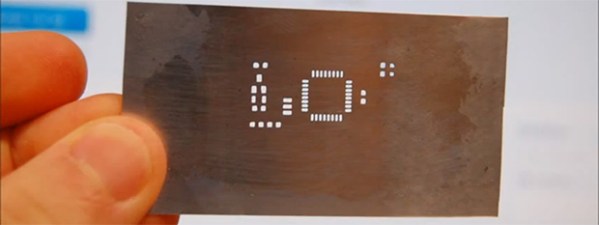
Yes, we’ve seen our share of tutorials for making solder paste stencils, but [Felix] hit it out of the park with this one. It’s the definitive guide to making solder stencils at home, with quality as good as you would find in any professionally made stencil.

The material for the stencils comes from the same source as so many other DIY solder stencils – aluminium cans. The interior plastic coating and the exterior paint job are both removed with heat, acetone, and patience. After laying out the cream layer of his board in a PDF file, [Felix] used a fairly interesting transfer medium to get the toner onto the aluminum; cheap vinyl shelving paper attached to a piece of paper apparently makes for an ideal surface to transfer toner.

After transfer, the board is etched with HCl and peroxide. [Felix] is getting some very good results with his method, including a few very fine pitch IC footprints. It’s just as good as a professionally made, laser cut stainless stencil, and you probably already have all the necessary ingredients lying around your house. That’s a win anytime.

Turning Grandpa’s O-scope Into A Clock

clock

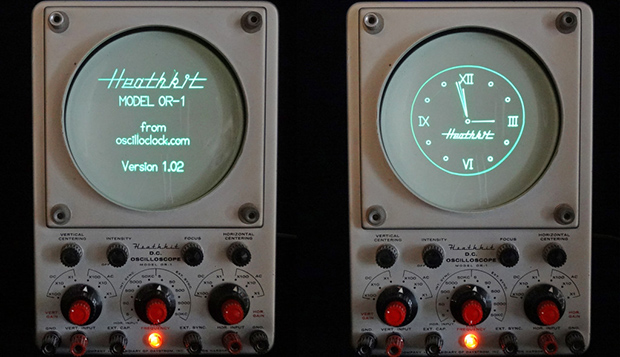
Around 1960, [Aaron]’s grandfather decided to try his hand at a new career in electronics repair. It didn’t pan out, but before he gave up he built a beautiful Heathkit oscilloscope, a model OR-1. Grandpa’s electronics career never took off, but years later it would serve as the impetus for [Aaron]’s own career in electronics. Now [Aaron] has too many oscilloscopes, but still wanted a way to preserve his grandfather’s legacy. An oscilloclock was just the project to do that.

Of course to turn an oscilloscope into a clock requires some interesting control circuitry, and [Aaron] didn’t skimp on his build. He created a custom control board that is able to draw any shape on the CRT screen using just circles; squashing circles to draw a line, and cutting the beam entirely to slice a circle in half.

This isn’t [Aaron]’s first oscilloclock by a long shot. He previously created this amazing clock completely from scratch. Still, using Grandpa’s old tools is a great way to make this oscilloscope useful again, even if [Aaron] is already up to his gills in test equipment.

Working With Very Cool LCD Modules From Sharp

LCD

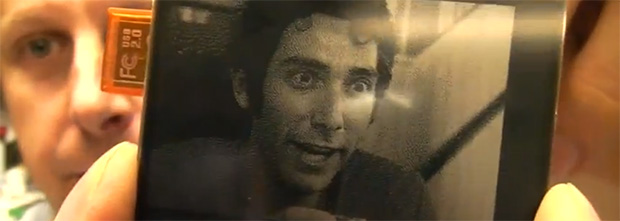
Here’s some interesting hardware for you: Sharp came out with a very cool series of LCD displays, gong by the name Sharp Memory LCD. Not only are these displays very low power – on the order of about 5 microAmps to keep the display alive – but some of the smaller displays are reflective, making them eminently readable even in daylight. [Mike] decided he’d take a look at these displays and liked what he found.

While these displays are still pretty new, there are a few breakout boards available to make them accessible to desktop tinkerers. The folks at MakerDyne have a breakout board available and there’s one by kuzyatech over on Tindie.

While these displays are readable in daylight and are extremely low power, don’t expect to display LCD video on them anytime soon. The refresh rate is still fairly slow, but you might be able to get away with simple animations with interlacing and so forth. Still, outside of eink, you’re not going to find a better display in terms of power consumption and daylight readability.

Continue reading “Working With Very Cool LCD Modules From Sharp”

Designing A Marble Track From Scratch

Woodworker extraordinaire [Matthais] was approached by a toy company to create a ‘marble run’ toy. [Matthais]’ jig-building skills are beyond reproach, so whipping up a prototype for this toy was pretty easy for him.

The basic unit of construction for this marble run is a simple ramp block with inputs and outputs at either end. These were crafted from blocks of wood, with the ramp carved out with a slot mortising machine. To make the side cuts on each block, [Matthais] used his pantograph router and a jig that cuts the wood for marble inputs on either side.

After taking his creation to a hackerspace for some very large kids to play with, [Matthais] found a few problems with his initial design. The blocks didn’t want to stay aligned when marbles were moving down the ramps, so a small mortise and tenon – looking very much like a piece of Lego – were added in several locations on the underside of each block.

Making one of something is relatively easy, but [Matthais] is making hundreds of pieces for his marble run prototype, each interchangeable with another. That’s impressive for something crafted by hand, but when you’re a master at making jigs like [Matthais], everything goes by pretty easily.

3D Printed Pip-Boy, Geiger Counter Not Included

pip

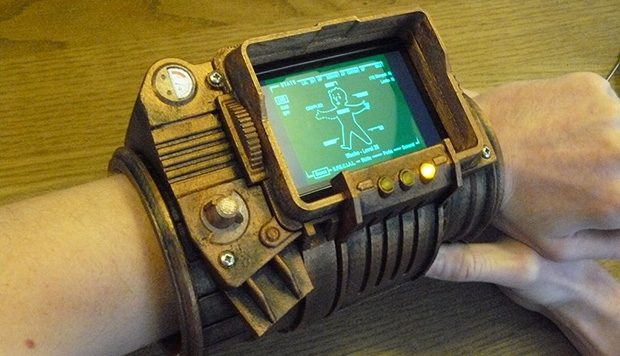
Yes, we all love portal guns and crowbars, but there’s one piece of video game paraphernalia that could conceivably be a useful piece of hardware for the modern technologist. It’s the Pip-Boy 3000, the wrist-wearable computer from Fallout, and now you can print on on your 3D printer.

All the pieces for this Pip-Boy are available over on Thingiverse. Included in those files are a dozen plastic parts that, when assembled, come together to form a wrist-mounted computer. You could, of course, print out a static image of a Pip-Boy screen for this build, but [dragonator] made a little addition to his model – he put in a space for a smartphone, so all your environmental sensors and inventory management also work with this 3D printed model.

This is far from the first wearable Pip-Boy we’ve seen, but it is the first that’s able to be fabricated on a 3D printer, and comes with the nice bonus of being the best phone case ever. It’s still a lot of work to put this together, but we’re going to say the results are fantastic.

You can check out the demo video of the Pip-Boy below.

Continue reading “3D Printed Pip-Boy, Geiger Counter Not Included”