A Rifle, Handmade Circa 1700

rifle

Today, rifles are made with exacting precision and very complex machine tools for milling, grinding, and boring out the barrel. Long rifles have been around much longer than these modern machine tools, so how exactly did gunsmiths create such exacting works of art in an age before Bridgeport mills and Sherline lathes?

In an amazing 10-part video series, [Wallace Gustler] of colonial Williamsburg takes us through the process of crafting a flintlock long rifle circa 1700. All the videos are embedded after the break, by the way.

The first step of making the rifle is fabricating the barrel. This is made from a bar of wrought iron, hammered into a tube around a mandrel, and welded together in the forge. With the help of a primitive hand-cranked lathe, the barrel is then bored out and eventually rifled with the help of a cutting tool that is constructed more out of hickory than tool steel.

With the barrel complete, [Wallace] moves on to the lock. Again, everything is fabricated by hand nearly entirely from materials that could be sourced locally at a new world colony in 1700. Spring steel is one of the exceptions of to this desire for local materials, along with a few bits of brass that were recycled from imported sources.

A gunsmith must be a master of metalwork, of course, but he must also be an excellent wood-carver. The stock of the gun iw made from a huge sugar maple board, carefully carved to accept the barrel, lock, and the custom cast brass pieces.

The result is a masterfully crafted flintlock rifle, capable of picking off a target at a few hundred yards. [Wallace Gustler] manufactured nearly everything in this gun by hand, an impressive display of skill for a master, but an inspiration to anyone who would want to work with their hands.

Continue reading “A Rifle, Handmade Circa 1700”

Sentrifying A Nerf Gun

vulcan

[Brittliv] made the mistake of getting her friends into Nerf weaponry, and so began the race to mutually secured destruction via foam darts. She may have the upper hand in this war, because her Nerf Vulcan sentry gun is both incredibly powerful and is able to be operated autonomously with a webcam featuring a friend or foe identification system.

The azimuth and elevation mount for the gun is made out of plywood, with each axis controlled by a single servo attached to an Arduino. Of course a stock Nerf gun would be fairly boring, so [BrittLiv] increased both the voltage going to the gun’s motor and the strength of the gun by replacing a 2kg spring with a 5kg spring.

Targets are tracked with a webcam using Processing and a bit of code from Project Sentry Gun. One interesting feature is a friend or foe tracking system; if the gun sees someone wearing a t-shirt with the Instructables logo, the target is identified as a friend and is not brutally mowed down with plastic darts.

Continue reading “Sentrifying A Nerf Gun”

Twenty Two Servos And An Awesome Clock

servo

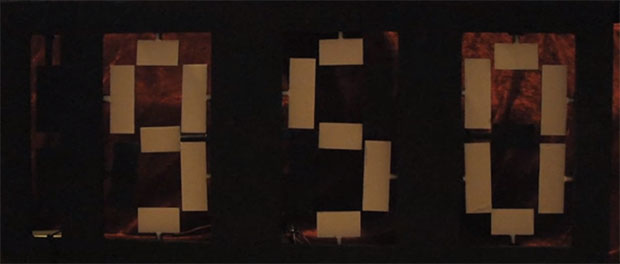
We can never get enough interesting clock builds, and [ebrithil]’s servo clock (Deutsche, Google translation) is up there with the best of them. There’s twenty-two servos in this clock, moving time forward with the mechanistic precision only an Arduino project can.

The digits in [ebrithil]’s clock are constructed like seven-segment displays, only instead of lighting up LEDs, servos turn small bits of paper that are light on one side and dark on the other. Turing the servo 180 degrees changes each segment from one shade to the other, making for an electromechanical seven-segment display.

The servos are controlled by an Arduino Mega connected to a DS1302 real-time clock. One problem [ebrithil] had with this project is having the segments rotate slightly every time someone turned on a light attached to the same circuit. He solved this problem by running the circuit off a perpetually charging cell phone battery, allowing him to take this clock on the go without losing time.

Continue reading “Twenty Two Servos And An Awesome Clock”

The 14th Game For The Nintendo Power Pad

[youtube=http://www.youtube.com/watch?v=6x23TWrInpI&w=580]

Released 25 years ago, the Nintendo Power Pad, a plastic mat that plugged into an NES, saw very limited success despite its prevalence in basements and attics. In total, only six games for the Power Pad were released in North America, and only 13 worldwide. The guys over at cyborgDino thought they should celebrate the sliver anniversary of the Power Pad by creating its 14th game, using an Arduino and a bit of playing around in Unity 3D.

The first order of business was to read the button inputs on the Power Pad. Like all NES peripherals, the Power Pad stores the state of its buttons in a shift register that can be easily read out with an Arduino. With a bit of help from the UnoJoy library, it was a relatively simple matter to make the Power Pad work as intended.

The video game cyborgDino created is called Axis. It’s a bit like a cross between Pong and a tower defense game; plant your feet on the right buttons, and a shield pops up, protecting your square in the middle of the screen from bouncing balls. It’s the 14th game ever created for the Power Pad, so that’s got to count for something.

Video of the game below.

Continue reading “The 14th Game For The Nintendo Power Pad”

Seeing Plant Health In Infrared

aerial

Since the 70s, NASA, NOAA, and the USGS have been operating a series of satellites designed to look at vegetation health around the world. These satellites, going under the name Landsat, use specialized camera filters that look at light reflecting off chlorophyll to gauge the health of forests, plains, oceans, and even farms. It’s all very interesting technology, and a few very cool people want to put one of these near infrared cameras in the hands of everyone.

The basic idea behind gauging the health of plants from orbit, or the Normalized Difference Vegetation Index, is actually pretty simple: absorb red and blue light (thus our verdant forests), and reflect nearly all infrared light. By removing the IR filter from a digital camera and adding a ‘superblue’ filter, the NDVI can be calculated with just a little bit of image processing.

The folks behind this have put up a Kickstarter with rewards including a modified webcam, a custom point and shoot camera, and a very low-cost source of one of these superblue filters. Just the thing to see how your garden grows or how efficiently you can kill a houseplant.

Raspberry Pi, Now In A Mini-ITX Form Factor

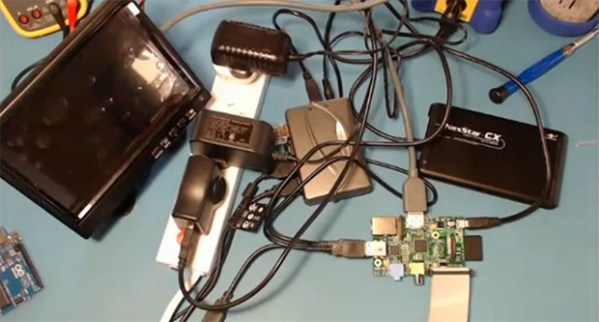
Shown above is a fairly simple Raspberry Pi setup. There’s the Raspi itself, a 2.5″ hard drive, a USB hub, GPIO expansion, and wireless and Bluetooth adapters. Throw in the power supplies for all these devices, and you’ve got a real mess on your hands. There is a solution to this problem of a Gordian knot of USB and power cables: the Fairywren, a board that turns your Raspberry Pi into a Mini-ITX computer.

The basic idea behind the Fairywren is to take the basic outline of a Mini-ITX motherboard and add goodies like a real-time clock serial port, and USB hub while providing a secure mounting place for a Raspberry Pi. It turns a Raspberry Pi into a proper computer, with all the ports in the rear, and is compatible with a whole slew of Mini-ITX cases.

At £40, the Fairywren isn’t exactly cheap. In fact, it’s more expensive than the Raspberry Pi itself. That being said, you do get a whole lot of hardware for the price, and if you already have a small Mini-ITX case lying around, it may be just the thing to clean up the mess on your electronics bench.

Unlocking A Rigol Scope Once Again

Rigol scopes are finding their way onto the workbenches of makers the world over. There’s a reason for that – they’re so easily upgraded. With a simple software update, you can turn the 50 MHz Rigol o’scope into a model with 100 MHz of bandwidth. Design decisions in one model are sometimes carried over to different product lines, so eventually someone would figure out how to turn the 70 MHz DS2072 scope into the 200 MHz DS2202. A great mod that turns an $800 oscilloscope into one with the features of a $1600 scope.

There’s no internal modifications necessary for this mod; it works simply by sending a few engineering unlock codes to the scope over USB, a simple task that [Blair] implemented with a Raspberry Pi and a bit of Python code. The only fault of the hack is the scope resetting each time it’s powered off. This can, in fact, be accomplished with just about any microcontroller with a Python interpreter.

A fairly uninformative demo video is available below, or you could check out the EEVBlog thread where this mod was conceived here.

We here at Hackaday expect a small, cheap USB/microcontroller dongle thingy that automagically updates the DS2072 to show up in our inbox any day now. We thank whoever sends that in.

Continue reading “Unlocking A Rigol Scope Once Again”