DRM Chair Only Works 8 Times

chair

Download a song from iTunes, and you can only add that song to the music library of five other computers. Grab a copy of the latest Microsoft Office, and you’d better hope you won’t be upgrading your computer any time soon. Obviously DRM is a great tool for companies to make sure we only use software and data as intended, but outside planned obsolescence, there isn’t much in the way of DRM for physical objects.

This is where a team from the University of Art and Design in Lausanne, Switzerland comes in. They designed a chair that can only be sat upon eight times. After that, the chair falls apart necessitating the purchase of a new chair. Somewhere in the flat-pack furniture industry, someone is kicking themselves for not thinking of this sooner while another is wondering how they made a chair last so long.

The design of the chair is fairly simple; all the joints of the chair are cast in wax with a piece of nichrome wire embedded in the wax. An Arduino with a small switch keeps track of how many times the chair has been used, while a solenoid taps out how many uses are left in the chair every time the user gets up. When the internal counter reaches zero, a relay sends power through the nichrome wire, melting the wax, and returning the chair to its native dowel rod and wooden board form.

Melting wax wasn’t the team’s first choice to rapidly disassemble a chair; their first experiments used gunpowder. This idea nearly worked, but it was soon realized no one on the team wanted to sit on a primed and loaded chair. You can see the videos of the wax model failing after the break.

Continue reading “DRM Chair Only Works 8 Times”

24-port GPIO On A PCI Card

btgpio

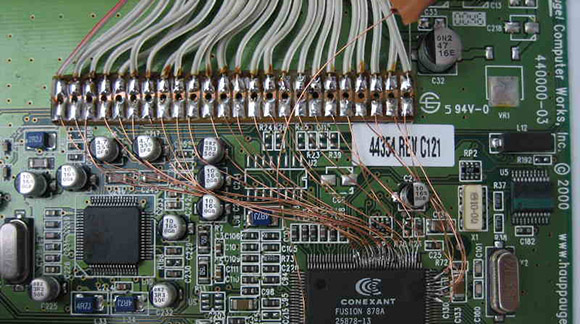
So you’ve got a project running on an x86 board and you’d like some GPIO pins. Whether you want to read a few buttons, light up a few LEDs, put an accelerometer in your computer or whatever, you’ve got a problem. Luckily there’s an easy way to get 24 GPIO pins on an x86 board using a PCI card for just a few bucks.

The key component of the build is a PCI TV Tuner card made by Hauppague under the WinTV brand. If you’ve got one of these cards with either a Brooktree bt848, bt849, bt878 or bt879 video capture chip, having 24 GPIO pins is just a spool of magnet wire, a soldering iron, and a steady hand away.

It’s a great build if you’d like some GPIO action without going through the usual parallel port mess, and especially useful since these WinTV capture cards can be had from the usual Internet suppliers for just a few bucks. You’ll need a driver, of course, but the relevant Linux kernel driver – bt8xxgpio – should be included any reasonably modern distro.

Special thanks to [Dex Hamilton] for notifying us of this build.

Cool New Hardware Spectacular

press release

It should come as no surprise the Hackaday tip line is regularly flooded with press releases. Everything from an infographic comparing Call of Duty 3 to Battlefield 3 (yes, totally serious), announcements that a company we’ve never heard of is getting a new CFO, to the business proposals from hat box manufacturers that wind up in our inbox on a nearly weekly basis.

With the Hackaday crew sifting though hundreds of these emails a month, you’d figure the PR people would hit gold once in a while, right? Apparently not. The coolest stuff we get in our email is usually from an engineer working on a project and doing a PR rep’s job for them. We thank them for that, so here’s two really cool pieces of hardware that showed up in the tip line recently.

Continue reading “Cool New Hardware Spectacular”

PwnPad, The Pentesting Tablet

pwnpad3_1024x1024

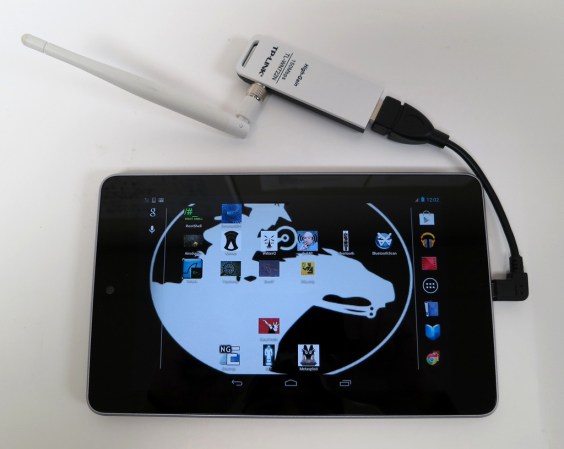
Over the last few months, we’ve seen our fair share of pentesting appliances. Whether they’re in the form of a Raspberry Pi with a custom distro, or an innocuous looking Internet-connected wall wart, they’re all great tools for investigating potential security vulnerabilites at home, in the workplace, or in someone else’s workplace. Pwnie Express, manufacturers of pentesting equipment, are now releasing one of the best looking and potentially most useful piece of pentesting equipment we’ve ever seen. It’s called the PwnPad, and it allows you to get your pentesting on while still looking stylish.

Based on Google’s Nexus 7 tablet, the PwnPad combines all the goodies of a really great tablet – the ability to read NFC tags and multiband radios – with open source tools and a USB OTG cable with USB Ethernet, Bluetooth, and WiFi adapters. Everything in the PwnPad is designed for maximum utility for pentesting applications.

Of course, for those of us that already have a $200 Nexus 7, Pwnie Express says they’ll be giving away the source for their software, enabling anyone with knowledge of make to have the same functionality of the PwnPad. Of course you’ll need to get yourself a USB OTG cable and the WiFi, Bluetooth, and Ethernet adapters, but that should only add up to about $100; combined with a $200 Nexus 7, building your own is more than just a bit cheaper than Pwnie Express’ asking pre-order price of $795.

Tymkrs’ Deconstruction For The Zombie Apocalypse

tmker

We’ve seen a few of the projects from The Deconstruction, a 48-hour build-a-thon for hackerspaces and other groups around the globe. Of course Tymkrs, a pair of geeky vloggers famous for their building prowess, were part of The Deconstruction, and in the process they came up with a few really cool builds at their hackerspace, The Rabbit Hole, in Rochester, MN.

Their theme for The Deconstruction was “a zombie apocalypse”. Instead of homemade crossbows and electric fences, Tymkrs and the rest of The Rabbit Hole put a ‘rebuilding society’ spin on the whole zombie apocalypse and ended up building things that would be useful after Z-day.

First up is a PVC bike trailer designed to easily attach to the back of a bicycle. The frame is made out of a few pieces of 2″ PVC pipe with some nylon rope knotted together for a nice webbed platform. a 5/8″ steel rod was turned down to accept two 20″ bike wheels. A useful build, even if it’s not the zombie apocalypse.

The second build is a solar japanese lantern, combining [Addie]’s love of solar lanterns and japanese-style lanterns into one great project. The materials for this build came from a broken solar-powered lantern with completely revamped electronics. There’s a Joule thief to keep the LED lit, and a few solar panels to charge up the batteries during the day. Of course the build wasn’t complete without a little decoration, so [Addie] drew four panels of rabbits for The Rabbit Hole team.

By far the most dangerous build undertaken by The Rabbit Hole is their can crusher. It’s a pair of snowblower tires powered by a disused garage door opener. The theory of operations is that a can will drop in between the rotating wheels, crushing the can, and sending it to a waste basket below the device. In practice, the device didn’t really live up to expectations, but it’s loud and dangerous, so we’ll give it a pass.

High Powered Rocket Engines Made From PVC Pipe

rocket

For as much as we enjoy rockets, explosives, and other dangerous things, we haven’t said a word about the works of [Richard Nakka]. He’s the original hacker rocketeer with thousands of words dedicated to the craft of making things move straight up really fast. One of his more interesting builds is his series on building rocket engines out of PVC pipe written in conjunction with [Chuck Knight].

For the propellent grains, the PVC rocket didn’t use the usual potassium nitrate and sugar mixture of so many homebrew solid rockets. Instead, it uses Sorbitol, an artificial sweetener. While melting and casting the Sorbitol-based propellant grains is much easier than a sugar-based concoction,  the Sorbitol had much less thrust than a typical sugar rocket, making it the perfect candidate for a PVC engine.

For those of you wondering about the strength of a PVC engine casing, [Richard] does say making larger rocket engines out of 2 or 3-inch PVC may not make much sense due to the increased chamber pressures. There is a fairly clever reinforcement method for these PVC rockets (PDF warning) that involves using PVC couplers, but the experiments into the strength of these casings have yet to undertaken.

Thanks [Caley] for sending this one in.

Interpreting Brainf*#k On An AVR

We won’t call it useless, but we will ask why [Dan] wrote a brainfuck interpreter for the AVR

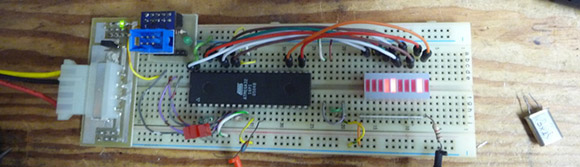
It’s not generating code for the AVR; think of it more as a bootloader. To run a brainfuck program, [Dan] uploads it to the EEPROM inside his ATMega32, after which the microcontroller takes over and starts performing whatever instruction the brainfuck program tells it to do. Because the whole thing runs off the EEPROM, the code size is limited to 1022 bytes. Enough for any brainfuck program written by a human, we think.

As for why [Dan] would want an AVR to build an interpreter for a language that is nearly unreadable by humans, we honestly have no idea other than the common, ‘because it’s there’ sentiment. There are some pretty cool projects out there that use brainfuck, including this genetic algorithm software developer. Right now, though, blinkey LEDs are enough to keep us happy, so you can see a video of brainfuck doing its thing on a LED bar display after the break.

Continue reading “Interpreting Brainf*#k On An AVR”